XIAOYI
The new Miboxer C4-12 Upgrade is the top charger from the Miboxer brand. The device is advertised as a Fully Automatic Fast Charger, and that's the honest truth. Note that the name doesn't include the word Smart, and that's also the truth. I bought it on AliExpress for 34 dollars, I've already run some tests and can draw conclusions about the Miboxer C4-12, but let's take it in order. As the good soldier Švejk used to say, "everything has to come out of me gradually, like from an old mattress, or you won't be able to picture the whole course of events". So let's start with the specifications:
Put into plain language, the manufacturer claims a device that is as simple to use and as safe as possible. Let's get on with testing.
We'll test charging of nickel batteries, one good and one "tired", and charging of lithium batteries in automatic mode and at maximum current.
When a battery is inserted, the device first measures its internal resistance, judges the battery's condition from the measurement and sets a safe charging current. Experimenting with different batteries, I found that for lithium ones it sets 1 A if the internal resistance is below 100 mΩ, 500 mA if it's below 200 mΩ, and 300 mA if it's above 300 mΩ. Intermediate values fall within these limits.
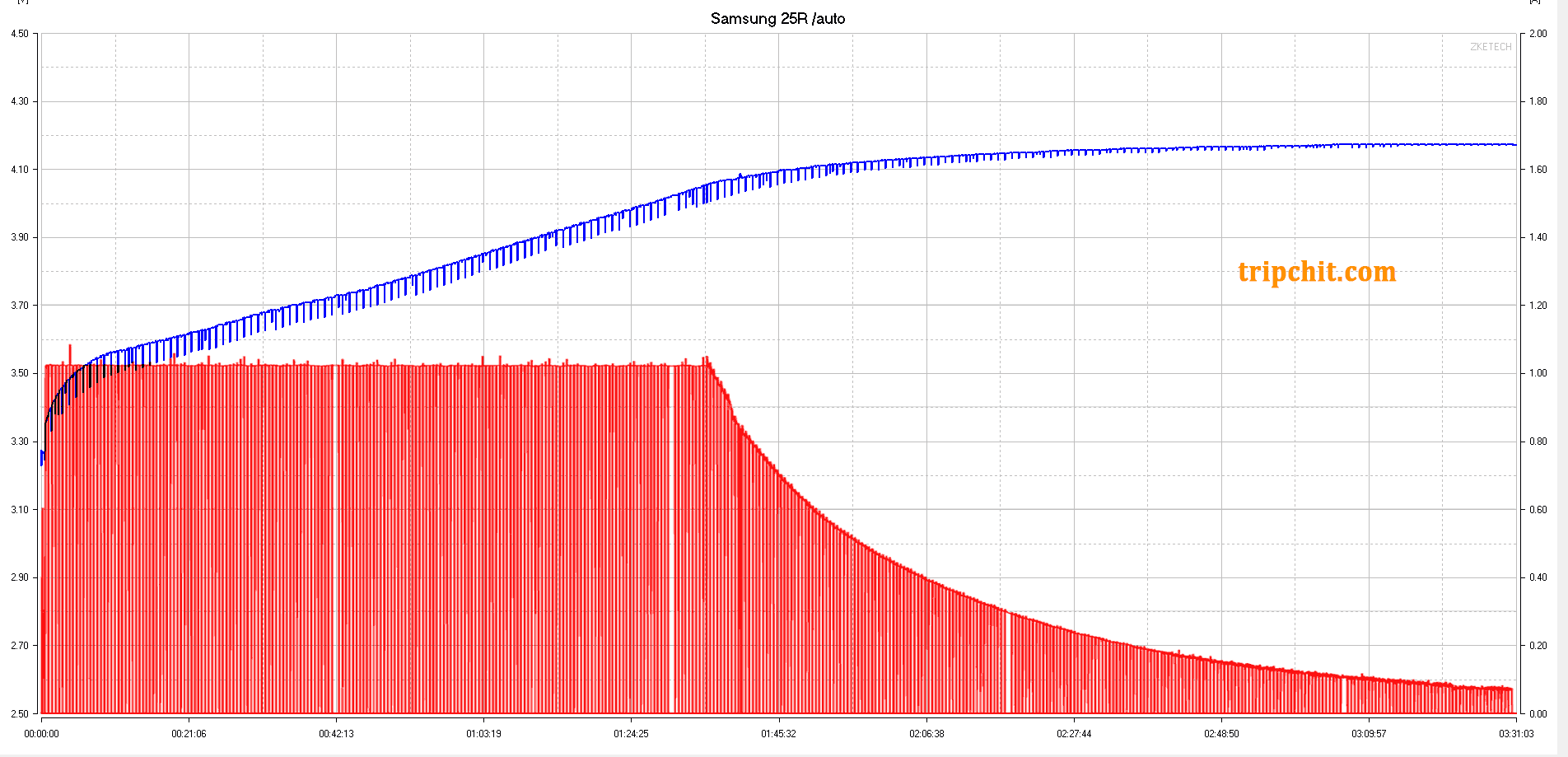
A Samsung INR18650 25R lithium battery in decent condition, automatic mode. The Miboxer C4-12 measured an internal resistance of as much as 100 mΩ and set a charging current of 1 A. For comparison, the IC99, which is currently my baseline charger and whose readings I trust far more, shows 19-25 mΩ on this battery. About 2000 mAh was put into the battery, and charging took almost 3 hours 30 minutes. The maximum current during charging didn't exceed 1007 mA, and the cutoff current was 60 mA. During charging the device cut the current every 20 seconds to measure the voltage on the cell. The voltmeter readings correlate poorly with real ones: the device overstates the value by about 20 mV at the end of charge and up to 0.45 V during the process (measured without an ammeter, only the voltage across the battery terminals).
The same Samsung battery, but this time I manually selected the maximum current of 3A. However, the device wouldn't let me, limiting the current on its own to 2300 mA, which was the value shown on the screen during charging. The real value didn't exceed 1950 mA. I tried moving the battery to different slots, but nothing changed. The final battery voltage is 4.182 V. The cutoff current, as in the first case, is 60 mA.
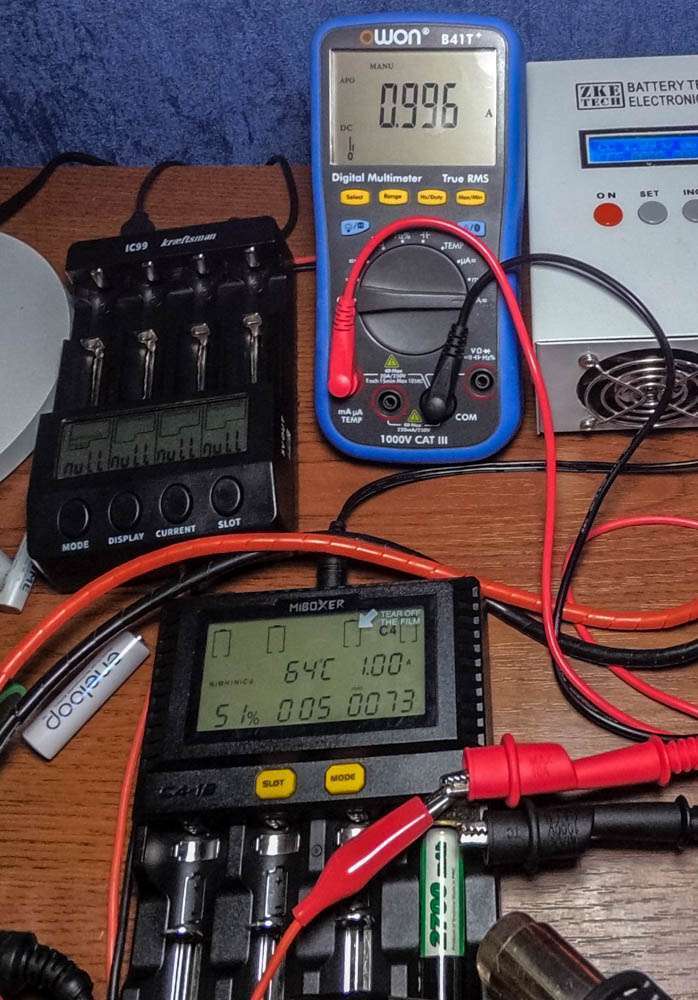
In fairness, I'll note that the device did show me the stated 3A after all, but only on the screen. The real current was 2.6A. A new VTC6 battery was used.
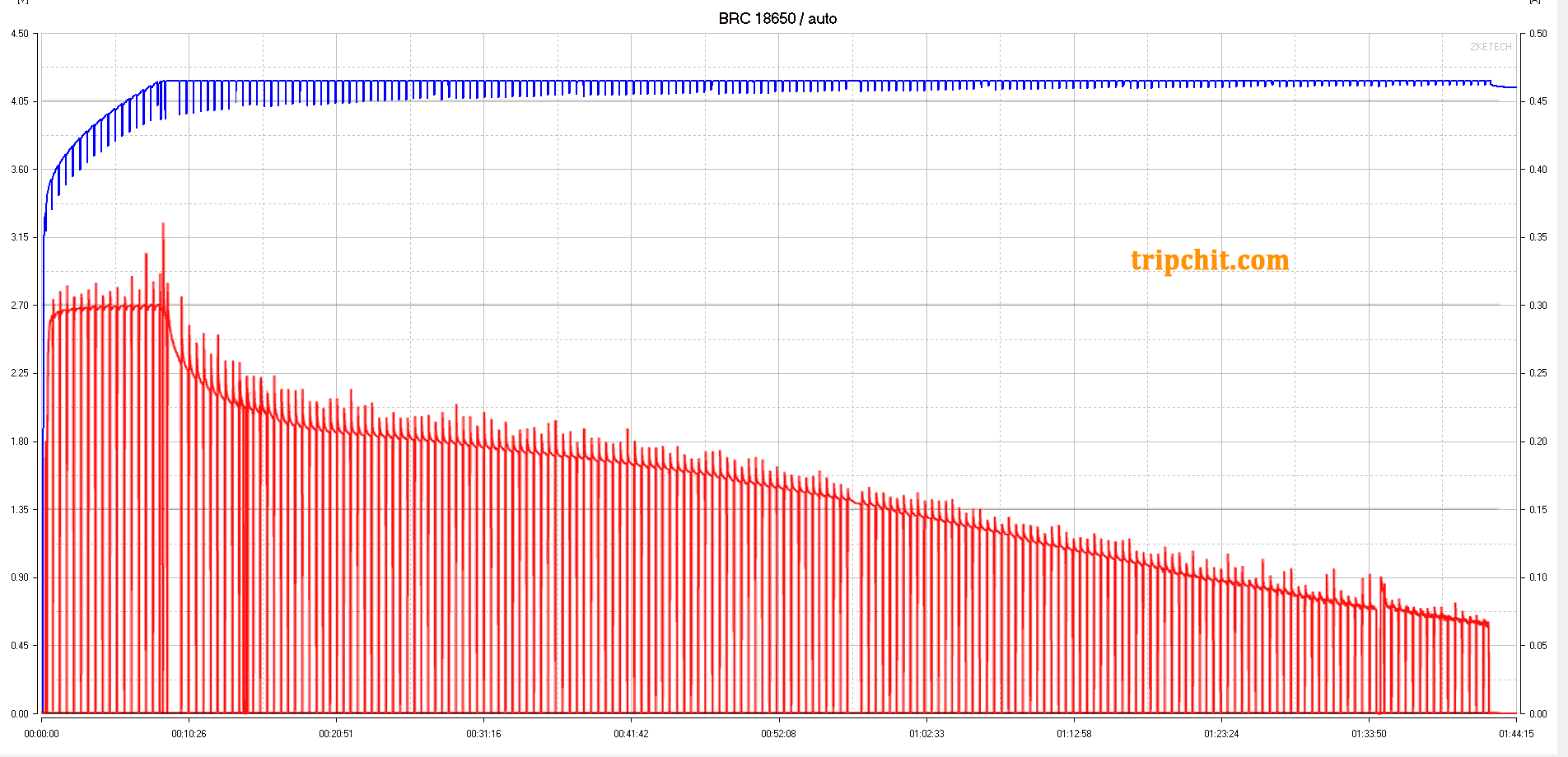
Any charger will charge a good battery. To check whether the algorithm is sensible, I'll try installing a BRC 18650 battery and see how well the device copes with outrageous Chinese fakes. The Chinese battery's capacity is only about 400 mAh, and the internal resistance determined by the Miboxer C4-12 is 712 mΩ. The current set by the device is 300 mA. The cutoff current is still 60 mA. The voltage the battery charged to is 4.185 V.
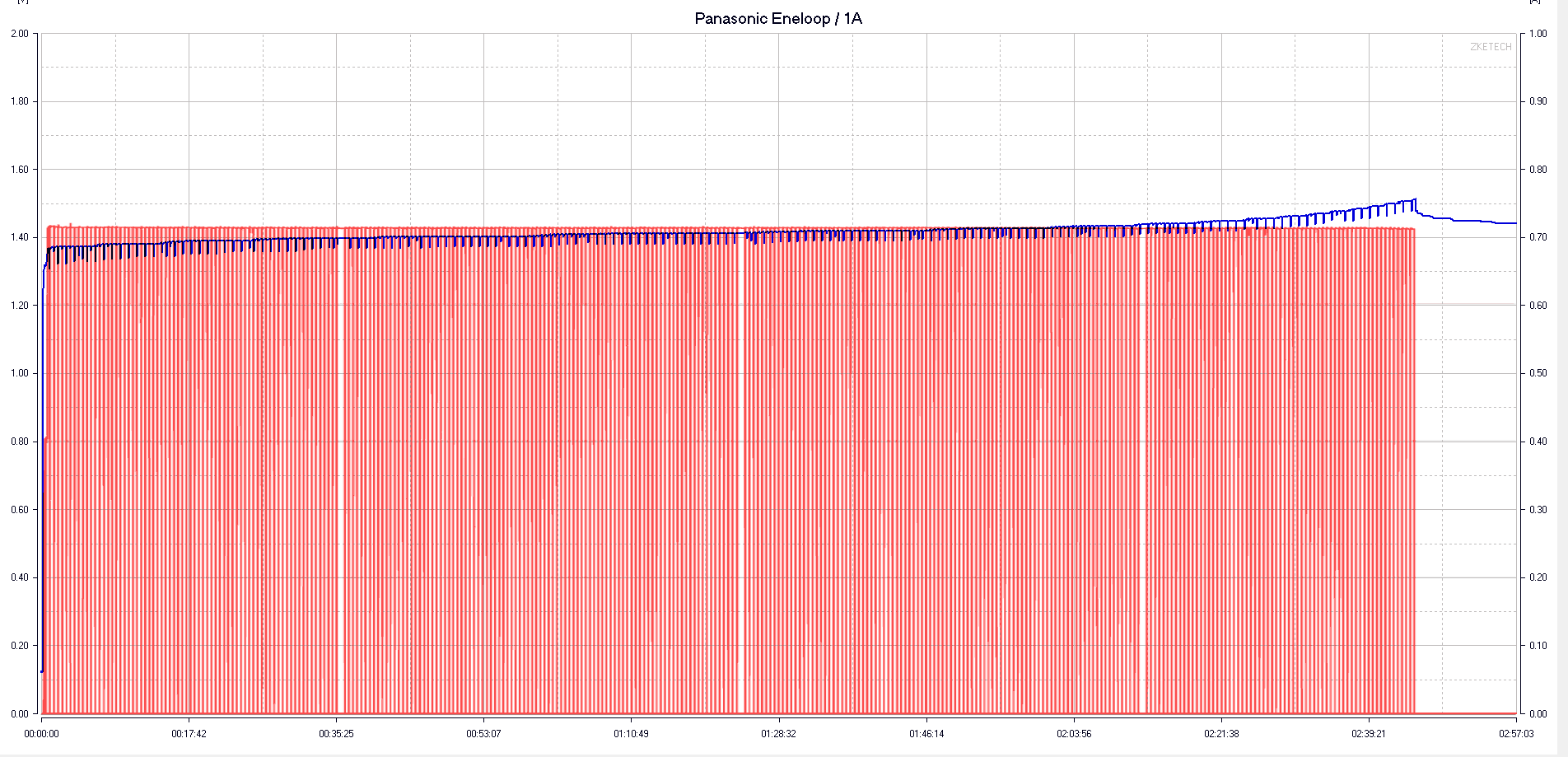
As the test subject I use a Panasonic BK-3MCEE. The measured internal resistance was 34 mΩ, and the device automatically set a current of 0.7 A. The real charging current didn't exceed 711 mA throughout the cycle.
Every 25 seconds the Miboxer stops charging to measure the voltage on the cell being charged, dropping the current to zero. This moment is clearly visible as spikes on the graph, while the current during charging is constant, which indicates charging with the -Δv algorithm.
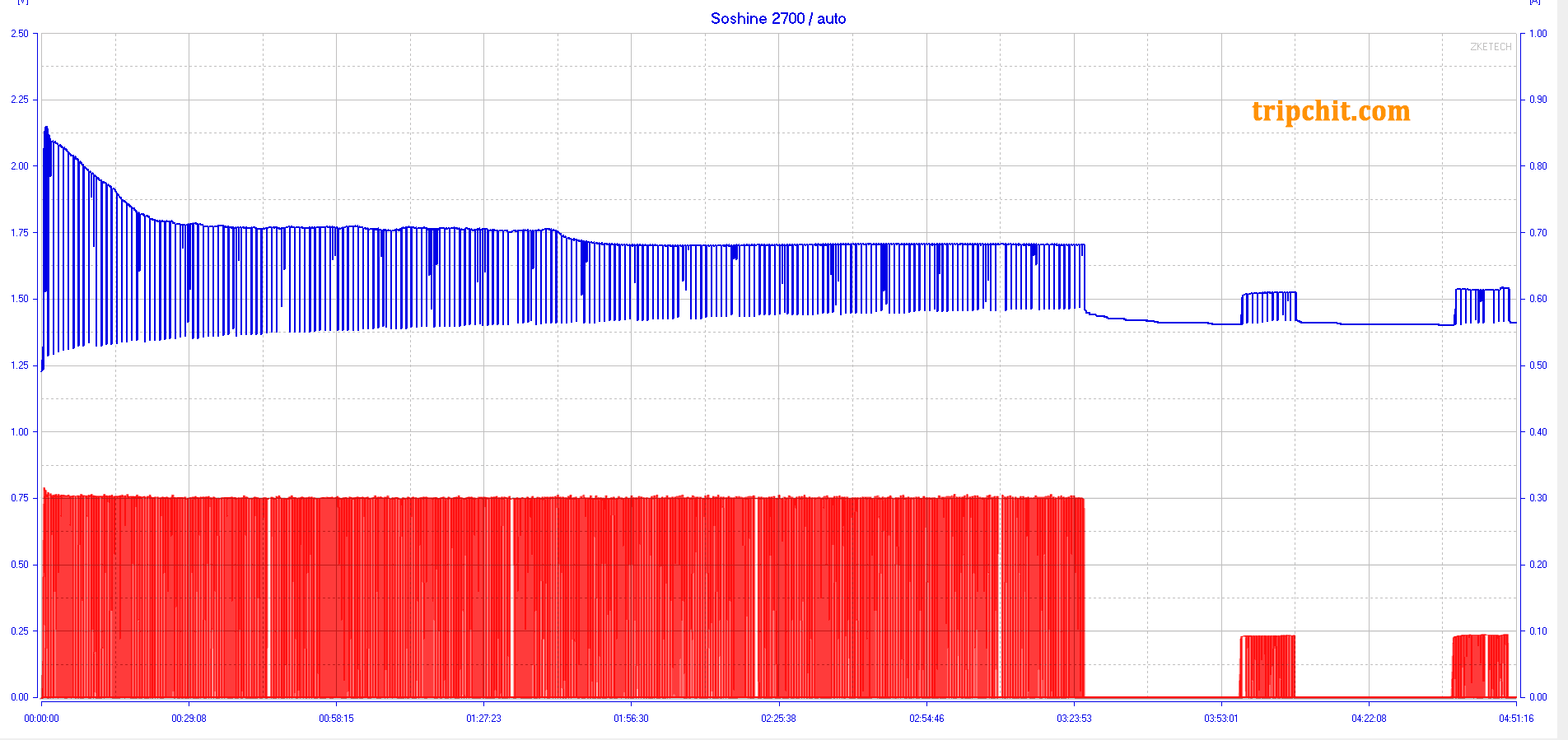
As usual, I check the charger with a "tired" Soshine battery. It's more than 10 years old, has about 800 mAh of capacity left and an internal resistance above 2000 mΩ. The Miboxer couldn't measure the internal resistance, showing three dashes, so it set a charging current of 300 mA, which is the minimum current in automatic mode. Some time after charging began, the resistance reading changed to 999 mΩ.
The algorithm stayed the same: holding the set current throughout charging. The problem is that even this current is too high for the battery under test. Because of the poor condition of the electrodes and electrolyte, the electrochemical reaction during charging is slow, and to hold the current at 300 mA the device has to raise the voltage. In our case (in automatic mode) the voltage reached 2.149 V.
Yes, 2.145 volts while charging a nickel battery, and then "trickle" charging at 95 mA. I understand why it's like this, since it's hard to track -dV at low current.
Of course, I tried manually setting the maximum current. At a current of 1 amp the voltage on the nickel-metal-hydride battery was 3.21 volts.
For the full experience, I warmed the battery a little with a hair dryer. When the thermometer on the screen showed 65 degrees, the device went into protection. Until that moment charging continued without any reduction in current.
A rather specific device. Among the clear pluses are -dV for nickel batteries and 3 amps for lithium. On the other hand, I don't like the automatic current limiting for lithium batteries, because of which the current you pick manually doesn't match the real one; I'd prefer at least to see the real charging current on the screen. And this protection works only for lithium batteries. I don't understand why there's no similar limit for nickel-chemistry batteries, since they're no less afraid of overheating than others.
Nevertheless, thanks to being able to adjust the charging current from 100 mA, the device is well suited to charging nickel AAA batteries and other low-capacity batteries. The only thing it lacks is a training mode.
Overall, I'd recommend this device if you use high-current lithium batteries and want to charge them fast.
Прокомментируйте: