XIAOYI
Golisi I4 charger
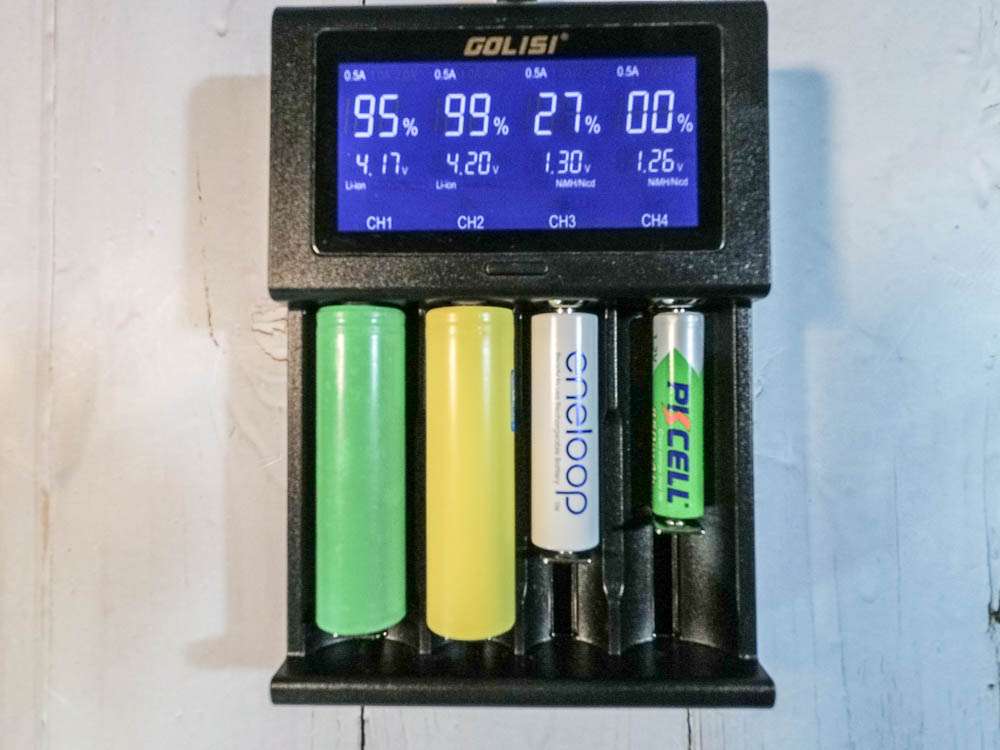
Today we're testing a four-channel charger from Golisi. In essence, the Golisi i4 is an ordinary charger with a screen. It differs from its younger brother, the Golisi S4, in being powered by USB instead of 220 V, so the Golisi i4 can work anywhere there's a USB port of sufficient power.
Golisi is a well-known maker of high-current batteries; in particular, the Golisi S42 26650 was a real test champion and held 35 amps without losing capacity.
I bought the device on AliExpress for 18 dollars, and it arrived in 2 weeks. It's packed in a stylish matte black box, with a manual and a quality Micro USB cable in the kit.
Golisi i4 specifications:
The sockets really are good, and the cable in the kit is lovely. The bright, informative screen also catches the eye, but the impression is spoiled by the narrow viewing angles. The single button switches the battery charge readouts (current-voltage-time), and a long press turns the screen backlight on and off.
The manufacturer provides no user adjustment of charging parameters. The fourth slot is marked 2A, like the Liitokala Lii-PD4, so a single lithium battery put in it should be charged at 2 amps.
Testing the GOLISI i4
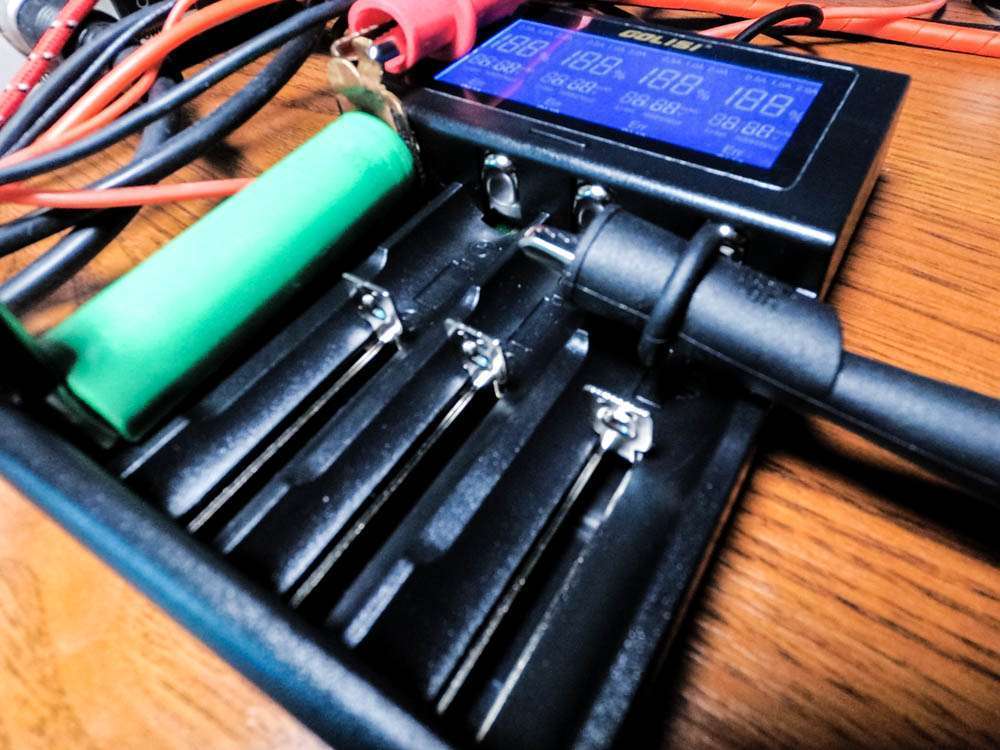
As usual, testing a charger means charging batteries in all modes to check that the charging algorithm is sensible and to collect readings for graphs. Today we'll charge Samsung INR18650-25R lithium batteries, a GS Yuasa Enitime AAA and an old Soshine AA. Below is a photo of the preparation for testing the first battery. By the way, the photo clearly shows that at a 45-degree angle the screen is practically "blind".
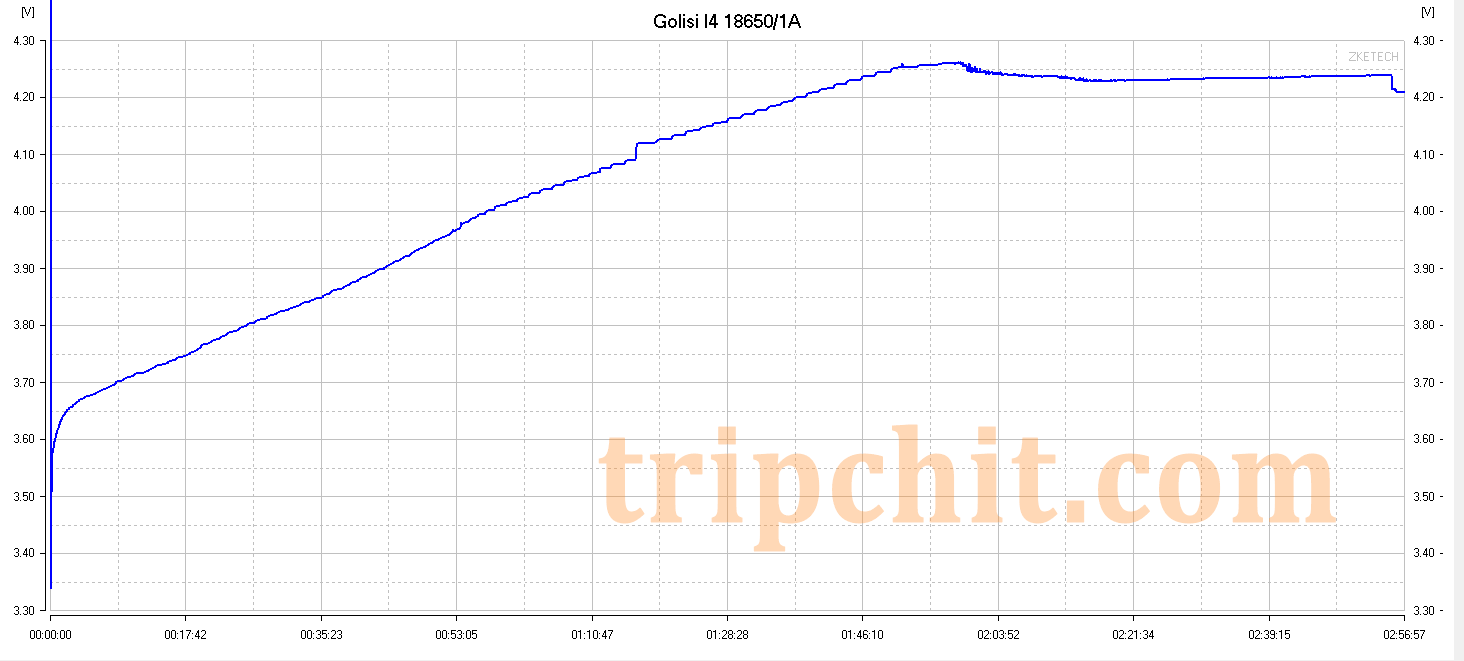
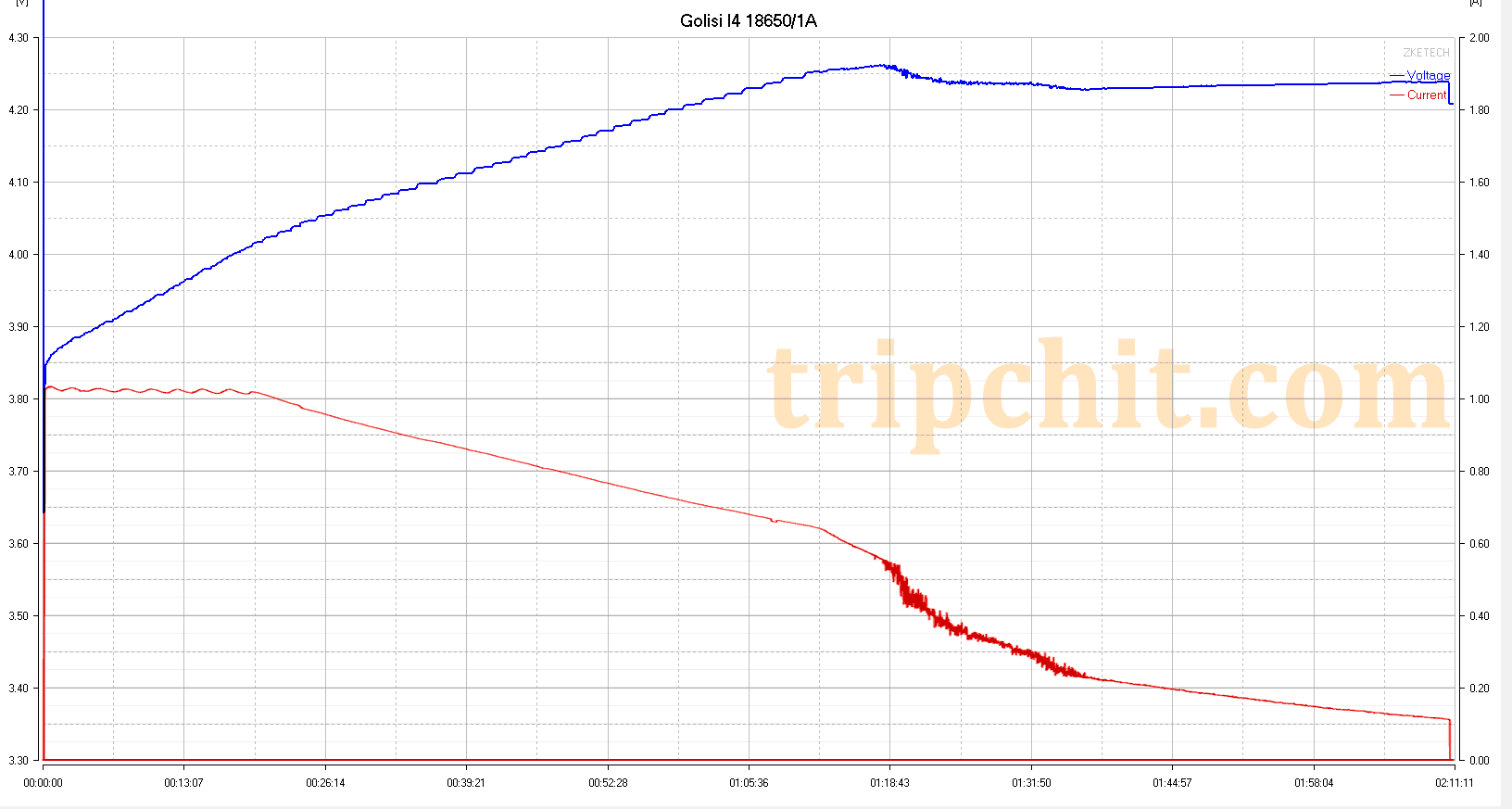
To begin, let's check the first slot, charging a lithium battery at 1A without measuring current, only monitoring voltage. And I can already see a departure from the CC/CV algorithm. As a reminder, this algorithm is recommended by battery manufacturers and means charging up to 4.2 volts with a tolerance of about 5% (0.21 V).
In the constant-current stage the GOLISI i4 raises the voltage to 4.26 V, and in the second stage the voltage drops to 4.23 V. After charging ended, the battery voltage was 4.214 V.
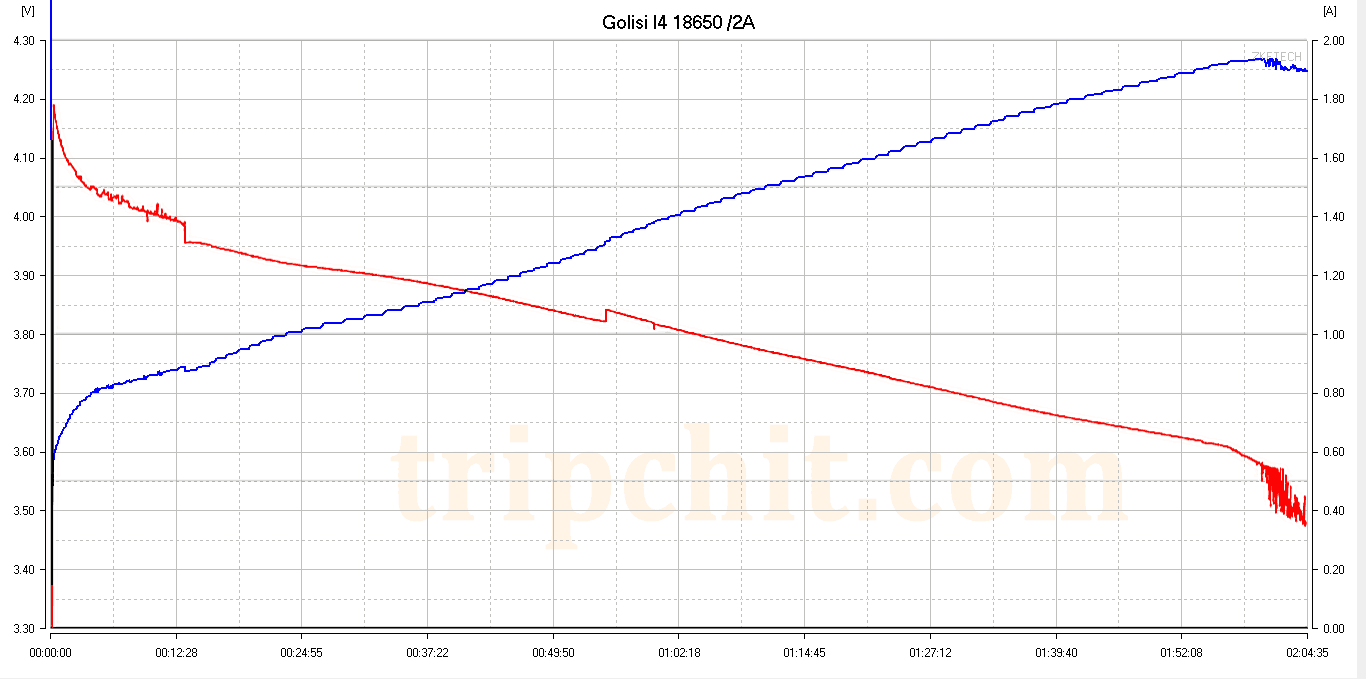
We check charging of a battery in the fourth slot. At the start of charging, the Golisi I4 delivers almost 1800 mAh, but immediately begins to reduce it.
There's nothing wrong with a graph of this shape, but it isn't the classic CC/CV; there's neither a first nor a second distinct phase. The device's display showed 100%, and I stopped the instruments recording the readings without looking at them. But, as the graph shows, charging was still going on and the charging current was about 300 mA, while the cutoff current of this device is 110 mA.
Charging time in this slot is only 50 minutes (roughly a third) shorter than in the other slots. In essence, if I had waited for the real end of charging, it's far from certain it would have been any faster.
At the start the charging current is around 1.1 A. When the voltage at the terminals rises to 4.024 V, the current begins to drop. At the moment charging switches to CV mode, the current is about 600 mA and the terminal voltage is 4.26 V. The cutoff current is 110 mA. The battery voltage right after the current is cut is 4.208 V.
GOLISI i4, charging an AA battery
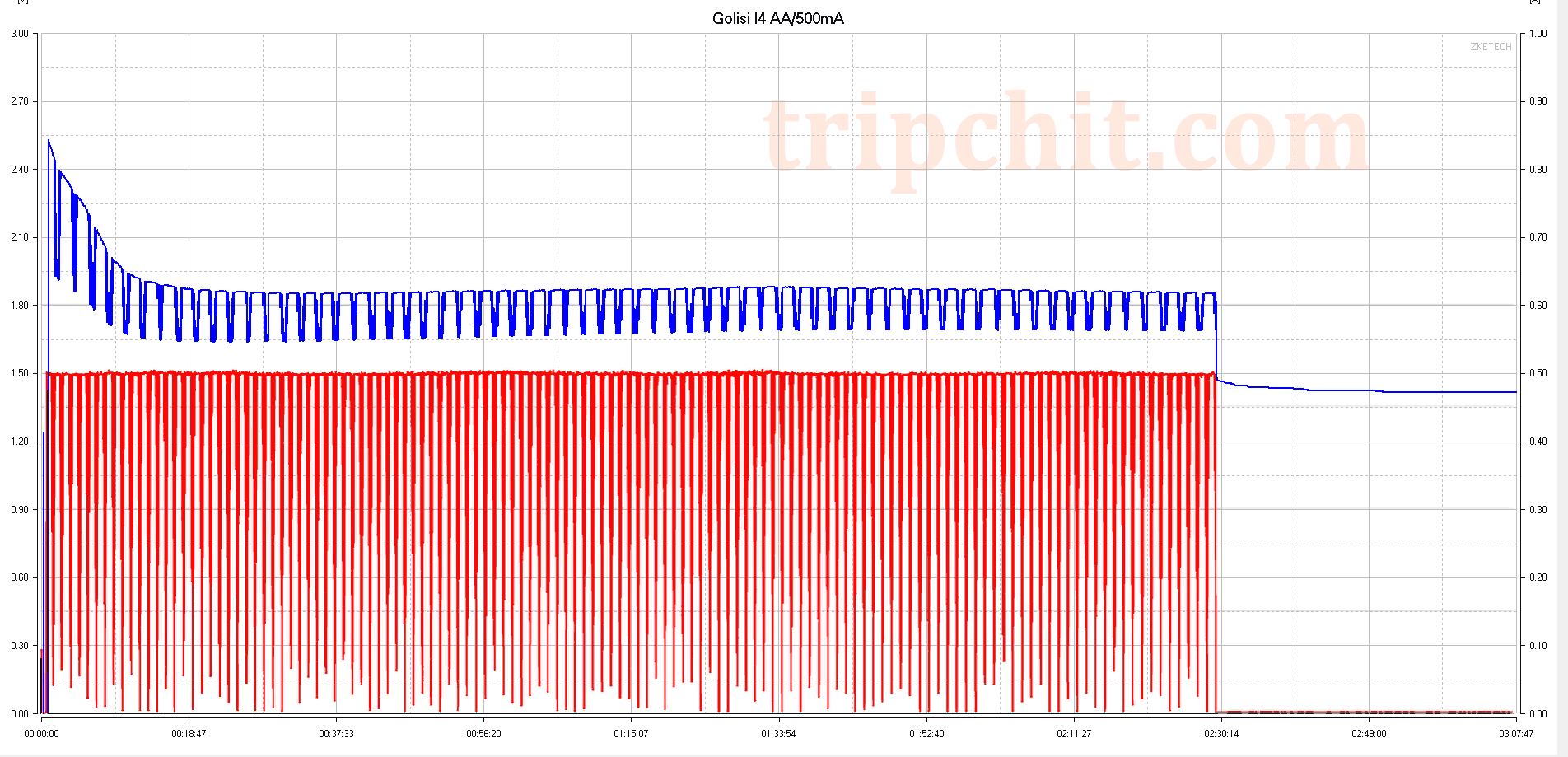
The charging current for NiMH batteries is fixed at 0.5A. This value can't be changed. Charging uses the -dV (minus delta V) algorithm, with the battery voltage measured once per second.
For the test I used a battery that isn't new and has a high internal resistance. I didn't take a new one because a battery is only new at first, and this sample represents the typical picture of an average household battery: capacity has still held at the rated level, but internal resistance is already fairly high because of degradation of the electrolyte and electrodes.
Because of the battery's high internal resistance, the device has to raise the voltage to maintain the set current, and at the start of charging the voltage reached 2.65 V. But overall the graph is correct for a -dV algorithm.
GOLISI i4: charging an AAA battery
We're charging a ten-year-old AAA GS Yuasa EniTime. I used this battery in relatively gentle conditions: it was installed in a weather station, where it discharged in roughly half a year, so in ten years it had only about twenty charge-discharge cycles, not counting training cycles.
Despite the capacity loss, this battery's internal resistance is around 45 mΩ, so it's in decent shape.
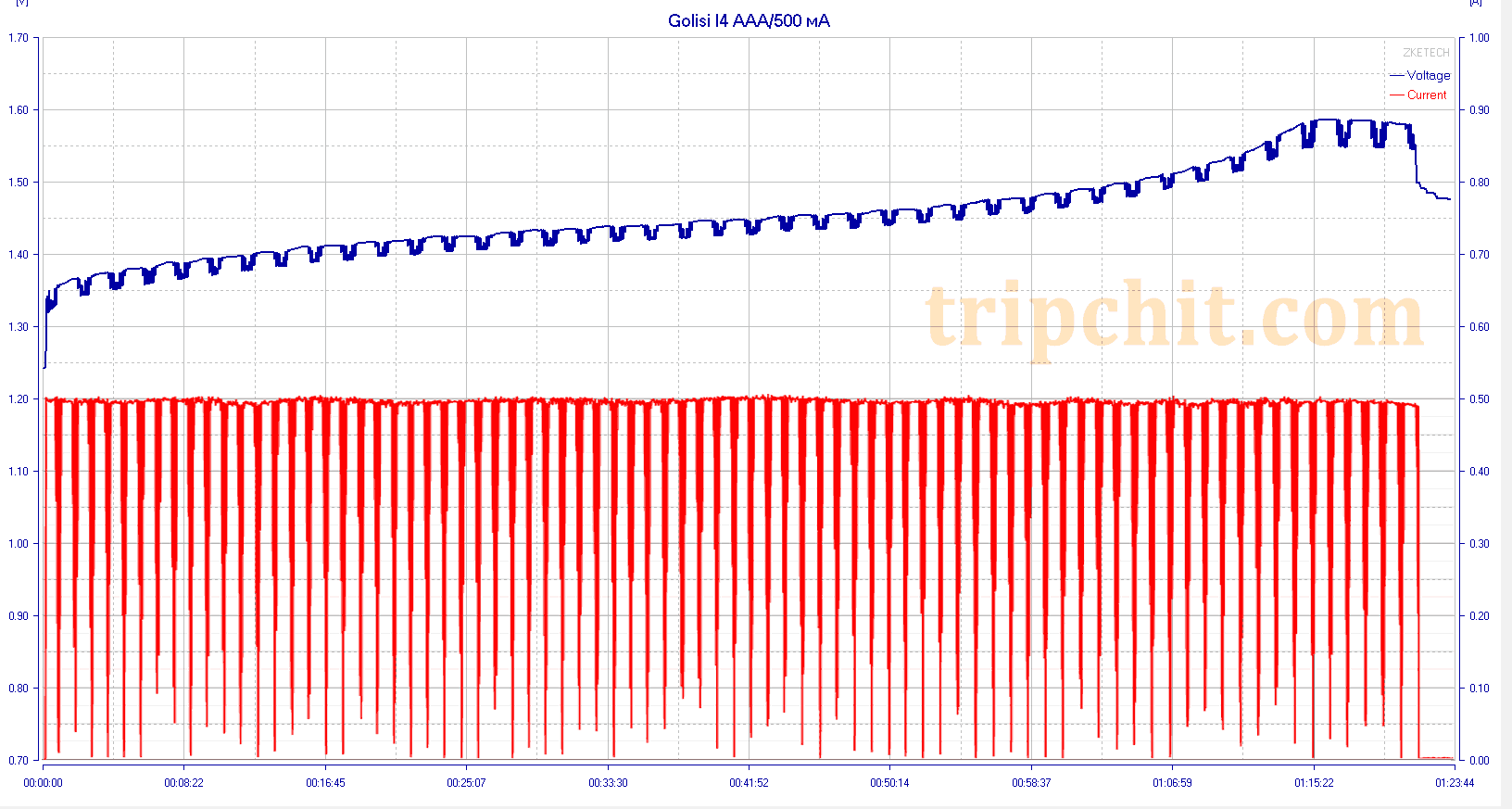
We see that for a healthy AAA battery there's no problem at all with charging at 0.5 A. The charging graph is close to ideal for a -dV algorithm.
My overall impression of the device is rather positive. I liked the build quality. The sockets and springs are excellent, with a soft action and no play, squeaks or jams. The only build-quality questions concern the edges of the screen; the screen itself is quite informative.
There are no questions about the nickel charging algorithm: minus delta V is caught well, helped by the 0.5A current. It's perfectly adequate for good AA and AAA batteries.
Lithium is trickier; in my opinion the final charging voltage is a bit high. For good batteries that isn't critical, and bad ones are better not used at all.
I also noticed that when powered from a standard two-amp USB port (from a Xiaomi extension cord), non-critical voltage sags appeared at maximum load, even though two amps should be enough according to the manufacturer. On the other hand, when powered from an 18-watt Xtar USB charger, no problems appeared.
Прокомментируйте: