In the previous review I looked at the Samsung INR18650-25R; now I want to test the Sony/Murata VTC5A cells, which were used for two years in the same conditions. How well the high-drain US18650VTC5A cells have kept their ability to hold high current, and how much capacity they have left.
Sony/Murata US18650VTC5A specifications:
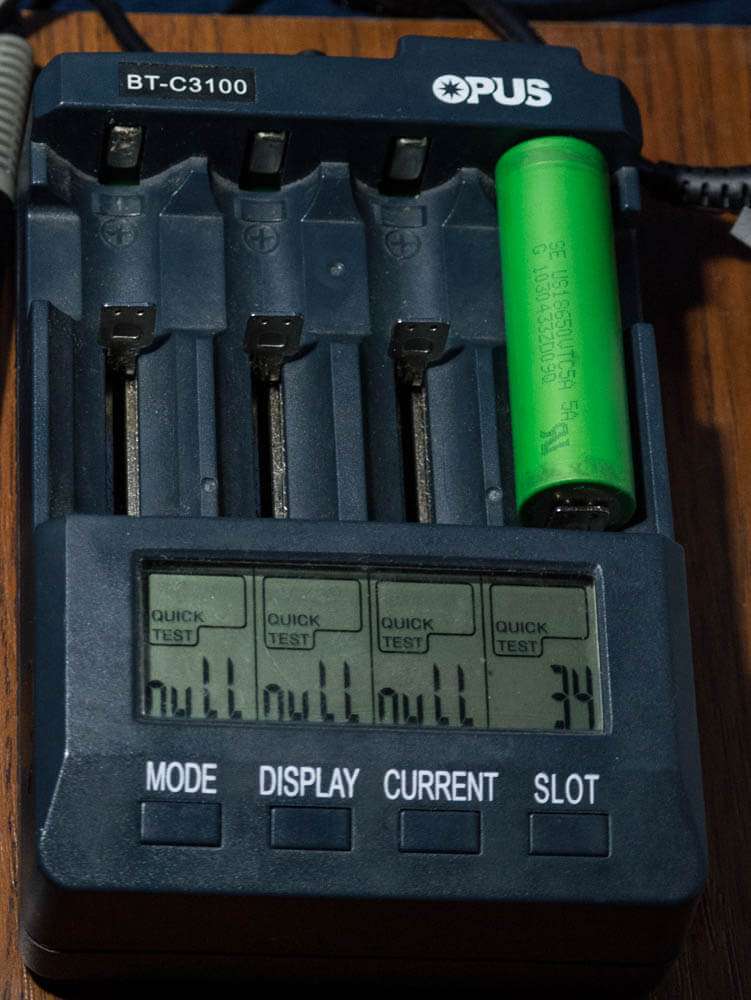
The internal resistance of the better of the pair of Sony/Murata VTC5A was 34 mΩ, and of the other 53 mΩ, whereas per the datasheet it shouldn't exceed 15 mΩ. Not very good.
The Samsung clearly leads in this test: one has 42, the other 43, which is higher than the better of the VTC5A pair, but the spread is minimal. As a reminder, the Sony and Samsung batteries were used in pairs, in turn, in the same device.
By Sony's method the capacity should exceed 2500mAh when discharged to 2 volts at 500mA, but at higher currents discharging below 2.5V isn't recommended. So I'll discharge at 1A down to 2.5V.
2372 mAh for a two-year-old battery with over 100 cycles on it is a perfectly good result.
The shape of the curve raises no suspicion, but the result is only 2061mAh. The Samsung gave 200 mAh more. Here I tested the battery with the higher internal resistance. While it charges, we'll test the second one at 10A.
It turned out that the second battery is in much better condition. 2256mAh, average voltage 3.36. That's better than the Samsung under the same load, and heating up to 35 degrees is perfectly acceptable.
This is the same battery as in the previous test. Capacity 2252 mAh and average voltage 3.25V, heating up to 42 degrees. A very good result, better than the Samsung, where the voltage was only 3.09V.
Meanwhile the battery with the higher internal resistance went through two low-current charge-discharge cycles, and I thought it had recovered its form.
I was wrong. During the test the battery heated up to an insane temperature; I couldn't even measure it, because the heat-shrink wrap on the battery melted, burst and slid off together with the temperature sensor. Most likely the second battery would have survived this test easily, but I decided to stop the experiment and call it a failure. You can see the results of the last stage on screen.
There's no need to draw any sweeping conclusions from this test; it's valuable in itself. Why did one of the batteries run into such trouble? I think the problem is an initial imbalance in characteristics. Although the batteries are of the same type, made at the same factory, and I bought them in the same store, their manufacture dates differ (January and April 2017). Presumably, batteries from different batches had a slight spread in characteristics, because of which, when connected in series, one of them discharged more deeply. At first this wasn't noticeable, but after a hundred cycles under serious load, the degradation of the battery turned out to be quite pronounced.
The Samsung batteries showed absolutely identical results, but they were also bought "from the same box". By the numbers, the better of the VTC5A batteries was slightly better than the INR18650-25R, and the other one significantly worse.
Which battery to prefer is up to you; my one piece of advice is to look at the manufacture date so that the characteristics of batteries used in pairs are the same.
Прокомментируйте: