I bought the LiitoKala lii-70A cells for use in a lithium motorcycle battery. The previous cells aren't enough to crank the starter: the BMS protection trips (at the moment of starting, the voltage sags below 2.5V), so I decided to build a 4s2p battery, and if the protection keeps tripping, I'll simply remove it and install a balancing board with no protection. As is tradition, every battery I buy goes through a load test. I bought from the official store so as not to end up with a fake.
So, here's what we have:
To equalize the potentials, I connected the cells in parallel and ran three charge-discharge cycles. I noticed that the total capacity of the cells on the last cycle of this procedure grew by about 2000mAh.
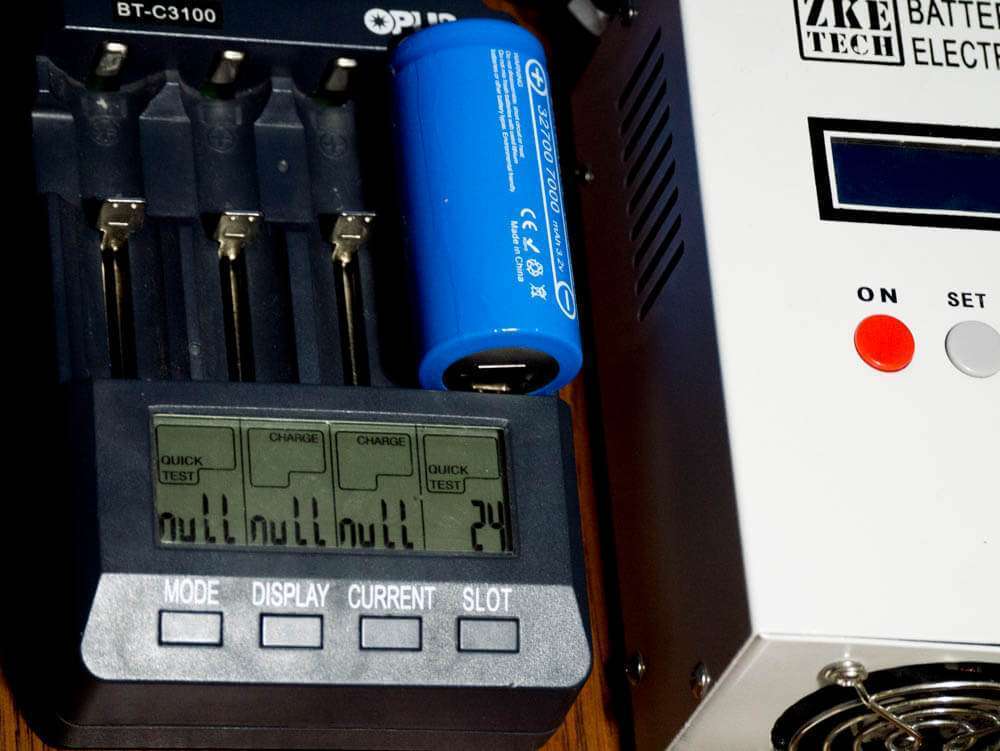
The cells' internal resistance is ~24 mΩ. Measuring internal resistance with the Opus isn't very accurate, but the result is clearly better than that of the 32650 in the previous test.
In the 1-amp discharge stage the cell showed a capacity of 5780 mAh and an average voltage of 3.19 V. I got the feeling that the cells need a few more charge-discharge cycles to start the electrochemistry "at full strength". Otherwise using them in a starter battery makes no sense, because a motorcycle battery doesn't work in cycles; it's almost always fully charged. You can't count on it gaining capacity in the course of use.
Discharged at 5 amps, the cell delivered 5388 mAh at an average voltage of 3.01 V. I expected more; a high-drain lithium iron phosphate cell shouldn't deliver a capacity 25% below nominal when discharged at less than 1C.
Discharge at 10 amps showed that within these limits the capacity hardly drops: 5334 mAh and an average voltage of 2.93V. It's also nice that the cell's temperature didn't rise under this load. The idea came to me to let the cells work through a dozen cycles and run another test.
The LiitoKala 32700 Lii-70A LiFePo4 digested the 20 amp current quite well, delivering 5177mAh and warming only to 35 degrees at an average voltage of 2.75 V. That's much better than with the previous LiFePo4 cells, where the temperature was 10 degrees higher and the average voltage was only 2.66V.
The LiitoKala 32700 3.2 v 7000 mAh Lii-70A cells work. If they'd been labeled 5500 mAh, I'd have called them excellent, but since it says 7000, a bad aftertaste remains anyway. The LiitoKala 32700 has lower internal resistance, heats up less and handles high load better, so they're better than the no-name 32650 from the previous review, which also cost more.
Прокомментируйте: