Palo AA specifications
The article on AA and AAA batteries and chargers explains in detail which batteries are worth buying and why. Palo batteries are mentioned there in a negative light, because they already came to me for testing about 8 years ago, and their capacity was only 200-400 mAh although 3000 was written on them.
By my observation, under the Palo trademark, batteries and chargers that look like the real thing but are in essence imitations have been made in China for at least ten years, sold a couple of dollars cheaper, which gives them a steady flow of customers.
For example, some Palo chargers have a screen so that the buyer thinks it's a smart charger, but in reality the screen is a four-segment indicator working like a low-accuracy voltmeter, and it can only show the charge level: 25-50-75-100%. Considering that the production cost of such gadgets is about 5% of the retail price, I'll venture that Palo could fund a whole institute for developing ideal batteries and chargers.
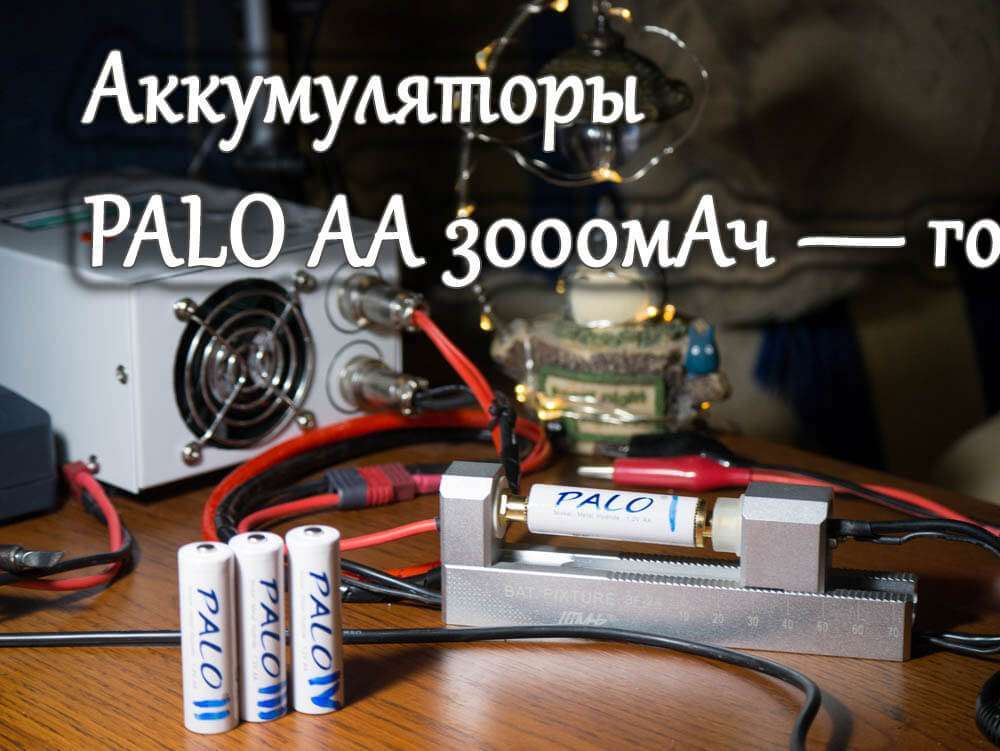
To understand what's changed in eight years, I bought a pack of AA Palo batteries on Ali for six and a half dollars and now want to study them carefully to find out what buyers are paying for.
Stated specifications:
- Type: NI-MH Low-self discharge;
- Size: AA;
- Rated voltage: 1.2V;
- Discharge current: 300-2400mA;
- Capacity: 3000mA (that's how the seller writes it!);
- Certificates: CE, ROHS and so on;
- Packaging: blister;
- Number of cycles: 1800.
The batteries came in a nice blister pack, which says the following of note:
- model: PL-AA3000x4 NiMH 1.2V;
- number of cycles 1200 (well, well, the seller promised 1800);
- a loud claim: "we are the largest electronics manufacturer and present batteries with the world's highest rated capacity";
- charge only with Palo chargers (I suppose so that buyers don't find out the real capacity);
- do not disassemble or give to children;
- the logo of the largest insurance company, Ping An of China.
With the last item the manufacturer is apparently hinting that the user is insured against a battery explosion; I see no other reason to print another company's logo on the label. As we can see, there's no mention of Low-self discharge on either the packaging or the batteries themselves. Moreover, neither the packaging nor the cells give the manufacturer's website, and never mind the website, there isn't even the manufacturer's name. The batteries don't say made in China, although even the no-name cells I pulled out of an old mouse did. But the visual design, a white label with a pearly-blue logo and gray letters, painfully resembles Eneloop.
At the stage of external inspection I'd have passed on the purchase. But I'm acting as a researcher, not a consumer, so let's get on with testing.


Capacity measurement results for PALO AA "out of the box"
First we discharge the PALO batteries at the minimum current stated on the packaging, 300 mA. If you believe the manufacturer, that's 0.1C. But I know that AA batteries of 3000 mAh don't exist in nature because of technological limits. If you cram electrodes able to store 3000 mAh into a battery measuring 14 x 50 mm, there'll be no room left for the electrolyte.
So let's see how much LSD there is in these batteries:
- 1453 mAh.
- 1464 mAh.
- 1452 mAh.
- 1453 mAh.
So the characteristics of four batteries from one pack have a spread of less than 1%. That would be an excellent result if you didn't take into account that the energy remaining in the batteries is less than 50% of the stated figure. The Eneloop, which I consider the benchmark of NiMH batteries, loses 30% of its energy over ten years of storage. We conclude that the concept of Low Self Discharge, as applied to PALO batteries, is slightly exaggerated.


PALO AA discharge curve at 300 mA
After three training discharge-charge cycles, let's run a control test head-on at 300 mA. As expected, the real capacity doesn't match the stated one. The results are as follows:
- 1989 mAh, average voltage 1.23 V.
- 2171 mAh, average voltage 1.23 V.
- 2135 mAh, average voltage 1.23 V.
- 2066 mAh, average voltage 1.22 V.
The difference between the values is significant because the batteries weren't tested at the same time. I didn't think it might matter and tested them in the order 2-3-4-1. Testing one battery takes more than 7 hours, so battery number two was tested right after removal from the charger, number three after 8 hours (losing 36 mAh in that time), the fourth after 16 hours (105 mAh lost), and number one after a day (minus 182 mAh).
Now you know what "self-discharge" is: it's when a battery loses 10% of its capacity in the first day after charging. For nickel batteries it's a normal phenomenon; for example, Xiaomi batteries made at the Panasonic factory using Eneloop technology are guilty of the same, and the Eneloop itself, no use hiding it, loses about ten percent of its charge in the first day. The only difference is that the Eneloop has a stated capacity of 1900 mAh, shows 2100 on a charge-discharge cycle, loses 10% in a day but still stays within 1900, while the Palo has a stated 3000 mAh and in reality shows a little over 66% of the stated capacity.


PALO AA discharge at 600 mA
I went along with the manufacturer (by the way, if you know who it is, write in the comments) and discharged the batteries at 600mA (supposedly 0.2C). This time I also left the batteries in the charger on trickle charge after charging (I hope the charger's trickle current is greater than what the PALO loses through self-discharge). The figures obtained:
- 2153 mAh;
- 2147 mAh;
- 2106 mAh;
- 2067 mAh;
I hoped in vain. Even in "maintenance" charge mode, the batteries lose capacity before your eyes.
I should have discharged at 1A, following my own method, but I slipped up. Though I don't think the results would differ much, so let's go straight to discharge at 2A.


PALO AA discharge at 2000 mA
At this stage of testing, as at the last one, the batteries were charged to cutoff and then stayed in the charger on maintenance charge. Results:
- 2014 mAh;
- 2102 mAh;
- 2065 mAh;
- 2030 mAh.
Is that a lot or a little? Decide for yourself. I'll only say the result is much better than the batch I tested some eight years ago.


Monitoring PALO AA self-discharge
I connected a charged PALO AA (number one), which showed 2014 mAh at the previous stage, to a load to see how far its voltage would drop in a day. After 24 hours and 3 minutes the voltage fell from 1.450V to 1.386V.
After that I immediately ran another discharge with the same load.
Result: 1963 mAh. The self-discharge is quite significant.

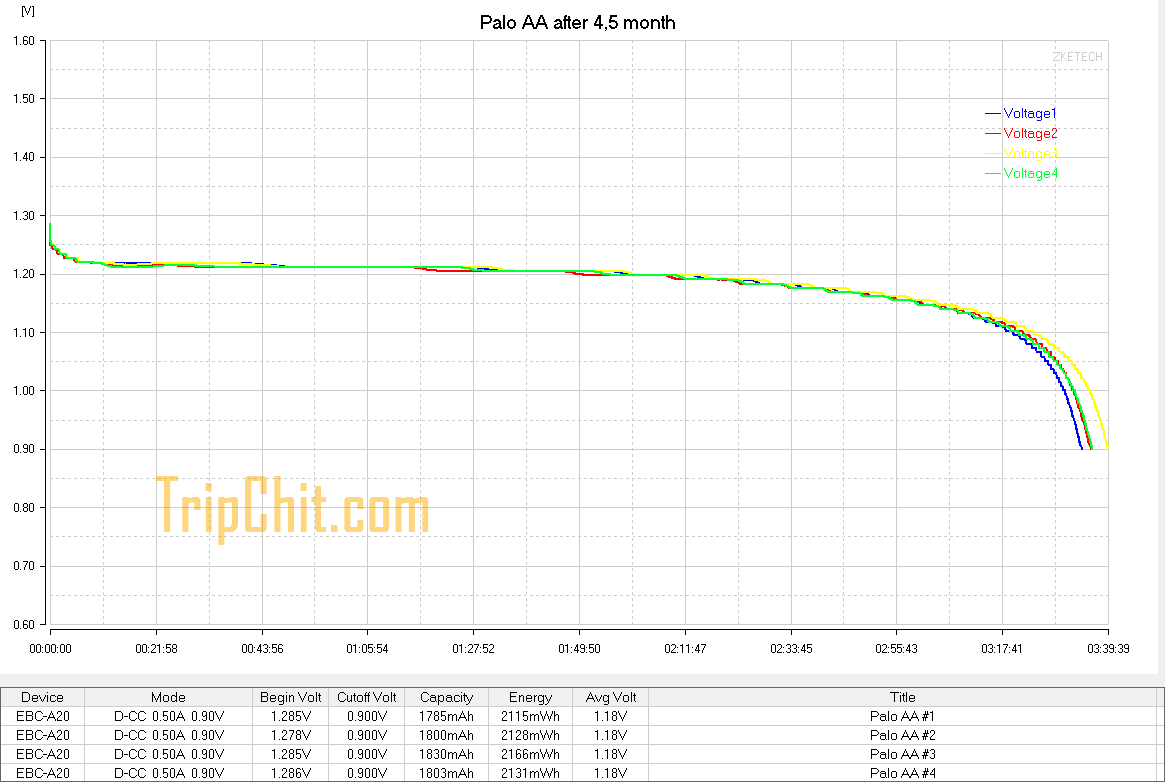
PALO AA self-discharge over 138 days
The article was published on October 13, 2019. On that day I ran a training cycle on the batteries and put them on a far shelf, and today, February 28, 2020, I took them out and started a test at 500 mA.
The batteries showed very close results, and quite decent ones: 1785, 1800, 1830 and 1803 mAh. Taking the real capacity as the reference rather than the stated one, in 4.5 months the batteries lost only about 10%.
Conclusion
The test results showed that Palo batteries have become much better. There are minuses, though:
- The stated capacity is much higher than the real one, which is about 2000 mAh.
- Self-discharge is high in the first day after charging; after that the battery loses only about 2.5% of its charge a month.
I don't recommend these batteries simply out of unwillingness to support cheats with money. Although if the battery said "2000 mAh", I'd reconsider my opinion.
If you aren't bothered by the exaggerated capacity and don't plan to store the batteries for several years, you can safely buy and use them.