XIAOYI
Liitokala recently widened its range with the budget universal Liitokala Lii-PD4 charger for LiIon, LiFePo4, LiHV, NiMH and NiCd batteries. Almost every manufacturer makes chargers with this kind of functionality, but the Lii-PD4 stands out from the competition with a very democratic price, for example, here.
I was curious how well the engineers had done with the new Liitokala, so I ordered a charger for testing from the official Liitokala store on AliExpress.
First, the specifications.
The device has a built-in power supply and runs from a 220 V outlet, but it can also be powered from a 12 V power supply and, through an adapter, from a car cigarette lighter. The box contains the charger itself, a 220V cord and a short manual in Chinese and English.
So we have a fairly modern charger with all the functions needed for charging batteries. Let's get on with testing.
First of all, I want to understand how correctly the device charges batteries. While testing the Liitokala Lii-PD4 I'll measure voltage and charging current, so we'll see the accuracy of the built-in voltmeter and how closely the stated charging current matches the real one. And since an ammeter introduces an error into the voltage measurement, I'll separately run another short stage with a partial discharge to measure voltage only.
The Samsung INR18650-25R battery is about 80 percent discharged. We put it into the fourth slot, which supports charging at 2A.
A beautiful graph. The classic CC/CV algorithm, with no jumps: at first the battery charges at 2A (actually a bit less, about 1950 mA); once the voltage reaches 4.2V the charger holds that voltage, the current gradually drops to 300 mA, and then the battery is considered charged. In fact, you could have squeezed in another forty milliamp-hours or so if the cutoff current were 0.15A rather than 0.3. But for the health of a battery, undercharging is better than overcharging. So I consider this algorithm absolutely correct and safe for the battery.
Since charging went through an ammeter, which has its own resistance, it was hard for the charger to hold the exact voltage, so I measured the voltage separately at the final stage of charging. The accuracy is impressive: at the end of charging the voltage was 4.201V, a deviation of just 1 millivolt, within the error of the measuring instrument.
The first slot supports a maximum current of 1A. Charging takes about an hour longer than in the fourth slot, and the cutoff current is 150 mA rather than 300 mA. The voltmeter is accurate, and there are no complaints about the algorithm.
Liitokala Lii-PD4: charging an AA battery
We're charging a GS Yuasa EniTime LSD AA battery. Capacity 1900 mAh, the battery is almost fully discharged. After insertion, charging starts at 1000 mA. You can't manually select a gentler 500 mA; the current drops only if you install more than two batteries.
An uneven graph of a configuration I can't make sense of. The constant changes in current and voltage say the device is constantly measuring the voltage; the oscilloscope showed pulses every 0.1 s. The measuring instruments aren't fast enough to analyze exactly what's going on, but a curve shaped like this when charging nickel batteries doesn't look normal to me.
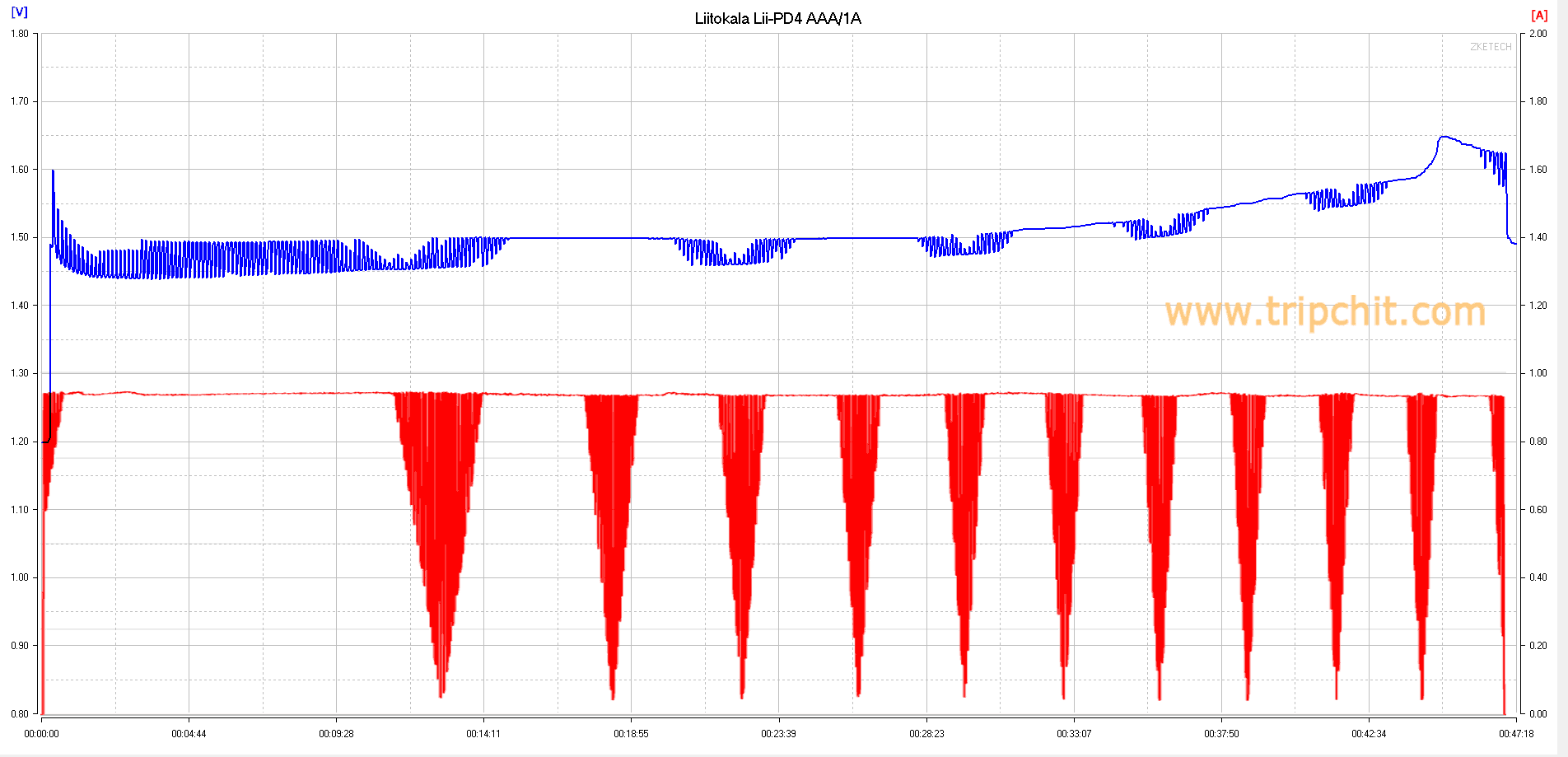
We're charging a GS Yuasa EniTime LSD AAA battery. Its rated capacity is 750 mAh, but the battery is almost 10 years old and only about 560 mAh really remains. The battery is almost fully discharged. After insertion into the slot, charging at 1000 mA starts automatically, and this can't be changed. During charging the battery heated up to 50 degrees.
Overall, a reasonably sensible graph for a nickel battery charged at 2C. The other question is that 2C is not in the slightest sensible for a nickel battery.
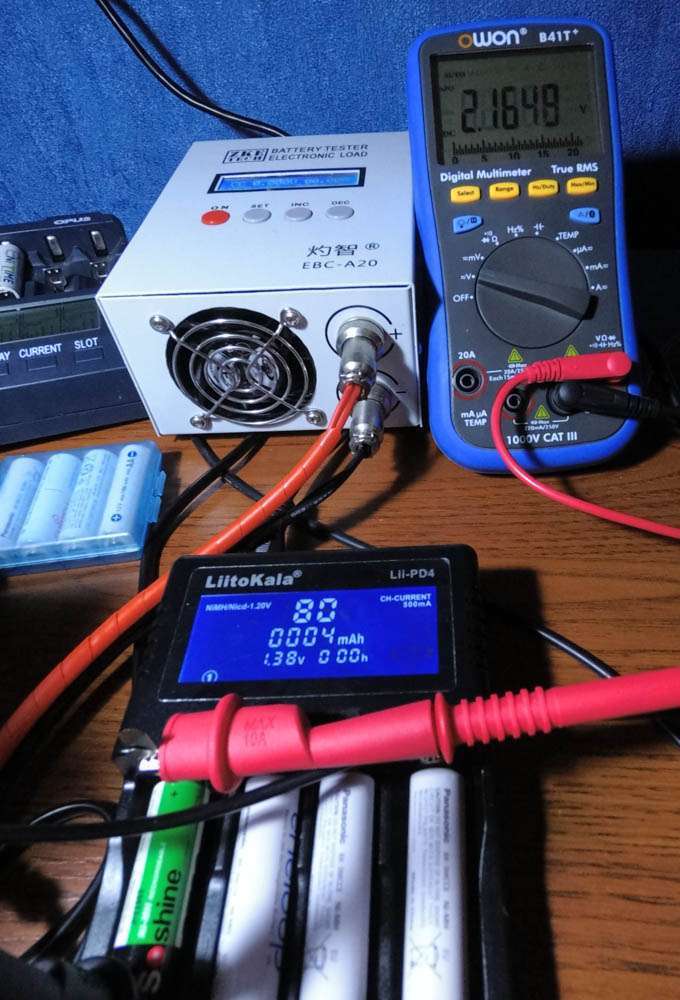
I put four batteries in the slots to lower the charging current to 500 mA, one of them a deliberately "tired" one, an old Soshine with about 300 mAh of capacity left, which I keep specifically for testing chargers. The device boiled the poor battery, raising the voltage to 2.2 volts.
Liitokala Lii-PD4: conclusion
Let's go over the pros and cons of the Liitokala Lii-PD4 charger. Among the pluses I can definitely count the excellent screen, the quality case, the good movable contacts, the lithium charging algorithm, and the choice of LiIon, LiFePo4 and LiHV battery chemistry and, accordingly, cutoff voltage. A huge plus is the accurate voltmeter: lithium batteries are charged to the right voltage to within one thousandth of a volt, which compares favorably with its older sibling, the Liitokala Lii-500S, whose voltmeter had a significant error and which overcharged batteries. Unlike the Opus BT-C3100, the Lii-PD4's voltage and current don't jump while charging lithium batteries, so batteries charge faster (and in a safer mode for them).
The charger's total current is two amps: you can charge one battery at two amps, two batteries at one amp each, and three or four at 500 mA. That's the whole "automation" of charging current selection: divide 2A by the number of batteries and you get the charging current.
Now for nickel. Charging NiMH batteries is worse on the Liitokala Lii-PD4. The current can't be set manually. Even if you charge 4 AAA batteries at once, the current will be 500 mA, almost 10 times higher than the 0.1-0.25C recommended by the manufacturer. However, for new, good AA-size batteries the current will be within the permissible range.
That's exactly why I don't much like the charging algorithm, even though it's a true -dv / dt. As we remember from school physics, current is voltage divided by resistance. If the battery is old or has low capacity, the device can maintain a current of 1 A by raising the voltage to 2.2 volts and even higher.
You can use it as a backup charger for nickel batteries, but if you charge with it all the time, the batteries won't reach their rated service life.
Прокомментируйте: