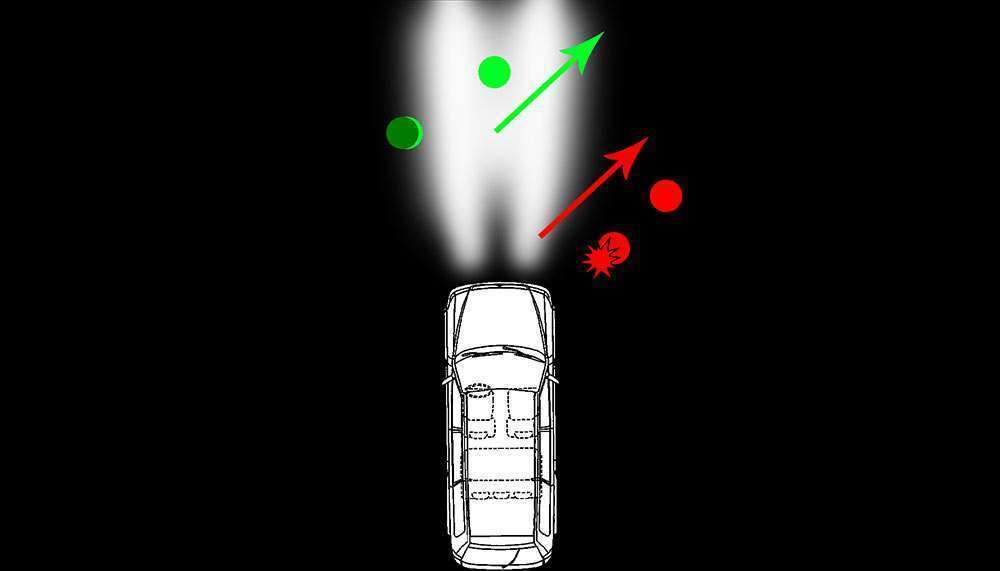
If you drive on roads, you don't need extra lights. Roads have markings, road signs are set up to fall within the headlight beams, and if you lack light at night, it's better to spend the time adjusting your stock headlights. It's another matter if you drive where there are no improved roads. Here you can't do without extra light, because stock optics are set to shine forward without dazzling oncoming drivers. Off-road there's no oncoming traffic, but obstacles can be not only on the track but also beside it and above it. In low-beam light, because of the cutoff line, you can't spot a log hanging from above, and high beam shines strictly straight ahead of the car and doesn't help at all if obstacles are on the sides and you have to maneuver between them. I tried to draw what I couldn't put into words: you see an obstacle ahead of the car and can steer around it to the right, but you don't see the obstacle on the right. An attempt to maneuver along the red trajectory ends in a collision.
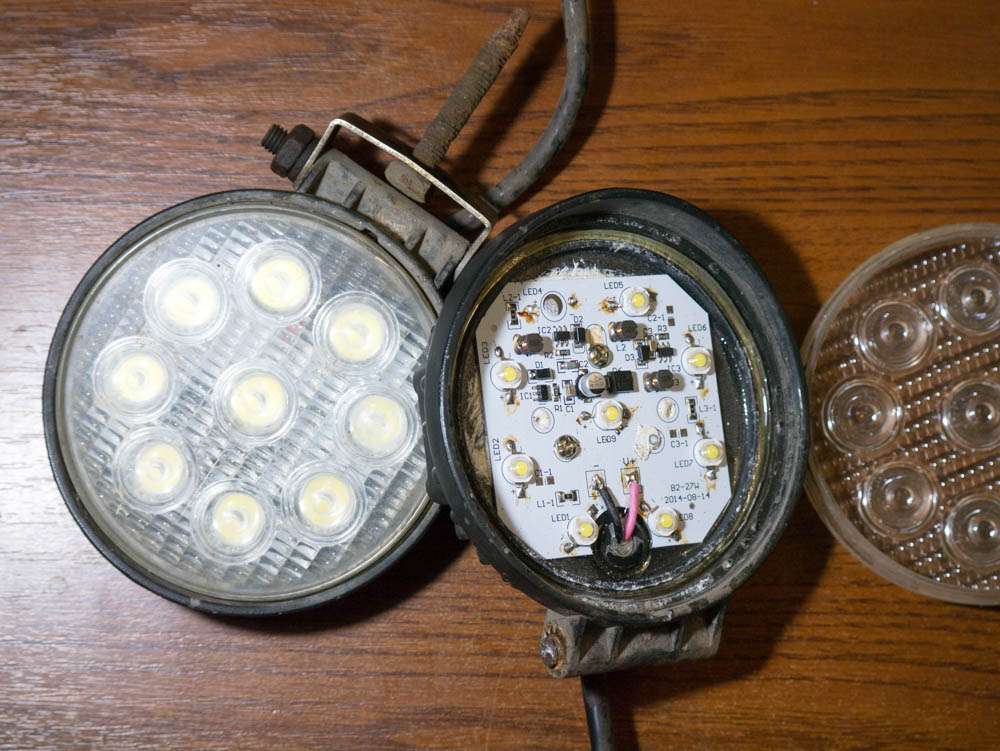
Five years ago I bought a boat on a trailer and started driving at night to places where you can't do anything without extra light. The drive to the river went like this: "we drive 50 meters, get out with a flashlight, shine it around, make sure we can go on, drive another fifty meters". So I bought the first LED lights I came across on AliExpress (9 LEDs of 3 watts each) and mounted them on the bull bar's crossbar. They did their job, shone quite brightly and helped me out a lot until one LED burned out in one of the lights. One burned out, but three went dark, because the LED power circuit is three by three, one driver per chain of three LEDs. No problem, I thought, ten such LEDs cost a dollar fifty. I'll buy and replace them. But it wasn't that simple. First, those lights turned out to be non-serviceable. After heating the body to 110 degrees I managed to remove the glass, and after the repair I could even have put it back and sealed it. But when taking the lights off, it turned out that the supplied hardware was black steel. The bolts holding the lights to the crossbar had rotted, and the ones that hold the light to the bracket had seized in the light body for good, so putting them back without a song and dance (in the form of drilling steel bolts out of the aluminum body) was no longer possible.
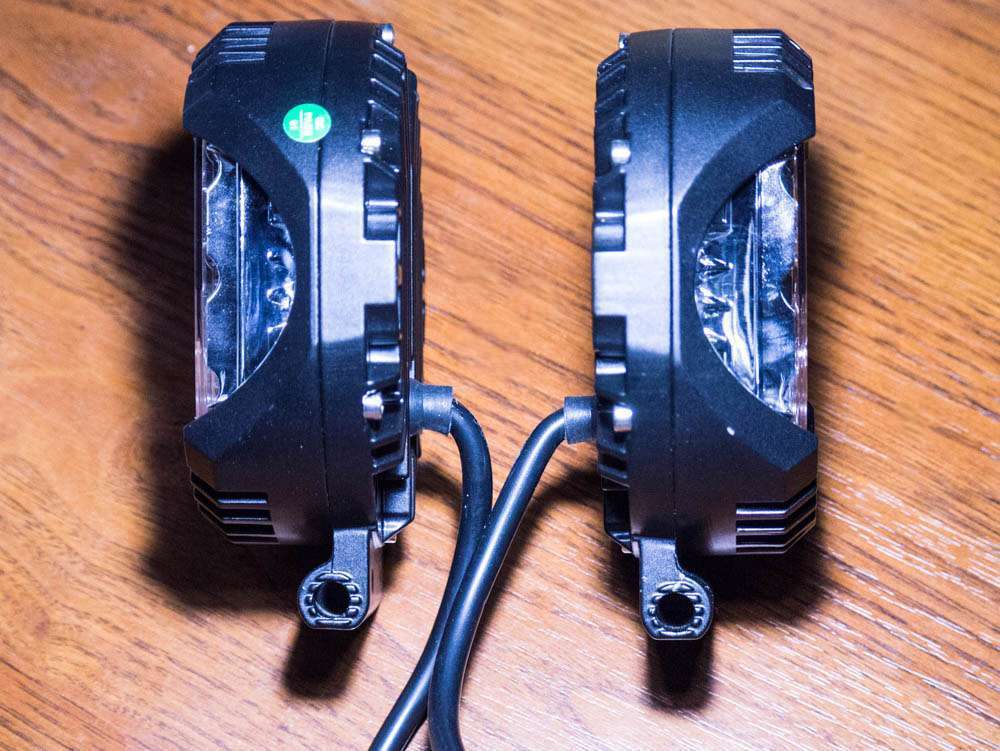
Since that's how it turned out, I decided to order more expensive lights, taking into account my experience with the previous ones. First condition: they must be thin, because the mounting spot is right up against the bumper and I simply couldn't install lights whose bracket sits on the front. Second: the lights must be repairable from the start, that is, they must come apart. Third: stainless steel hardware. The last one isn't very important, as four stainless bolts can be bought in the nearest hardware store, but I was lucky and in the model I chose the bracket and bolts were stainless. And the main thing, the light: no less bright than the previous ones, and a must-have pronounced side light. After all the nuances were taken into account, I settled on a work light kit called the MICTUNING Auto Side Shooter, which I bought at this store for just 55 dollars.
I'm not a fan of the "more expensive means better" formula and can give hundreds of examples where a cheaper thing is more practical and reliable than an expensive branded equivalent, from shoes and mobile phones to cars and boat motors. But in this case the formula works. The shape of the light beam: the old lights simply gave scattered light, while the new ones have three distinct lighting zones: a powerful (6 LEDs) beam ahead, like a "high beam", a wide band (4 LEDs) from verge to verge (like a "low beam"), and three LEDs on the right and on the left that shine sharply to the sides.
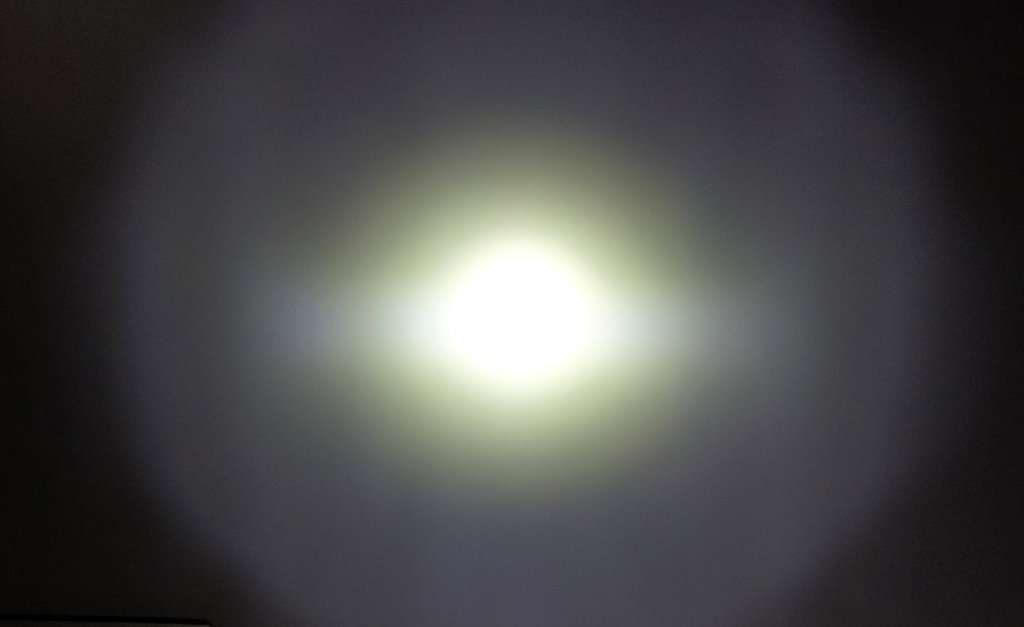
The efficiency of the new lights is striking. They're so much brighter that I can't even take a "old on the right, new on the left" photo, because as soon as I turn on the new one, the old light's glow isn't visible at all, it vanishes in the powerful light of the new one. How can that be, when the old one is 18 watts and the new one 24, a difference of only 25%? The reason is that the old light uses nine Chinese 2-watt no-name LEDs with a brightness of 110 lm, while the new one uses sixteen Cree XPE LEDs that consume only 1.5W with the same brightness. So the new lamp's brightness is 1760 lumens and the old one's just 990.
Here, in the photo, do you see the light from the second lamp? I don't either. But it's there.
Now I'm going to put the lights back in place, and when I've mounted them I'll take a photo "in combat conditions".
Thanks for dropping by, and I wish you the best of luck.
Прокомментируйте: