When I needed a blood pressure monitor, I was at a loss. You'd think there's nothing to ponder: go to the pharmacy and buy one. But that's with an ordinary mercury sphygmomanometer, where there are no questions and everything is simple: a cuff and a scale. All the measuring is done by your ears through a stethoscope. A modern digital monitor, though, is a smart device with lots of functions I, for one, didn't know about. First I'll tell you how I chose my first monitor, and in the second half of the article, how I bought exactly the same one for four times less.
You have to understand that blood pressure is unpredictable. Even if you're healthy yourself, a friend who comes to visit might suddenly feel ill. For example, the person feels nauseous and dizzy. Must have been poisoned, he thinks, and takes a trusted pill, which of course doesn't help, because this time the cause of the dizziness is low blood pressure. And then my parents came to visit us. Any older person should be able to measure their blood pressure, so I had to study the subject.
It's good that our family doctor keeps up with medical novelties, so I went to him for advice. So, what modern monitors can do besides measuring pressure itself, point by point with explanations:
Besides this, when choosing you should consider:
Having received exhaustive advice from the doctor on choosing a monitor, I went and bought an Omron M6 Comfort, which met all the requirements listed above and cost about 95 dollars at the exchange rate. And since the cuff was too big for Lera, we gave this monitor to my parents when they left.
Now with some experience, I set about choosing a monitor for our family, one that would suit me, Lera and our child. I just didn't want to spend another hundred dollars, so I decided I could sacrifice some one function if it significantly lowered the price.
Reasoning, rightly, that most monitors, whatever the brand, are made in China anyway, I decided to buy there. I found three suitable Chinese medical equipment brands: Aviche (a division of Aviation Industry Corp. of China), Yuwell (Yuwell-Jiangsu Yuyue medical equipment & supply Co.,) and Saint Health.
Based on my criteria, three devices were chosen:
The AVICHE monitor had no arrhythmia indicator, but it could run from ordinary USB (for example, from a phone charger) and had the right cuff size, 22-36 cm.
The second monitor, the Yuwell, was good in absolutely every way, but cost almost 40% more than the others. This brand has cheaper monitors, but they either lack a "multiple users" mode or have the wrong cuff size. In principle, $36 is cheaper than at the local pharmacy in any case, but the power connector also put me off.
The third has a notable plus, along with USB power: Russian-language voice prompts. But the configurations include only two cuffs: 22-32 and 32-48.
I chose the first option. In our family even the child understands English, and the child's age lets us do without a voice assistant for now. But it has memory for 2 users, arrhythmia detection (what the big-name manufacturers call PAD), CE certification and an accuracy of +/-3 mmHg.
Anyway, the monitor arrived and I'll tell you about it now.
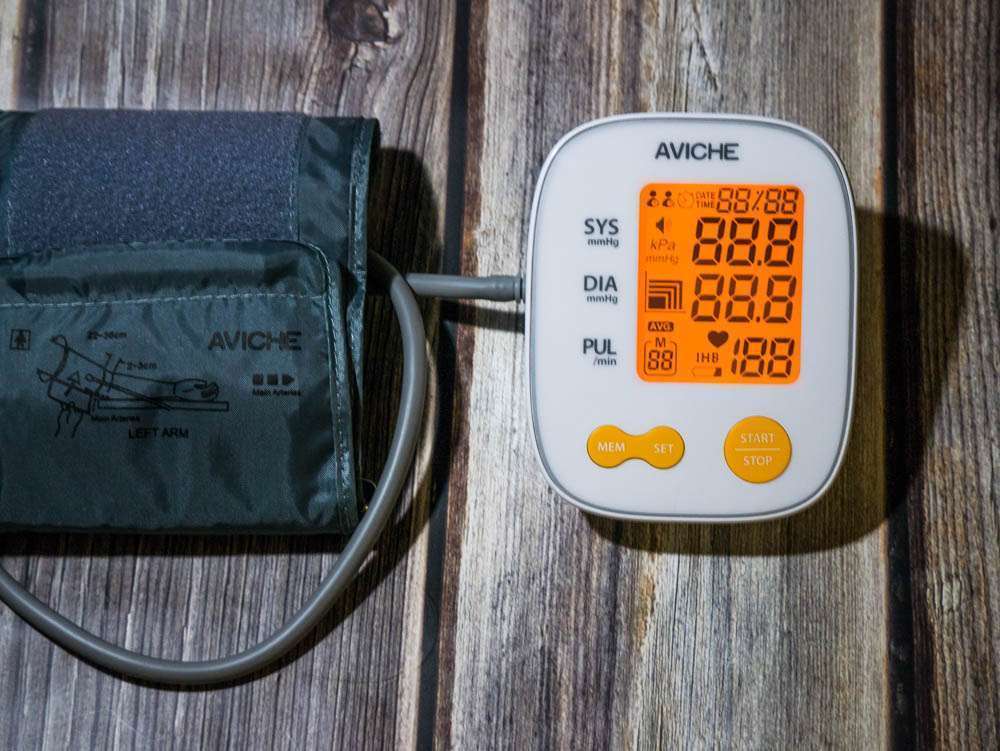
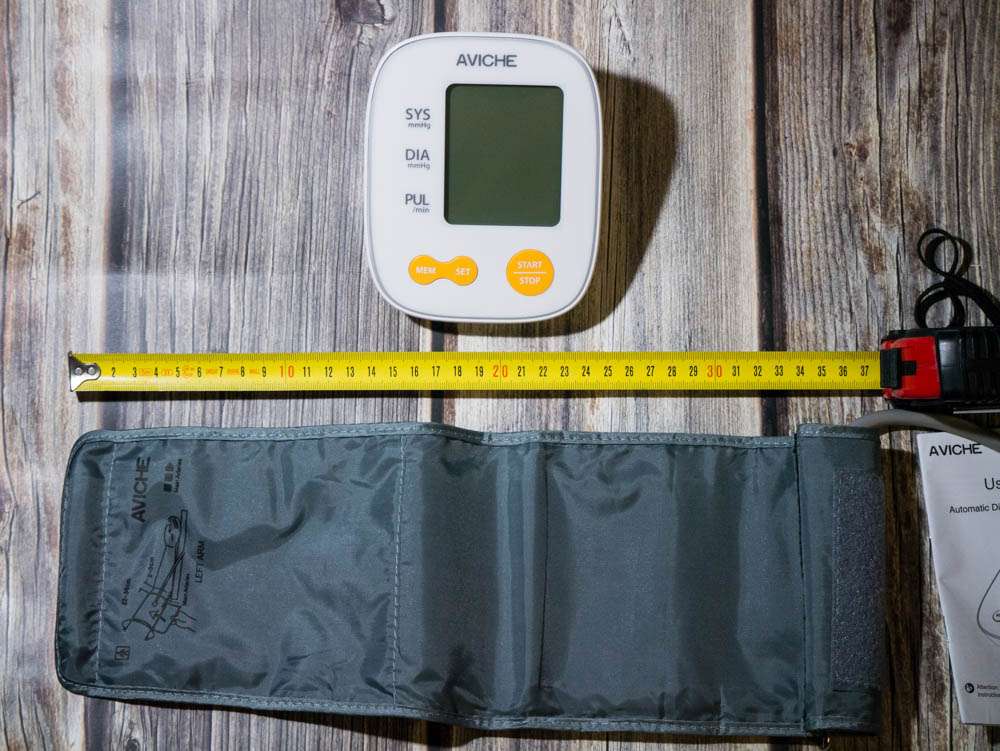
The monitor's body is made of ABS plastic, the screen is bright, the digits are high-contrast and the button presses are crisp. The build quality is no different from the first monitor: solid and reliable.
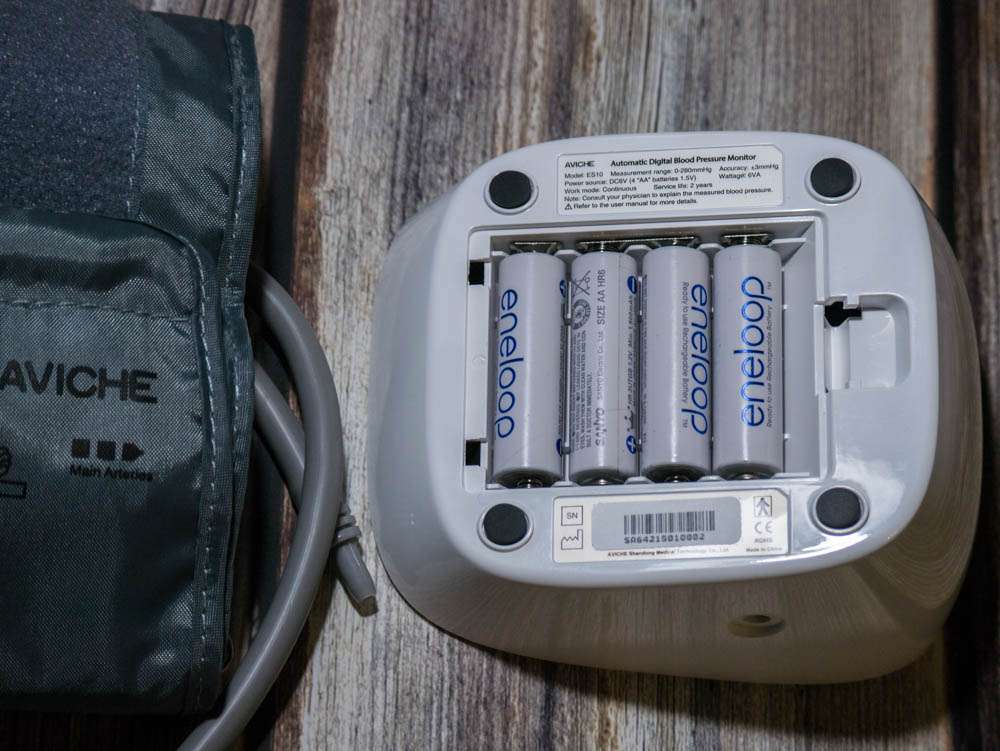
Before use, even if you plan to run it from the mains, it's worth putting a set of batteries into the monitor. The monitors have non-volatile memory, so the blood pressure results are kept even without power, but the electronic clock and date reset as soon as you unplug the monitor from USB.
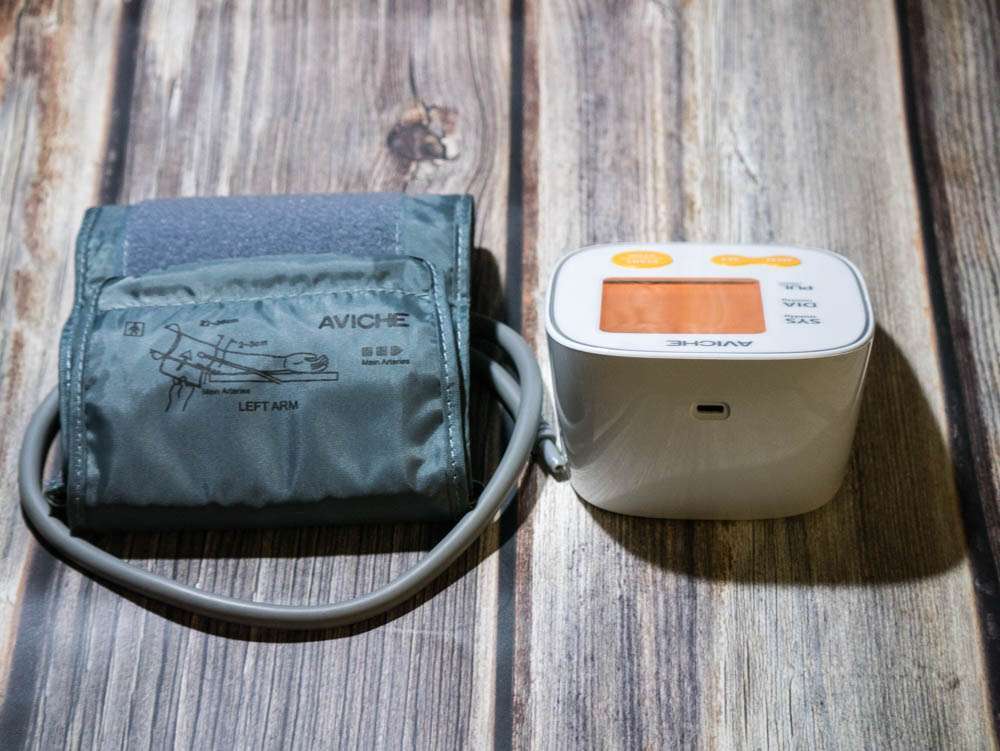
By the way, the device uses a USB Type-C connector, which delights me no end because it can be plugged in either way up. Even if you use other standards, a Type-C cable comes in the box.
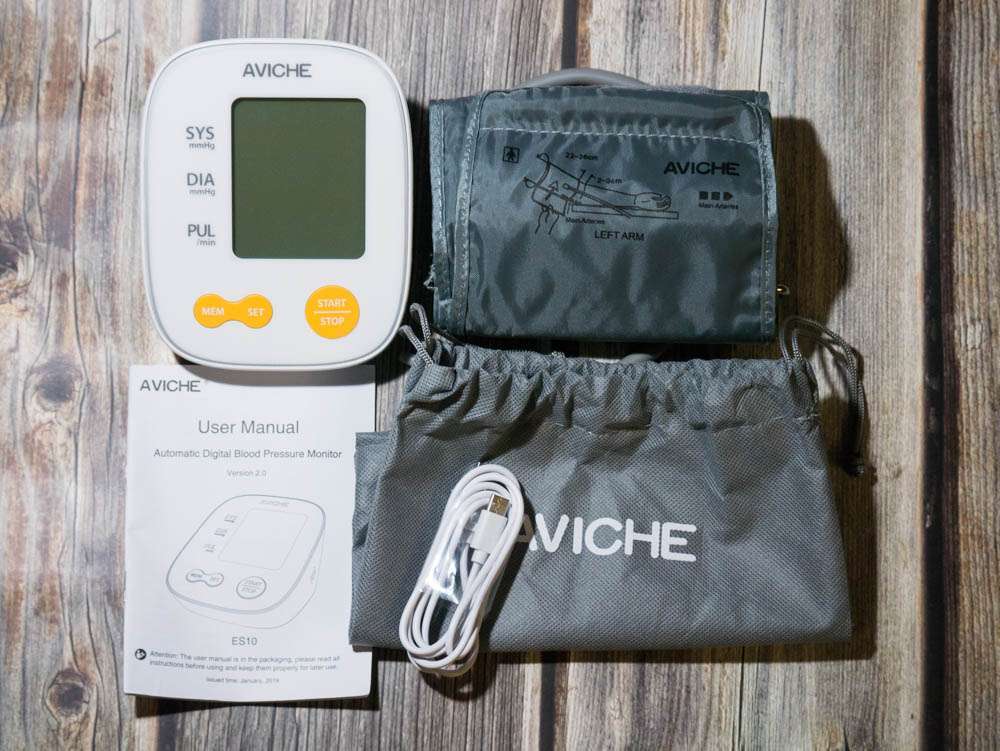
Besides the cable, the box contained a cuff, a storage pouch and a manual. I bought the monitor without a USB adapter in the kit, because now everything seems to have USB ports; right now there are seven of them on my desk across four different devices, and the monitor can be connected to any of them.
To enter setup mode, press and hold the SET button; it also cycles the values. To change values (date, time and other settings are set this way), press MEM.
To see the stored measurement results, press MEM once. After the first press the device shows the average of the last three measurements (it won't have a number), and each subsequent press brings up the previous result with its date and time.
The device is switched on by pressing START/STOP, and off with the same button. Measurement starts right after switching on, so decide at once who's first and who's second in your family, since before switching on you need to choose the user with the SET button. The measurement value is written to the memory slot of the selected user. In total the AVICHE monitor has 120 memory slots, 60 for each.
The device's cuff is recommended for arms with a circumference of 22 to 36 cm, but it fastens normally on arms from 19 to 40 cm, although measurement accuracy will be slightly lower.
The accuracy of the AVICHE monitor deserves a separate mention. The accuracy of +/- 3 mmHg stated by the manufacturer was checked against a Swiss device at a clinic, and indeed there was no difference of more than 3 millimeters (on the plus side). The doctor congratulated me on a good choice, and I decided to share my knowledge with you.
Good health!
Прокомментируйте: