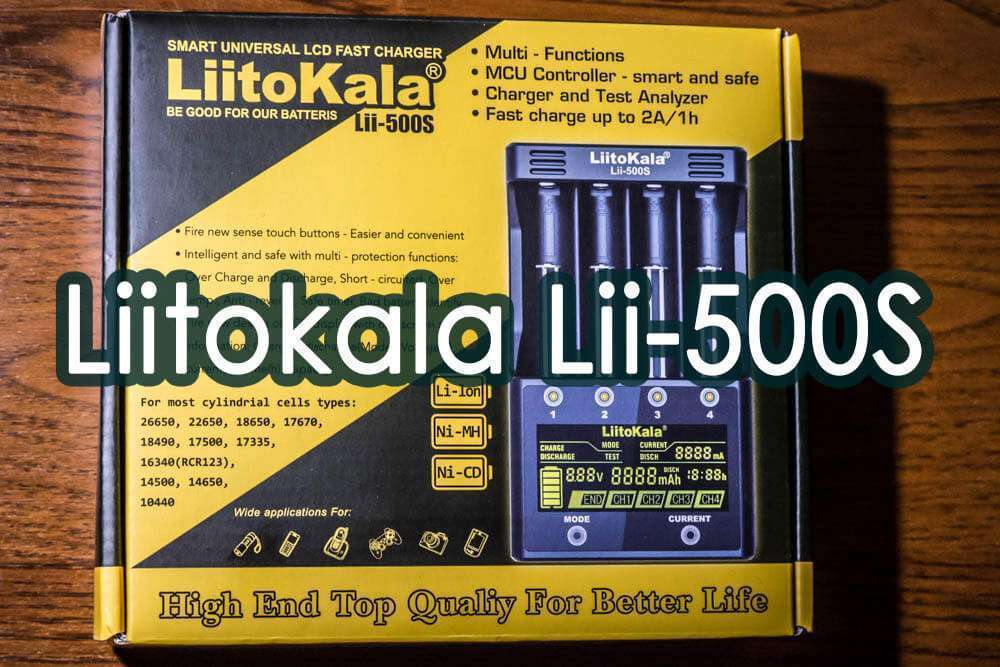
The top-of-the-line Liitokala Lii-500S charger
Many people were waiting for the Liitokala Lii-500S, since the previous version, the Liitokala Lii-500, was a rather decent device, though with its drawbacks. Did Liitokala's engineers manage to get rid of those drawbacks in the updated version? I was curious to know the answer, so I bought one on AliExpress. If this store doesn't have it, you can find it cheaper elsewhere; these chargers aren't counterfeited, so choose by store rating.
I want to point out that I described the methods and ways of working with the device in detail in the Russian manual for the Liitokala Lii-500S, which I had to write myself because of the poor translation and inaccuracies in the official manual. In this review I'll focus on the measurements.
First, let's deal with the previous version.
Pros: the Lii-500 worked correctly in terms of current and voltage, allowed charging currents of 300, 500, 700 and 1000 mA, didn't suffer from overcharging, could work with nickel batteries and measured internal resistance.
Cons: overheating and failure with regular simultaneous use of high charging currents (1000 mA) in all four slots, and extremely low accuracy of internal resistance measurement.
So when creating the new version, the engineers needed to improve two things:
- Internal resistance measurement accuracy,
- Board cooling.
The engineers dealt with the first task radically. They simply threw the internal resistance measurement function out of the device. Apparently they couldn't create a circuit that gives correct data and decided not to burden the device with a function that gives a relative spread of 100% on one and the same battery.
The second problem, though, seems to have been solved. When charging four batteries at maximum current at once, the device gets warm but not hot, and a temperature sensor is installed to monitor overheating.
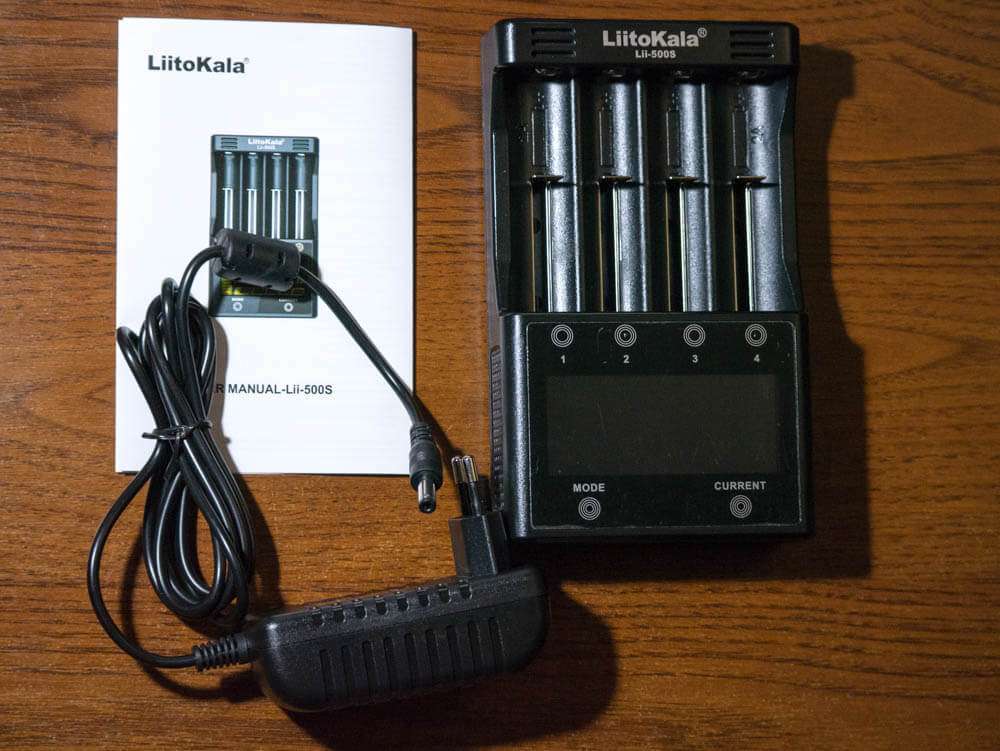
Liitokala Lii-500S specifications
Besides the missing Fast test mode, the main differences of the Lii-500S from its predecessor are:
- The device is bigger, which lets it charge batteries up to 75 mm long with no trouble, and it doesn't look monstrously large like the MAHA; it's solid and substantial;
- The useless Power Bank mode, which let you use a lithium battery inserted in one of the slots to charge, for example, a phone, is gone. In its place is a slightly more useful USB output, which works only when the device is plugged into the 220V mains and delivers just 1000 mA, which is also too little for most modern devices;
- The ability to set a 300 mA current has been removed, which is bad, because 500 mA is too high a current for ordinary AAA batteries;
- A function for activating batteries whose protection has tripped (0V activation) and a soft start function have been added, to spare the battery from sudden jumps in current or voltage at the start of charging;
- A 2000 mA charging current has been added (in the two outer slots).
Otherwise it's all very similar. The same controls (now touch), the same display of the parameters of only one battery on the screen (now with MVA technology, which lets you see the image from any angle). Nice, solid, modern.
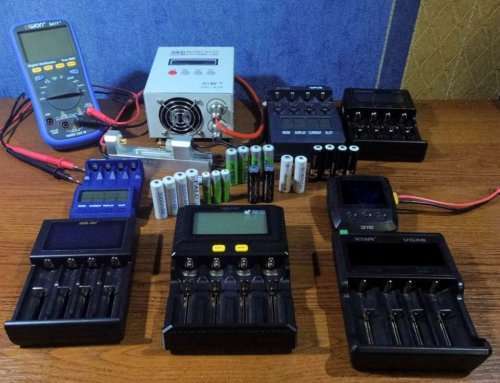
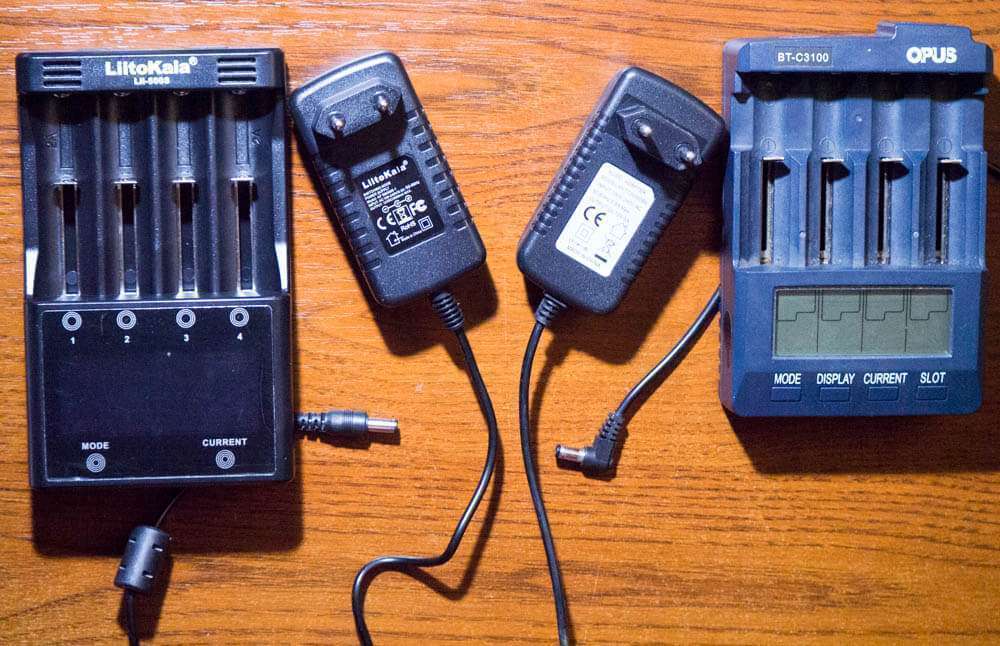
Below, in the photo, is the Liitokala Lii-500S next to the Opus BT-C3100. I noticed they have identical power supplies, 12 V/2A.
Testing the Liitokala Lii-500S
I want to find out how correctly the LiitoKala Lii-500S measures voltage, how accurately it detects minus delta V when charging NiMH batteries, how exactly the "intelligent end-of-charge detection" claimed by the manufacturer works when charging LiIon, and also what happens after the batteries are charged.
For this I'll connect my ZKE Tech EBC-A20 electronic load, in monitoring mode, to the battery contacts, insert the battery into the LiitoKala Lii-500S charger and record what happens in TEST mode and then for several hours after the word END lights up on the charger's screen. I'll also check CHARGE mode to find out which charging algorithm the device uses. The tests use Liitokala VTC6, Kedanone VTC6 and Palo AA batteries, which recently went through load testing, so their parameters are clear to me.
Liitokala Lii-500S: lithium battery No. 1
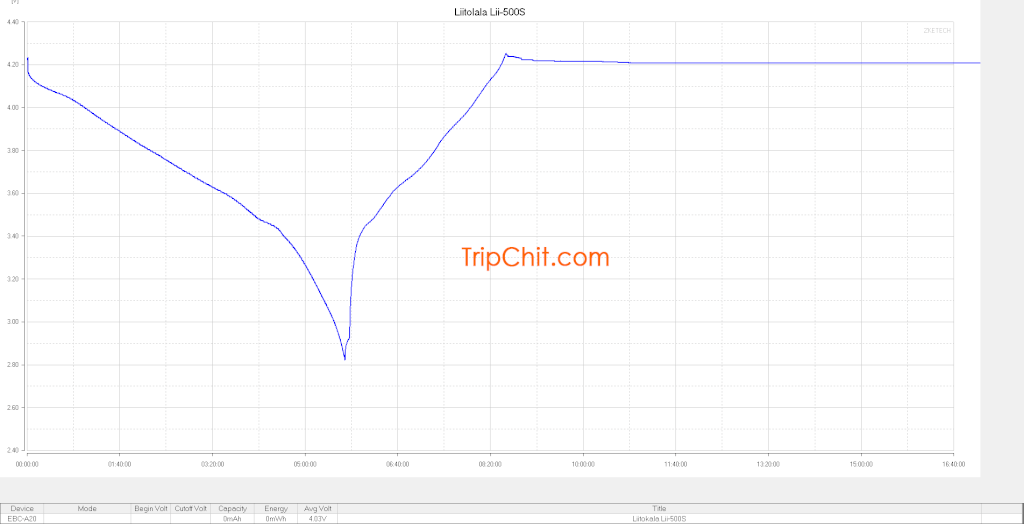
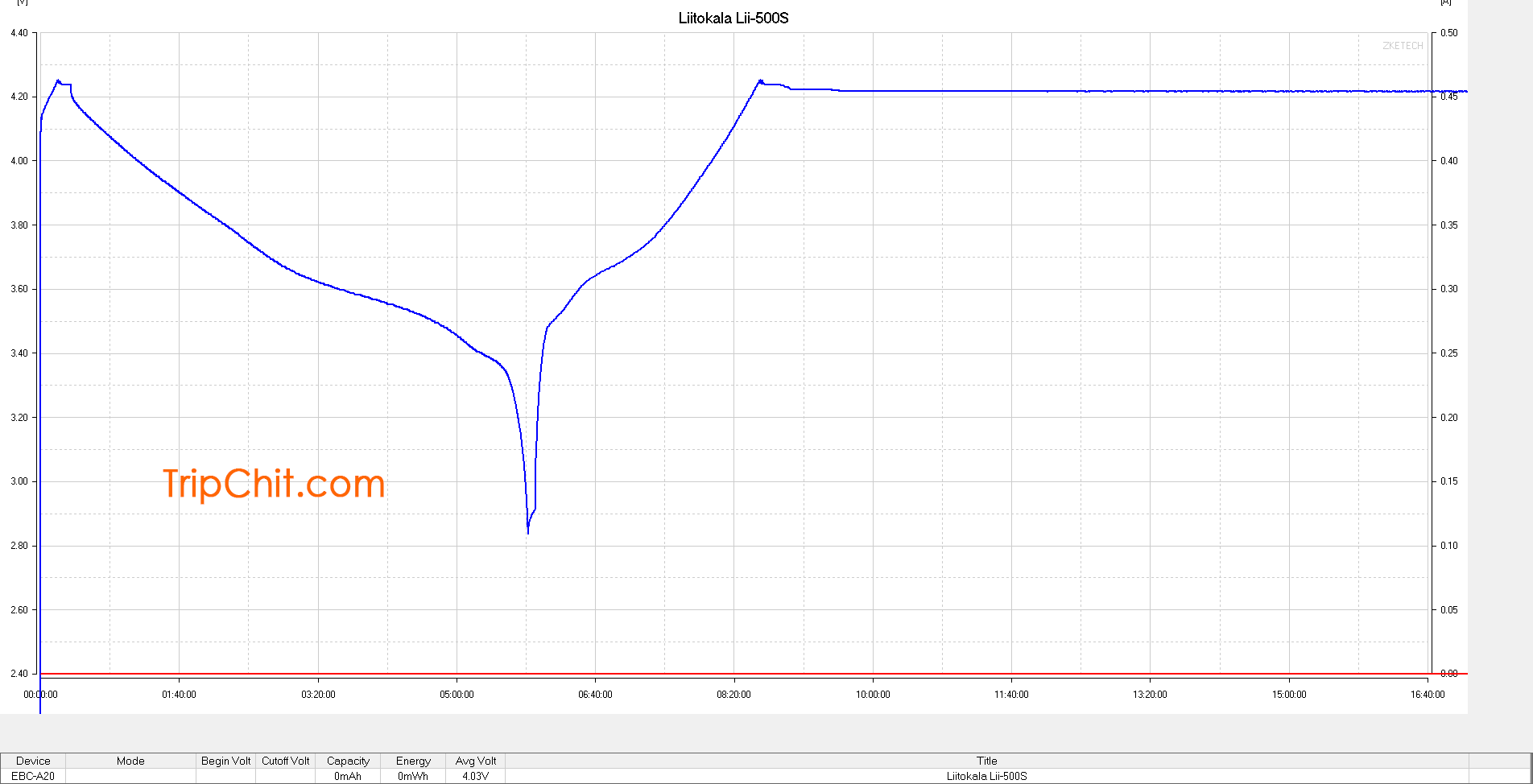
The Lii-VTC6 battery had been charged a couple of days earlier by this same device, and when I connected it to the tester I saw a voltage of 4.206 V.
Stage one: full charge at 1000 mA. Over a few minutes the Lii-500S raised the voltage to 4.231 V, after which it considered the battery charged. Meanwhile the charger's screen kept showing 4.20 V throughout that time. There's nothing wrong with charging batteries 0.74% above the nominal (manufacturers usually state a permissible excess of 0.03-0.05 V in their specifications), but I'd like to see the real voltage on the screen.
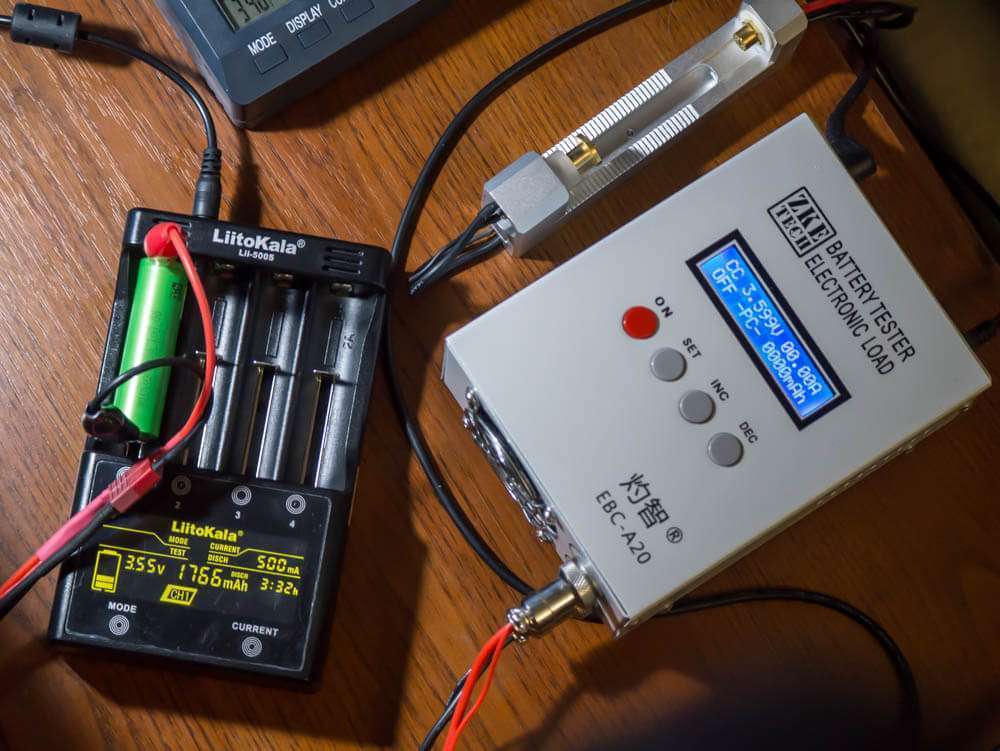
Stage two: full discharge. The Lii-500S discharges the battery at 500 mA and measures the discharge capacity. The discharge stopped at 2.817 V. I suspect the built-in voltmeter underreads the voltage. The photo above captures the moment of maximum discrepancy between the real value (3.599 V on the EBC-A20) and the Lii-500S screen reading (3.55 V), which supports this hypothesis.
Stage three: full charge at 1000 mA. The Lii-500S raises the voltage to 4.253 volts, then lowers the current and voltage until the battery voltage stabilizes at 4.208 V, and then holds it. Apparently these 0.008 volts are the real error of the charger's voltmeter, and the rest (discharge to 2.82 and the insignificant deviations of intermediate readings) is built into the program. We'll check that assumption on the next battery. Below is the curve the instrument recorded during this test cycle.
Liitokala Lii-500S: lithium battery No. 2
I discharged the Kedanone-VTC6 slightly in a flashlight beforehand.
Stage one: full charge at 1000 mA. The Lii-500S charged the battery from 4.09 V to 4.253 V, then began to discharge it. Apparently the charger has some algorithm inside that analyzes the battery, and it decided that this time the voltage should be raised to the maximum.
Stage two. The discharge ended at a voltage of 2.823 V.
Stage three. The Lii-500S charges the battery to 4.253 volts, then lowers the current, and the voltage stabilizes at 4.216 V; from then on the charger holds exactly this voltage.
When I realized the voltage differed from the first test, I tried putting a minimal load on this battery. When the voltage falls to 4.208, the charger switches charging on again, and after the load is removed the voltage rises back to 4.216 V. There's some logic to this, but it isn't quite clear to me.
I was thinking of ending the lithium testing at this point, but I want to understand whether the Lii-500S really tells apart batteries that allow charging to 4.25V in some way, or whether it's hard-coded in the software.
Liitokala Lii-500S: lithium battery No. 3
To check the algorithm I took a Samsung ICR19650-26H battery with code E13 (manufacture date January 3, 2014) and set a charging current of 500 mA. Because of its long service life, it simply can't hold a voltage up to 4.25. With classic charging (to 4.2V with a 100 mA cutoff current) its voltage stabilizes at 4.14 V.
The Lii-500S raised the voltage to 4.239 V, and the battery wouldn't accept more; the screen recorded 4.20 and the charging indicator was blinking. Over 15 minutes the current fell and the voltage dropped, and at the moment charging ended it had fallen to 4.223 volts. The battery is old, and that's the most it could take without noticeable harm to itself. After the "charge complete" light came on, the voltage kept falling and stabilized at 4.194 V. The charger held this voltage for 6 hours until I took the battery out. Note the end of the graph: as the voltage falls (the battery, remember, is tired), the charger immediately switches charging on. The more time passes, the more often the charger has to turn charging on.
Liitokala Lii-500S: charging a NiMH battery
The minimum charging current you can set is 500 mA. Accordingly, in TEST mode the discharge current will be 250 mA.
So, stage one. Charging "to full". Despite the charging voltage of 1.48 V given in the manual, the battery was charged to 1.549 V. A big plus is that the device showed a voltage close to the real one. When looking through the recorded readings, I noticed sawtooth segments of the graph repeating roughly every 6 minutes, reflecting fluctuations of the charging voltage with an amplitude of about 0.01 V. And the second thing: I didn't see the promised -ΔV on the graph. Charging simply stopped on reaching 1.549 V.
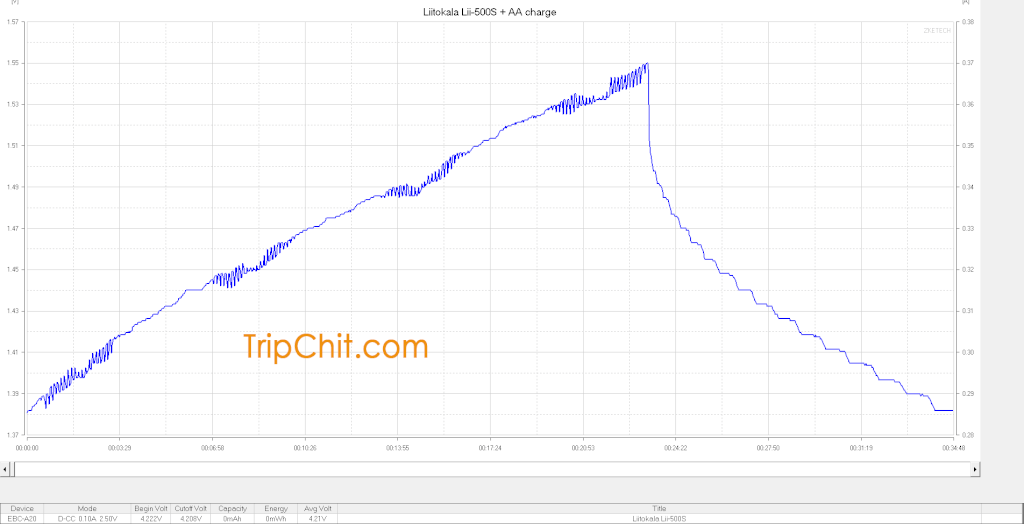
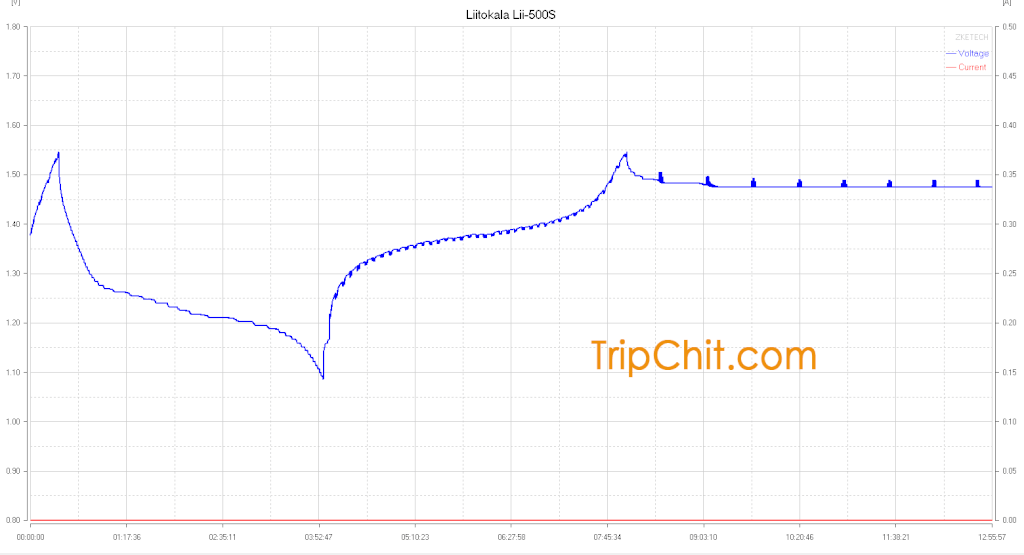
Stage number two. Discharging the battery at 250 mA. In theory, a nickel-metal-hydride battery is considered fully discharged at a voltage of 0.9 V. In practice the Lii-500S discharged the battery to 1.085 V. I don't understand why.
After a five-minute pause the device began charging.
Stage number three. Charging the battery at 500 mA. And again voltage jumps every five minutes. It feels like these pulsations are part of the voltage-measuring algorithm. For example, on the Opus BT-c3100 the NiMH charging graph has no straight sections at all; its algorithm is: apply current, switch off, measure the voltage at that moment, apply current again. Here, judging by the graph, voltage measurement happens not continuously but in series, at equal intervals.
And again, because of these jumps at the end of charging, I don't see a minus delta, but charging is interrupted at 1.547 V. Then the voltage falls to 1.475 V and is maintained by periodic series of short 1.49V pulses.
Liitokala Lii-500S: conclusion
The device is built very solidly, the slots are convenient, the display is excellent, the touch buttons work without complaint, and practically all cylindrical battery formats are supported.
The charging algorithm is this: when charging lithium batteries, a voltage of 4.25 V and the user-set current are applied. When the battery reaches 4.20 V, the current starts to fall. The terminal voltage rises to 4.25 and is then cut until it stabilizes, after which it's maintained by trickle charging. Many chargers do this, going by the voltage on the battery (periodically cutting the current and measuring the voltage at that moment) rather than by the device's terminals while charging.
What I dislike about the Liitokala Lii-500S's operating algorithm, first of all, is that when charging lithium batteries it doesn't show the real voltage (above 4.20 at the final stage of charging and below 4.20 after it stops). One could argue at length about the harm of a slight (+0.05 V) overcharge, and personally I don't think it will significantly shorten battery life; my complaint is precisely that the fact itself is hidden from the user.
As for charging nickel batteries: the display of real voltage is fine here, but I have complaints about the incomplete discharge (which rules out talk of proper nickel training in TEST mode), and I doubt the device tracks the real voltage drop at the end of charging (minus delta V). It feels as if the battery is charged using a lithium algorithm, only with a target of 1.55 V rather than 4.25 V.
So the Liitikala Lii-500S can be positioned as a device for working with lithium batteries, with the ability to charge nickel relatively decently. If, however, you mostly use nickel-chemistry batteries, take a look at the Opus.
The source data files (recorded tables of values in csv format) can be downloaded here.
I'll be glad to hear your comments and remarks.