What bulbs are in the Shineray X-Trail 250 headlight
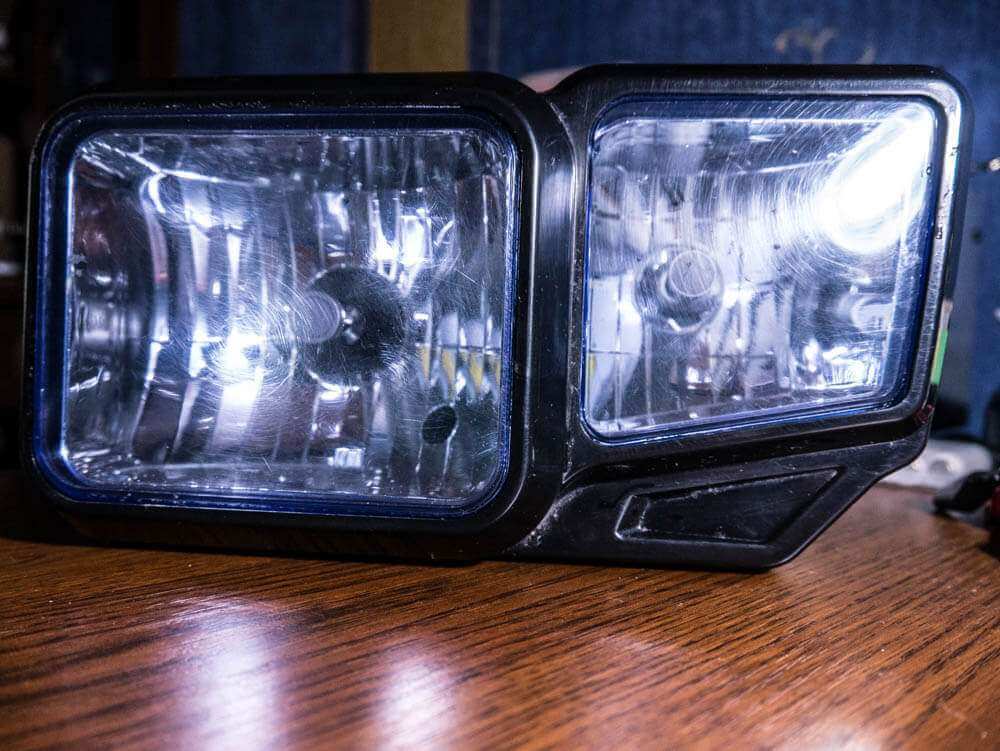
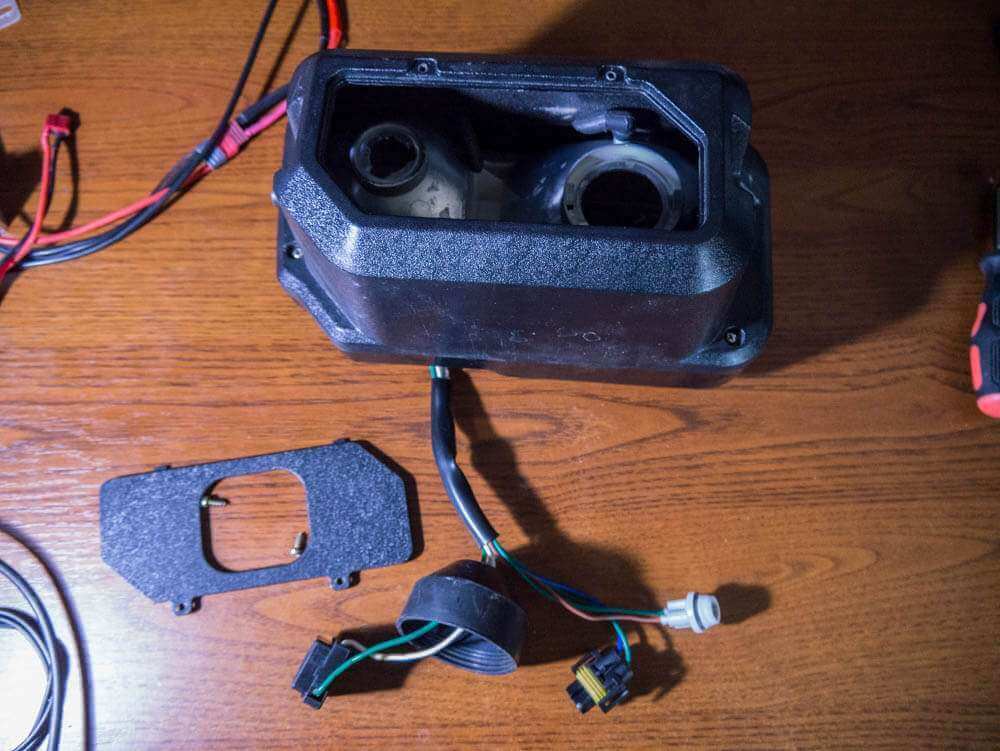
I asked this question on forums and asked the official Shineray importer. I asked at the official service station and wrote on the website through the feedback form. I even asked on Taobao, among Chinese sellers of Shineray headlights. No luck, nobody knows. The headlight is sold with the bulbs already installed, and the bulb catalog, as separate spare parts, doesn't list it. An employee told me that "one of the bulbs seems to be HS1". That struck me as complete nonsense, because the high and low beam bulbs in the Shineray X-trail headlight sit in different reflectors and work separately, while an HS1 is a bulb with two filaments, high+low. Tired of searching the web for an answer, I took the headlight off the motorcycle (all it takes is undoing a couple of hex bolts near the turn signals), brought it home and took it apart. And the Chinese engineers surprised me!
One of the bulbs in the Shineray X-trail headlight really is an HS1 35/35W, and only the low beam is wired up in it. The other bulb is an H11 55W, and it's installed in a completely unsuitable reflector. On top of that, the headlight also has a W5W bulb as a position light.
Why the Shineray X-Trail 250 headlight needs modifying
Because the Shineray X-trail motorcycle has no headlight to speak of out of the box. Well, sort of. If you treat the Shineray X-trail as an enduro bike and ride through forests and fields with no oncoming traffic and speeds under 50, the light is enough. But the moment you get on a highway, it becomes clear you have no light. No low beam, because a single 35W bulb lights nothing on the highway, and no high beam, because the H11 bulb, despite its 55 watts, throws a narrow beam toward the oncoming lane.
On my very first night ride I had to ride on low beam, constantly holding the "flash high beam" button down with a finger. With both lights on the glow was more or less decent, but I reached my destination with a drained battery. Apparently the generator isn't designed for a constant load of 95+ watts (let's not forget the 5W position light, which is always on). I had to plan the ride back so I'd either get home in daylight or stick to lit streets.
What made the Chinese engineers put this crazy headlight on an otherwise excellent motorcycle, and in such a configuration at that? I think it's the usual cost cutting. I suspect the headlight was originally designed for a different bulb configuration (and was in fact a left-side headlight from a quad or buggy, not a motorcycle). Perhaps the low/high beam was supposed to be an H4 bulb, and the second unit was meant for an H8 fog light. And there's also an unused sector under the "high beam"; apparently a turn signal was supposed to go there. Either way, if you plan to ride at night, you have to do something about the light.
Installing LED bulbs in the Shineray X-Trail 250 headlight
After studying the headlight and wiring it became clear that everything needs to be redone the way it was originally intended. Low and high beam should be handled by a single HS1 bulb, just a brighter one. The second "high beam" can be kept too, but the useless 55-watt halogen should be swapped for a more humane 15-watt LED bulb. That way, if the low beam has an HS1 35/35 halogen, the total of 35+15 won't exceed the 55W that the high beam drew originally.
On my previous motorcycle I tested an excellent HS1 LED bulb, so I ordered the same one here. And while the right bulb is on its way, I bought whatever LED bulbs were in stock at the nearest auto shop.
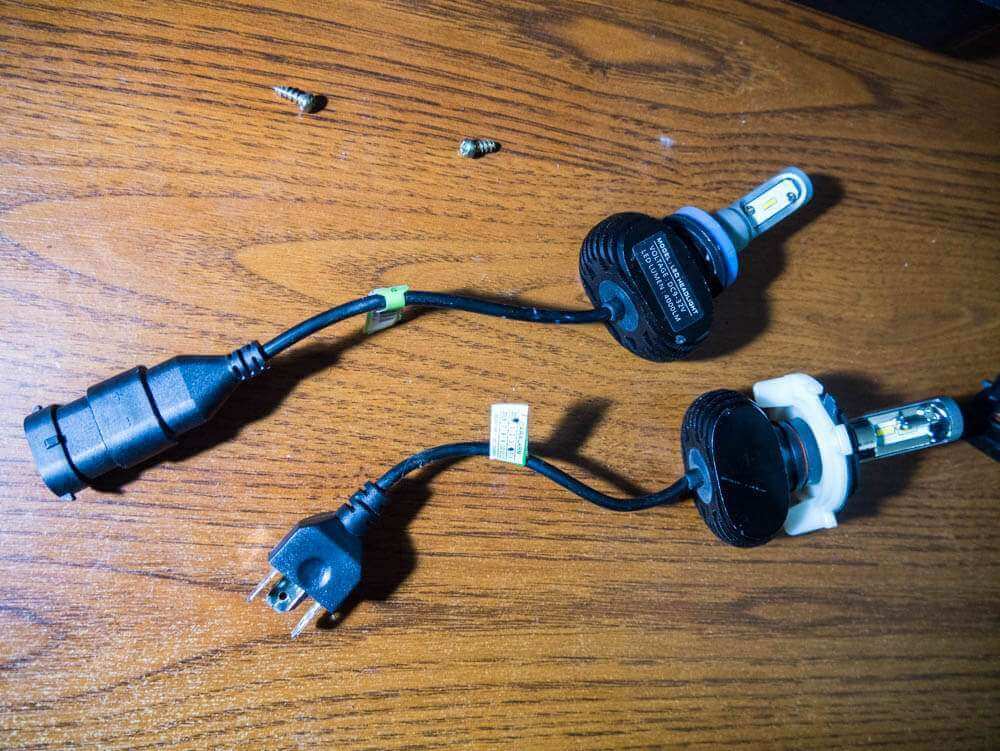
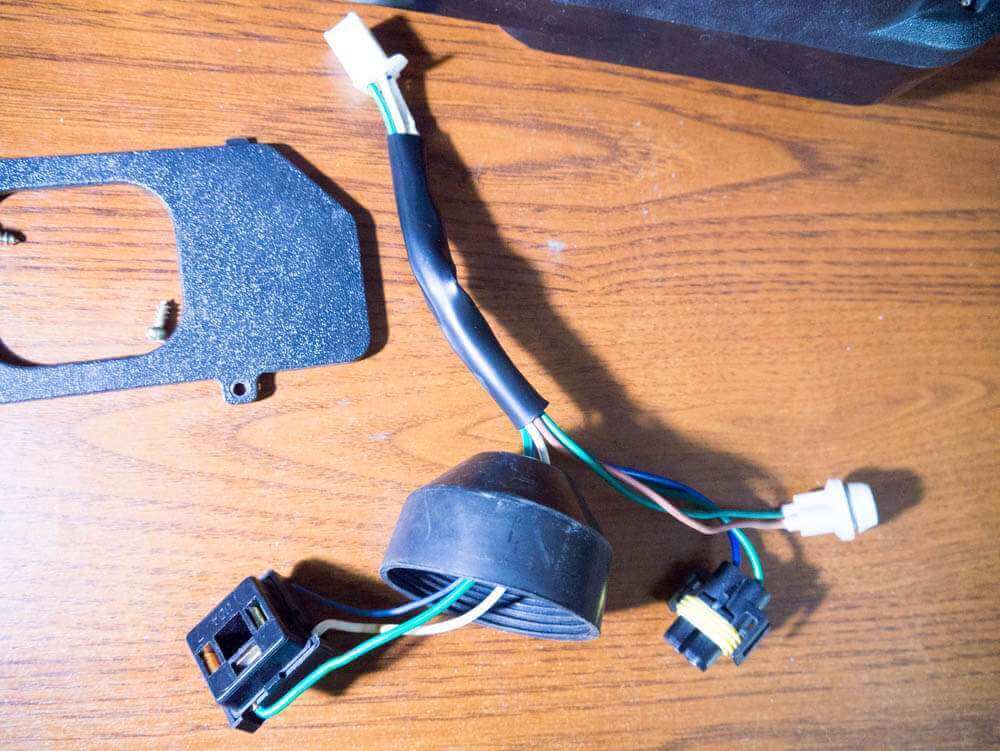
The bulbs are sorted. But besides the bulbs, the wiring needs redoing, because no contact is connected to the high beam terminal of the HS1 bulb. So we'll need a three-wire connector, preferably ceramic, like this one, and a soldering iron to solder a wire to the high beam terminal. Four contacts come to the plug: green is ground, brown is the position light, white is low beam and blue is high beam. I soldered the blue wire from the HS1 connector to the blue wire that ran to the H11 connector and insulated it with white heat-shrink. This is how it turned out:
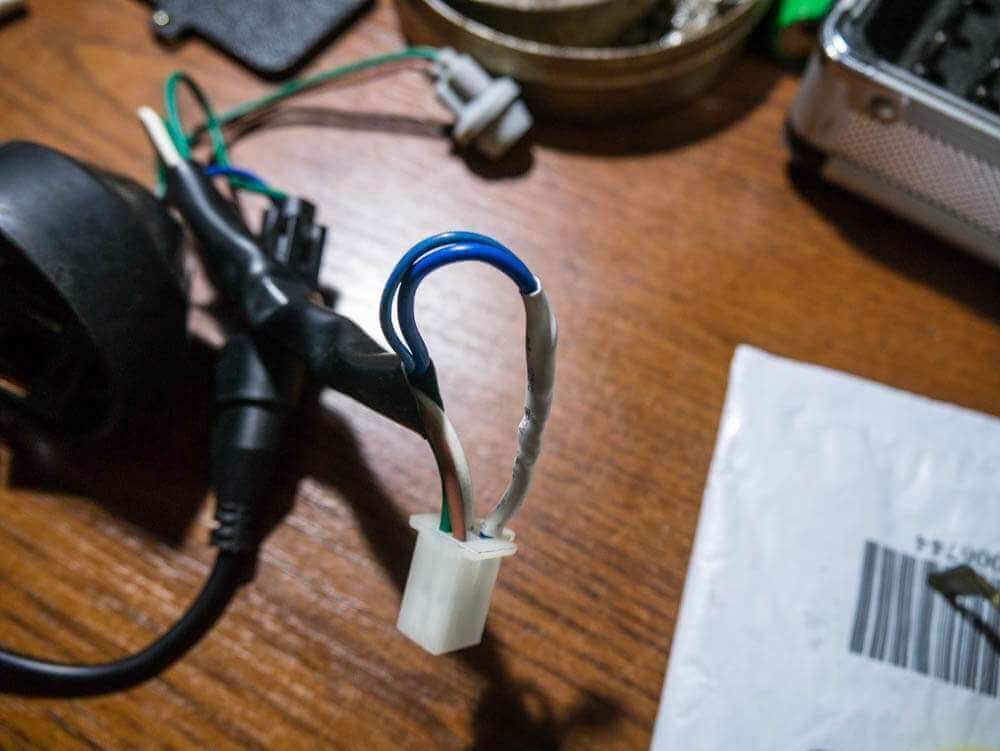
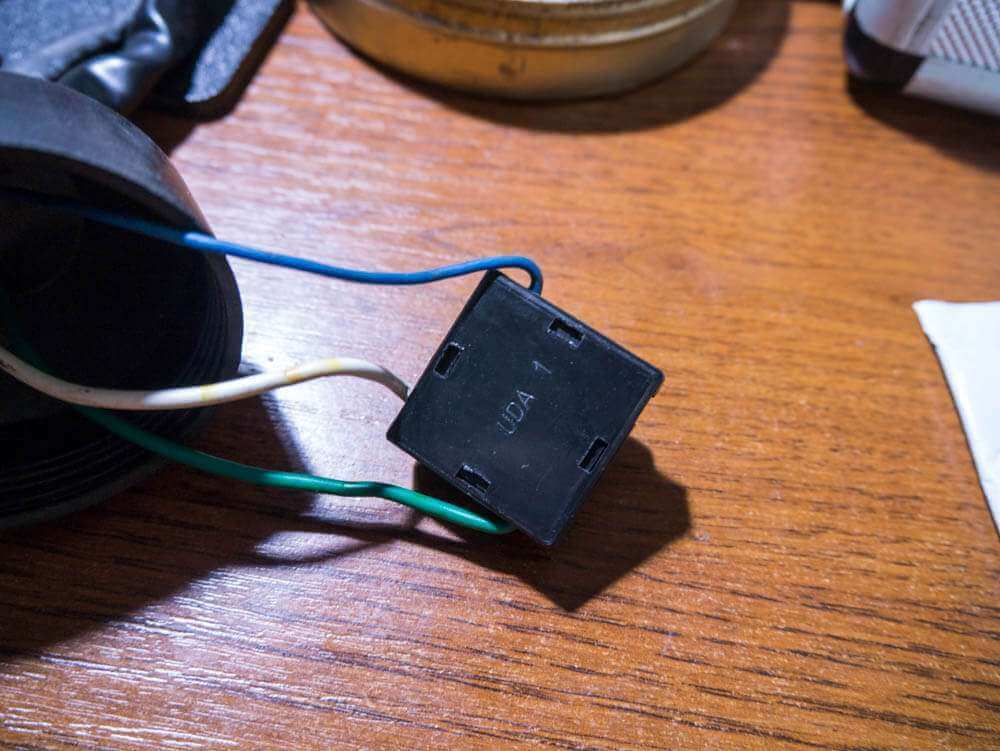
The whole procedure took about a minute and a half. Soldering iron aside. Now I'll install the bulbs and measure the power.
What do we get after modifying the headlight?
To begin with, I'll connect the headlight to a lab power supply. The voltage in the onboard network of a running motorcycle is about 14.7 volts, so that's roughly what we'll set.
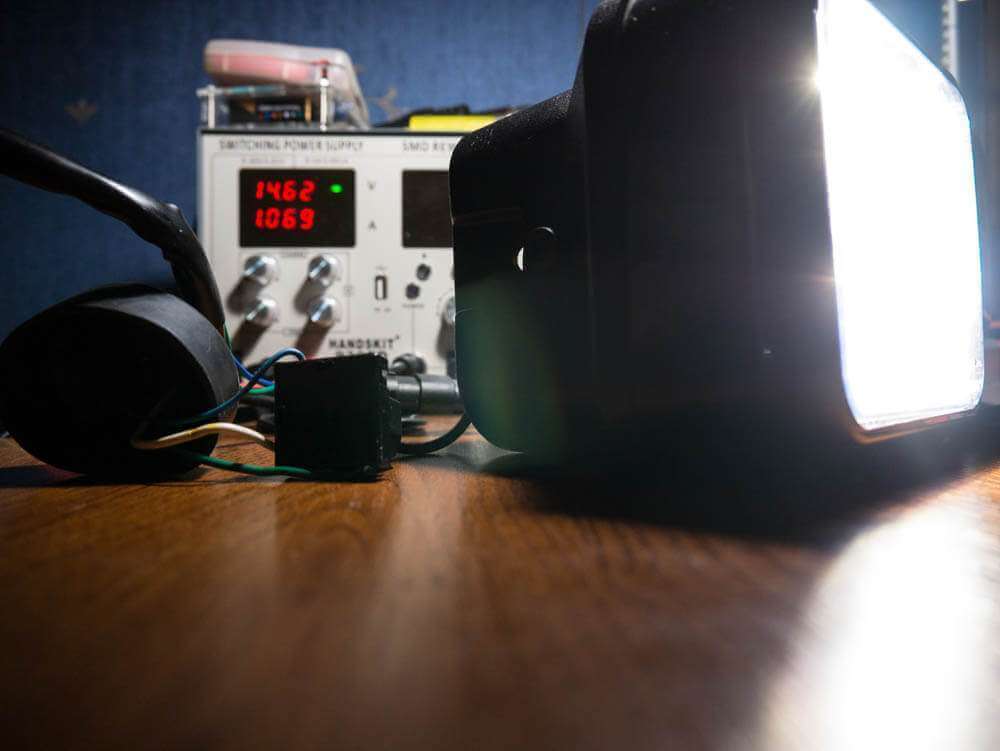
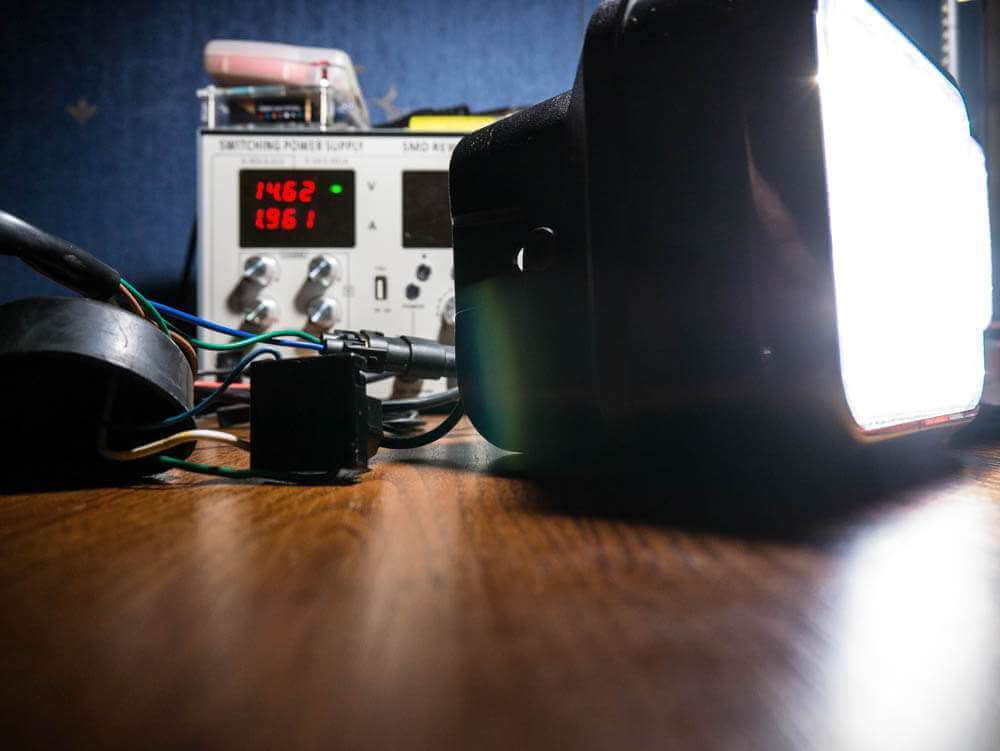
With the low beam on the current is about 1A, on high beam (both bulbs working) a little under 2A. So the low beam power is now 15.6W instead of 35W, and the high beam power is 28.55W instead of 55W. The generator will have it twice as easy, which is great.
For the full picture, "before" and "after" photos are missing, but I left the old bulbs in the garage, so there won't be comparison photos. I'll go out this evening and photograph the result, and until then, all the best!