The XTAR VC4S is a device I couldn't walk past, and now we're going to test it. First, a brief description. Distinguishing features:
Like the other products I've tested, this device was bought on AliExpress with my own money. I chose the version with a power supply, which is an Xtar 18W DBS15Q USB charger. The box also contains a Mini-USB 3.0 / 2.5A cable and a branded faux-leather pouch.
I want to single out the Xtar 18W DBS15Q USB charger. It's a wonderful device which, with a stated 5V/3A, 9V/2A and 12V/1.5A, easily holds 3.3A at five volts, 2.5A at nine and 1.8A at twelve, so in fact instead of 18W we get a 22.5W charger. That means in normal operation it runs with a good power reserve and doesn't overheat, unlike no-name "QC3.0" chargers at three dollars apiece.
The operating modes are selected with the Mode button, and in each mode the Disp button picks the display variant.
We check charging of nickel AA and AAA batteries (these will be relatively new ZMI Zi5 1700 and PKCell 850 cells with a couple of charge/discharge cycles, plus a thoroughly worn-out Sanyo Eneloop Pro made in 2012), and charging of lithium batteries (the test subjects are a Samsung 25R and a Chinese GTL EvreFire).
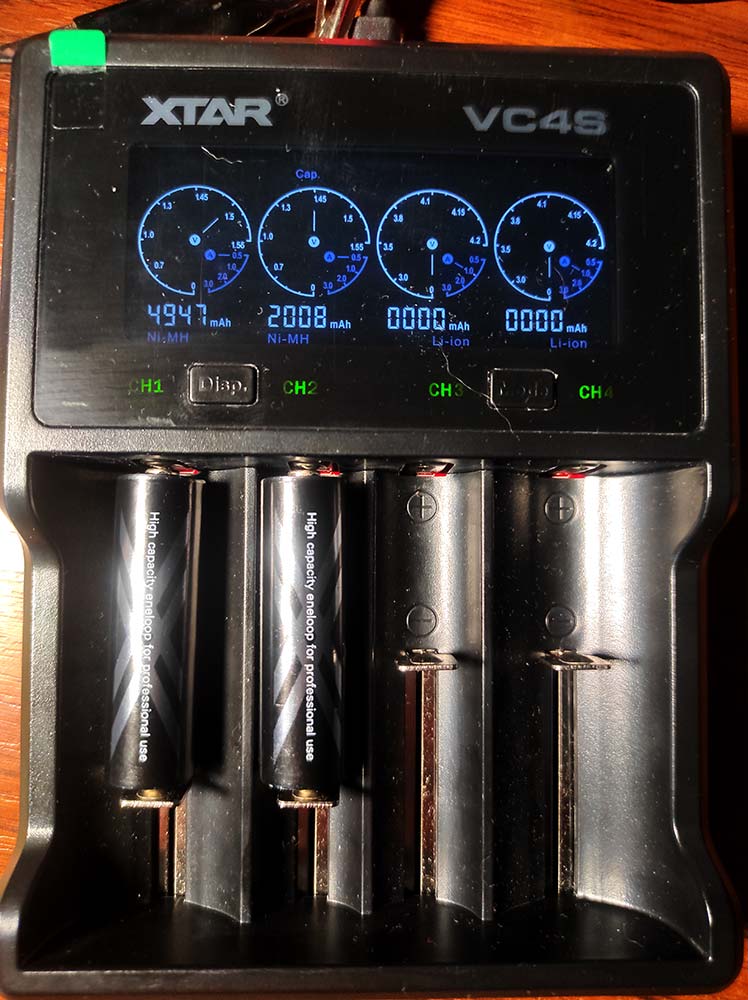
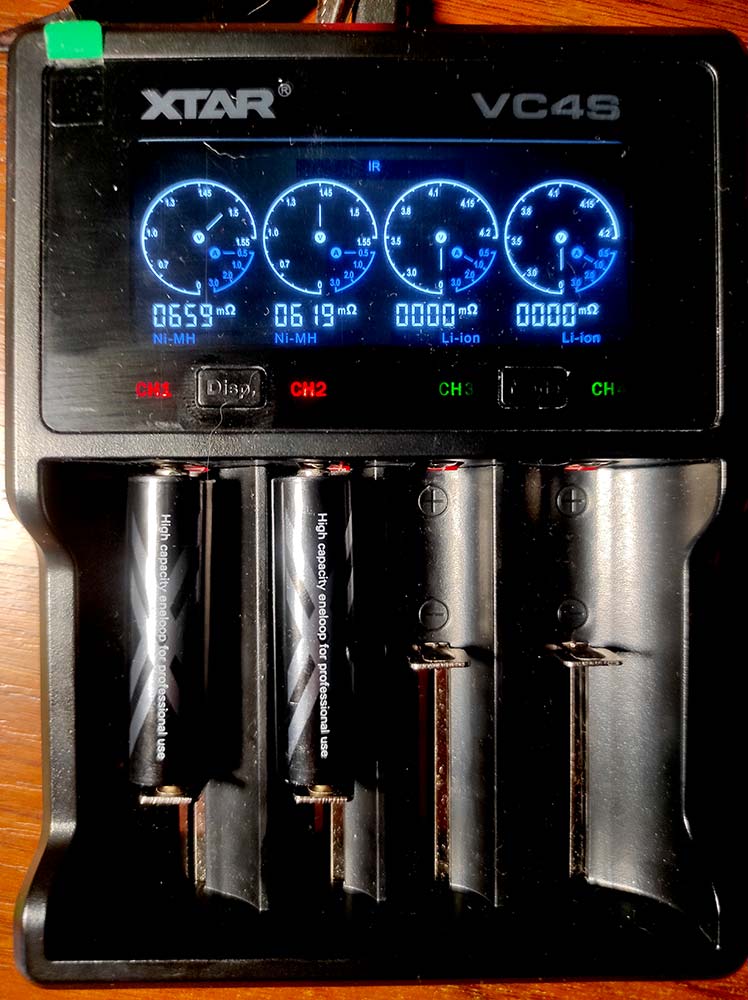
By the way, I hadn't planned to test the Eneloop Pro batteries; I just wanted to charge them for use in a multimeter. They're old, but they've kept their capacity. Their internal resistance, though, was quite high, around 600 mΩ, which is perfectly adequate for low-drain devices. While charging this pair I saw an interesting picture. One of them took its 2008 mAh and switched off. The charger pushed almost 5000 mAh into the second before it cut off charging. As a result, the voltage of the first was 1.45 V, and of the second almost 1.52 V. In fairness, after such a marathon the second battery's internal resistance dropped by 100 mΩ, but at the next charge the picture repeated: the first battery switched off, while the second charged for twenty hours until I took pity and cut the charge.
From this we can draw a first conclusion: at low currents (and those are exactly the currents the XTAR VC4S uses for batteries with high IR), our device isn't very good at catching -dV.
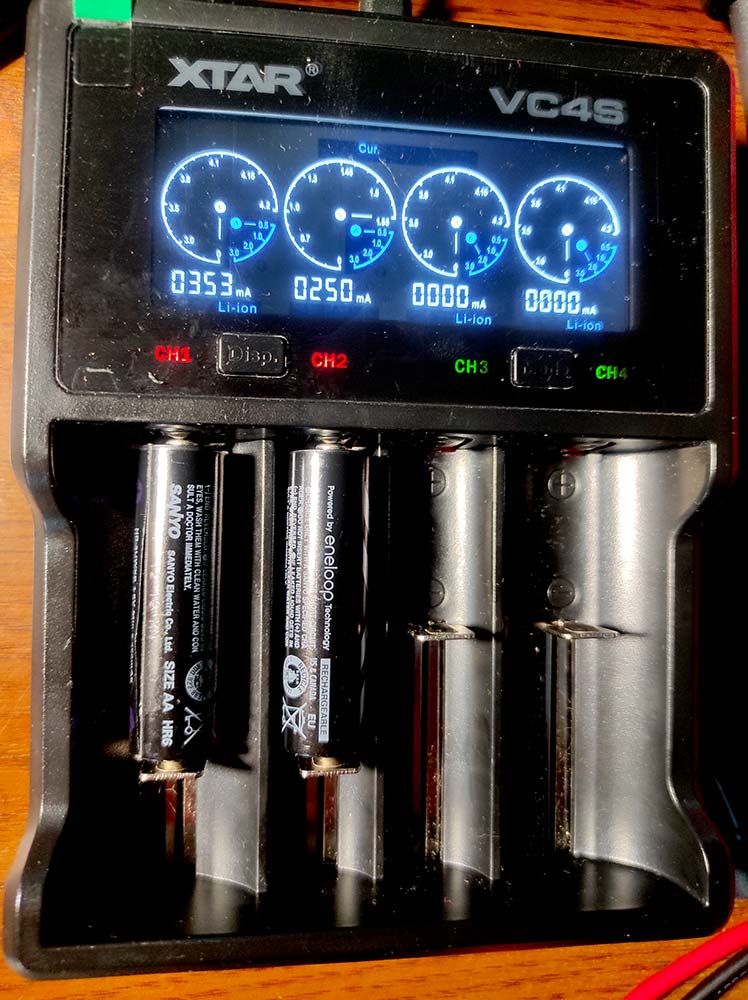
It gets even more fun. When I reinserted the already-charged batteries, the one whose voltage was above 1.5V was identified by the device as lithium, and it started charging it at 4.2 V and 350 mA. Clearly this is an abnormal situation, and a sane person wouldn't recharge freshly charged cells; it happened by accident, as I was adjusting the batteries for a photo and accidentally knocked one out, and when I was taking the picture I saw LiIon mode lit on the screen. But in principle the situation is possible, and I find it hard to imagine how a nickel battery would behave in this mode.
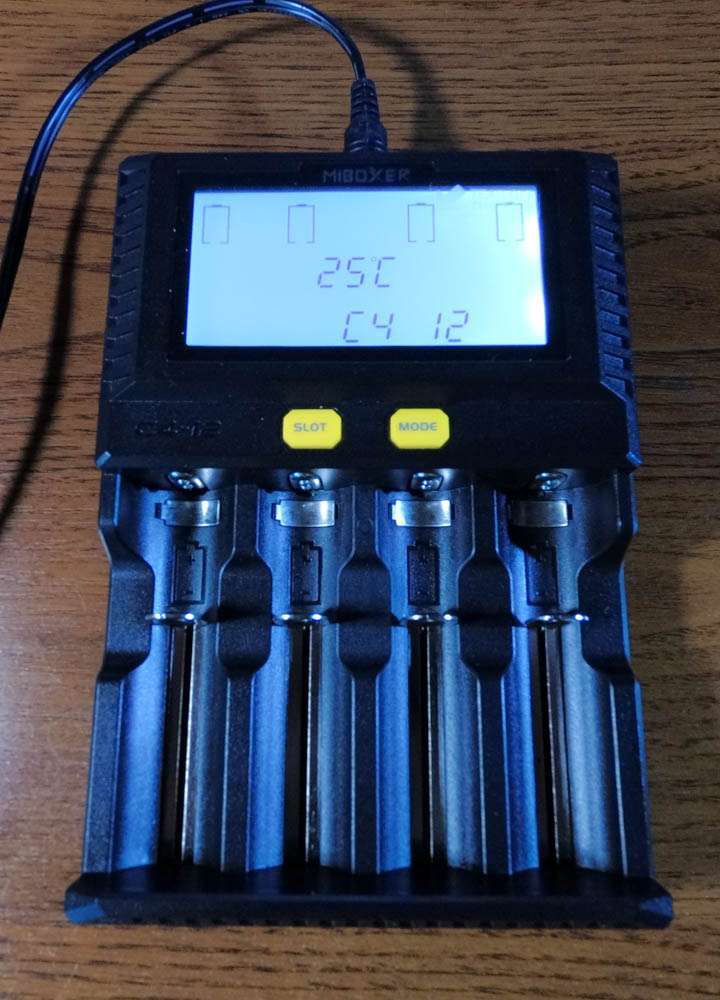
The first thing that surprised and pleased me was the exact match between the current on the measuring instrument and on the device's screen. When the multimeter shows 561 mA, the XTAR VC4S screen shows exactly the same value. For its honesty, the XTAR VC4S gets a big plus. It's pleasant and informative, because, for example, the Miboxer C4-12 or Liitokala Lii-500S show the preset current on screen rather than the real one.
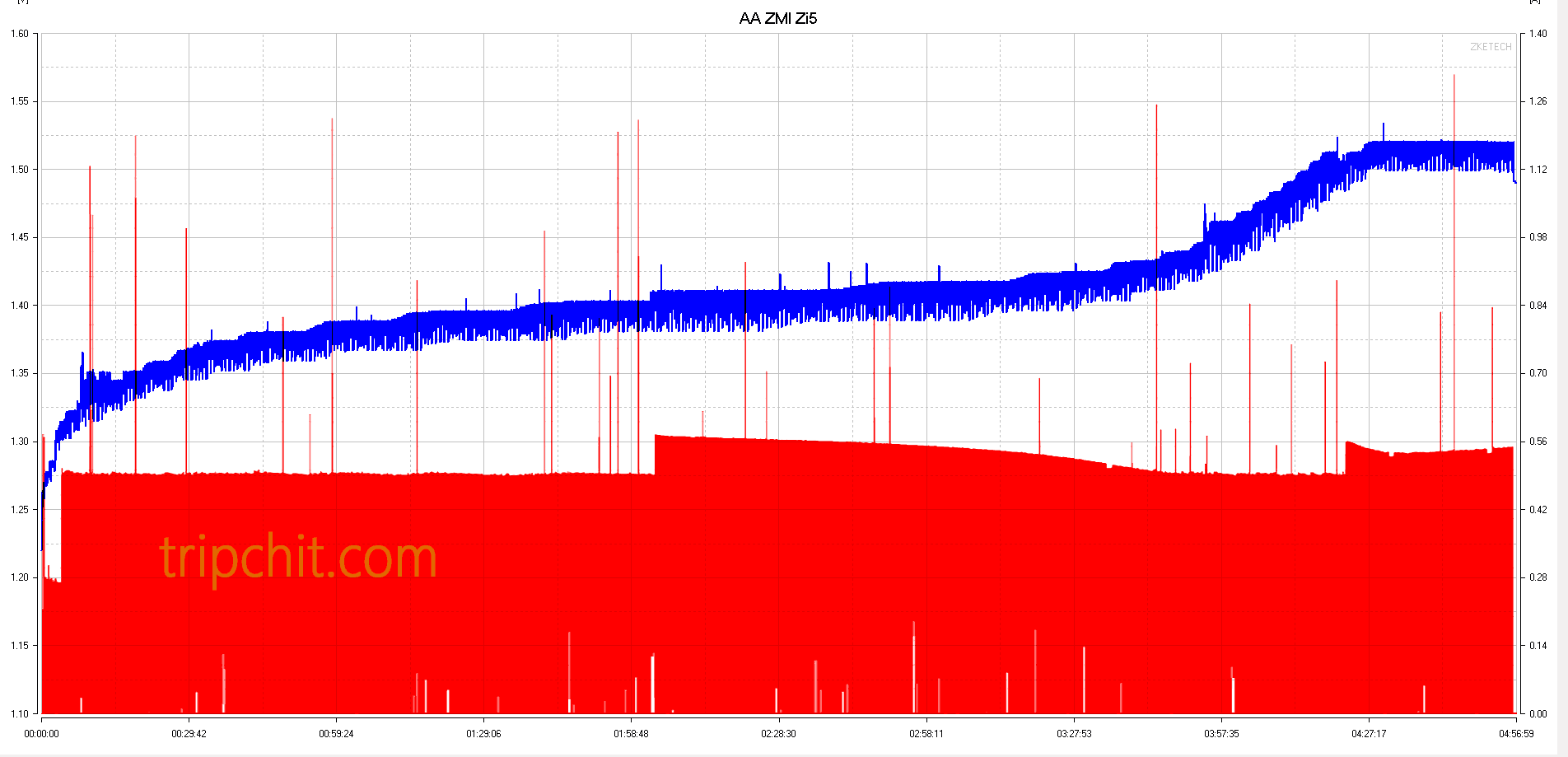
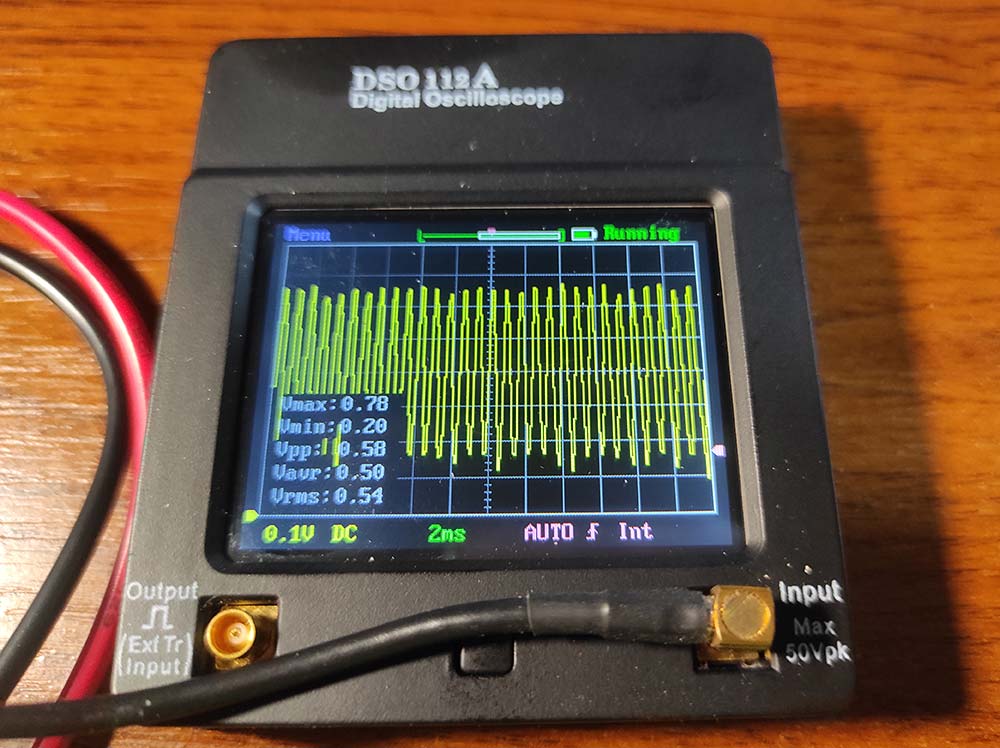
The second point: the current is pulsed, like on the Opus BT-C3100 V2.2. I've heard this isn't very good for the battery; I don't know, some of my batteries have been working with an Opus charger for over 8 years and haven't had any particular problems. I do know one thing: with pulsed current, charging time grows. In theory, charging at 500 mA, a 1700 mAh battery should charge in 1700/500=3.4 hours. In practice the device stops every second to measure the battery voltage, and charging time grows by the length of that stop each time, ending up at 5 hours rather than 3.4.
Charging the 1700 mAh battery took 5 hours. On the graph, around 4:20 the end of charge is already visible, and the device keeps charging the battery without lowering the current, waiting for -dV. The battery under test is new, 500 mA is a perfectly normal current for it, and at the start of the "step" it was as cold as at the beginning of charging. After a while the battery's temperature began to rise. When the temperature went up by a couple of degrees, the device saw -dV and stopped charging. That's good: the battery neither boiled nor heated up.
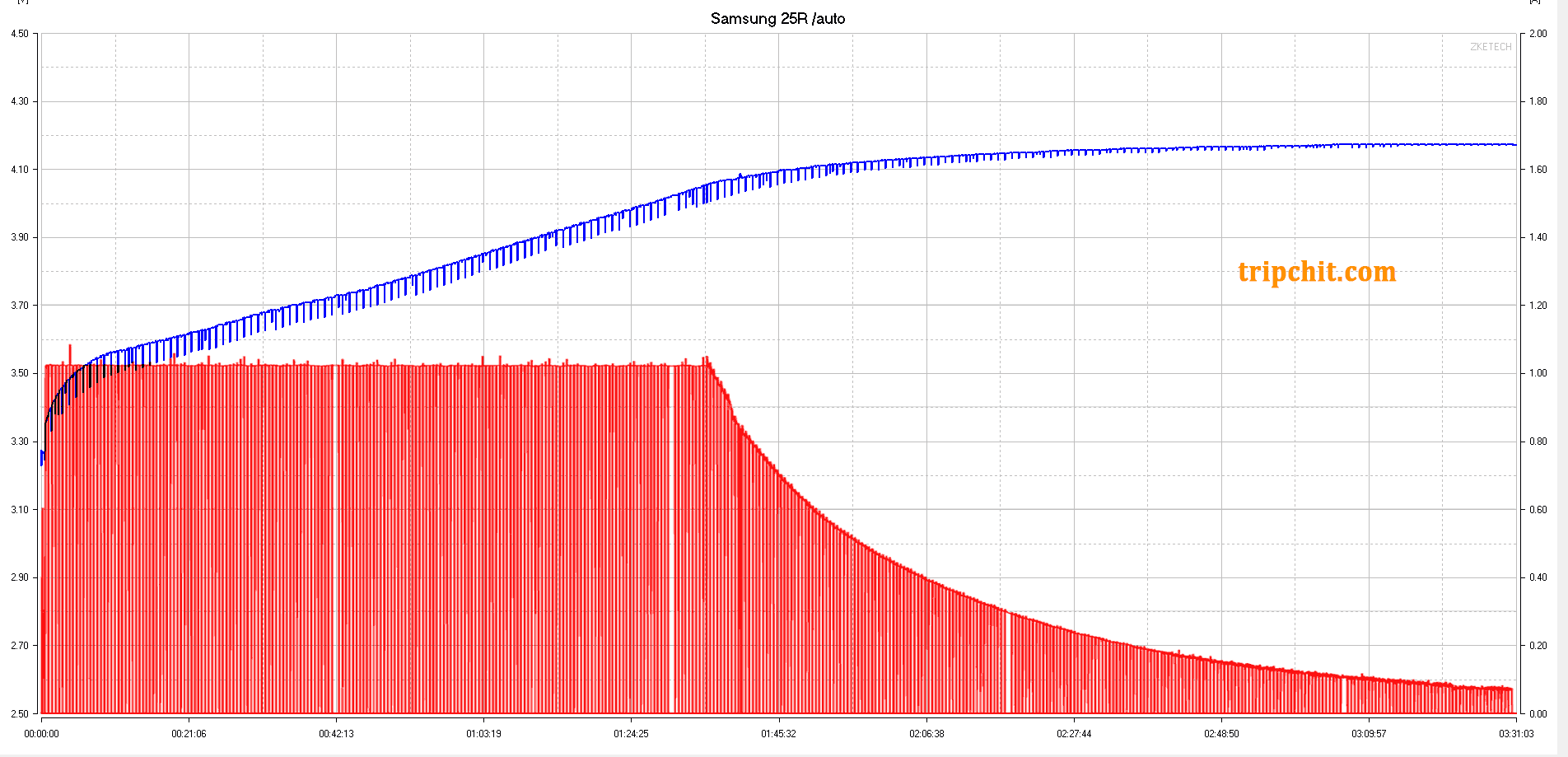
A Samsung INR18650 25R lithium battery in good condition is placed in the first slot. The XTAR VC4S showed an internal resistance of 61 mΩ and set a charging current of 1 A (992 mA in reality).
The charging mode is the standard CC/CV, with no notable current ripple, and the device's display and the measured values almost match. The final battery voltage is 4.185 V, current 0.135 A.
To check the charger's maximum capabilities I used a new Liitokala Lii-51S lithium battery in the first slot. The measured internal resistance is 18 mΩ, and the device set a current of 3A. At the start of the cycle the device's display shows 2998 mA, while the real current is 2941 mA. The discrepancy is minimal, and again there's that pleasant feeling of "they didn't cheat us". During charging, the gap between the real current and what the device shows doesn't exceed 80 mA.
GRAD mode is originally meant for measuring battery capacity: during the process it shows the capacity received (or delivered) at the current stage, and after it ends it shows the capacity delivered during the discharge stage. With lithium cells, GRAD mode lets you find out the remaining capacity, and NiMH cells can be given a try at training in this mode.
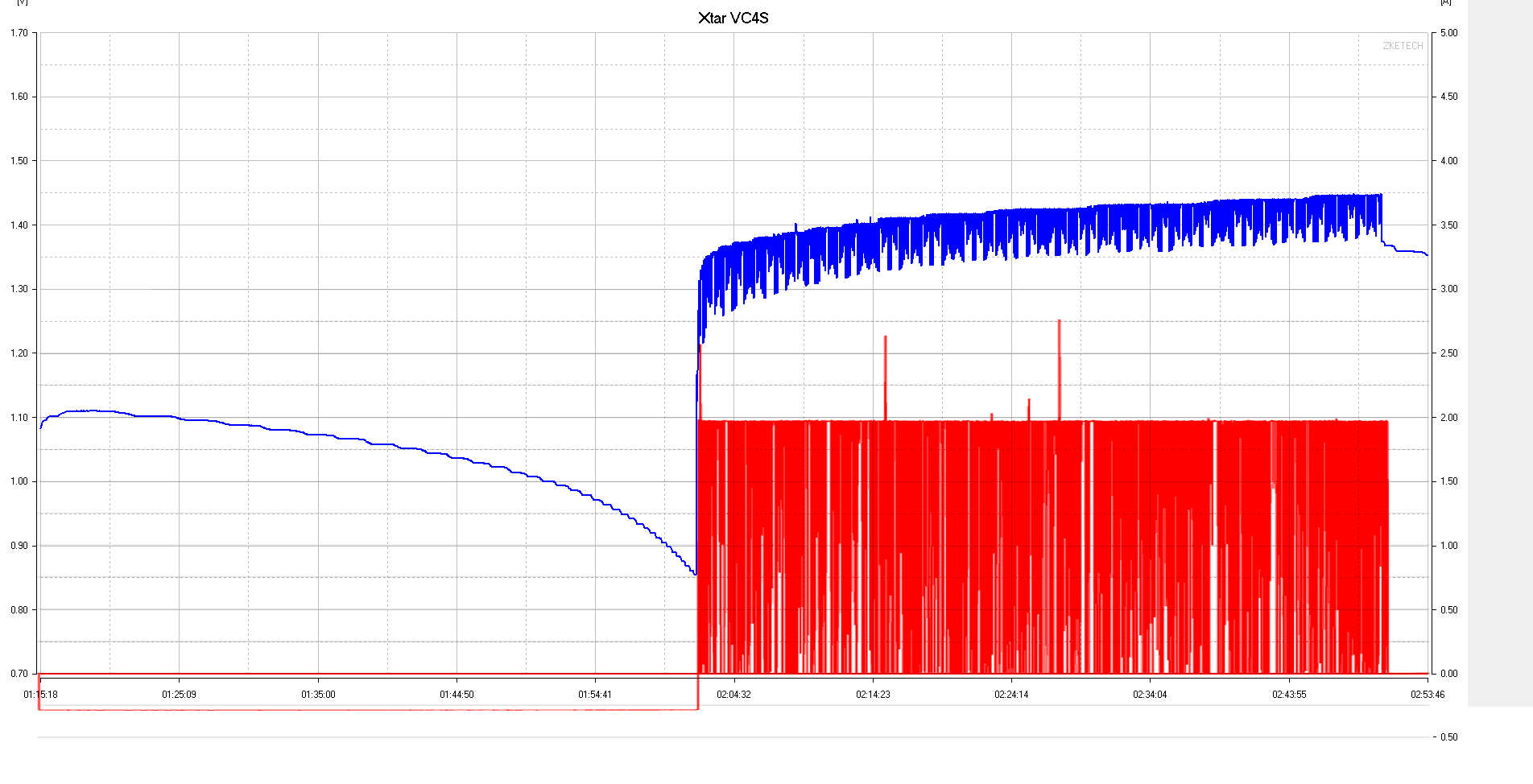
Considering that discharge is done at a constant 0.3 mAh and that the total running time of this cycle can exceed a day, I sped up the first and third stages by installing a new, pre-charged battery with an IR of 17 mΩ, and when the second stage started, I sped that up too by connecting an extra 1A load to the battery. The load was neatly switched off by the cat when 1.083 V was reached, for which many thanks, although I did get nervous. On the graph this moment is visible at the very beginning, where the voltage rises despite the 0.3A load.
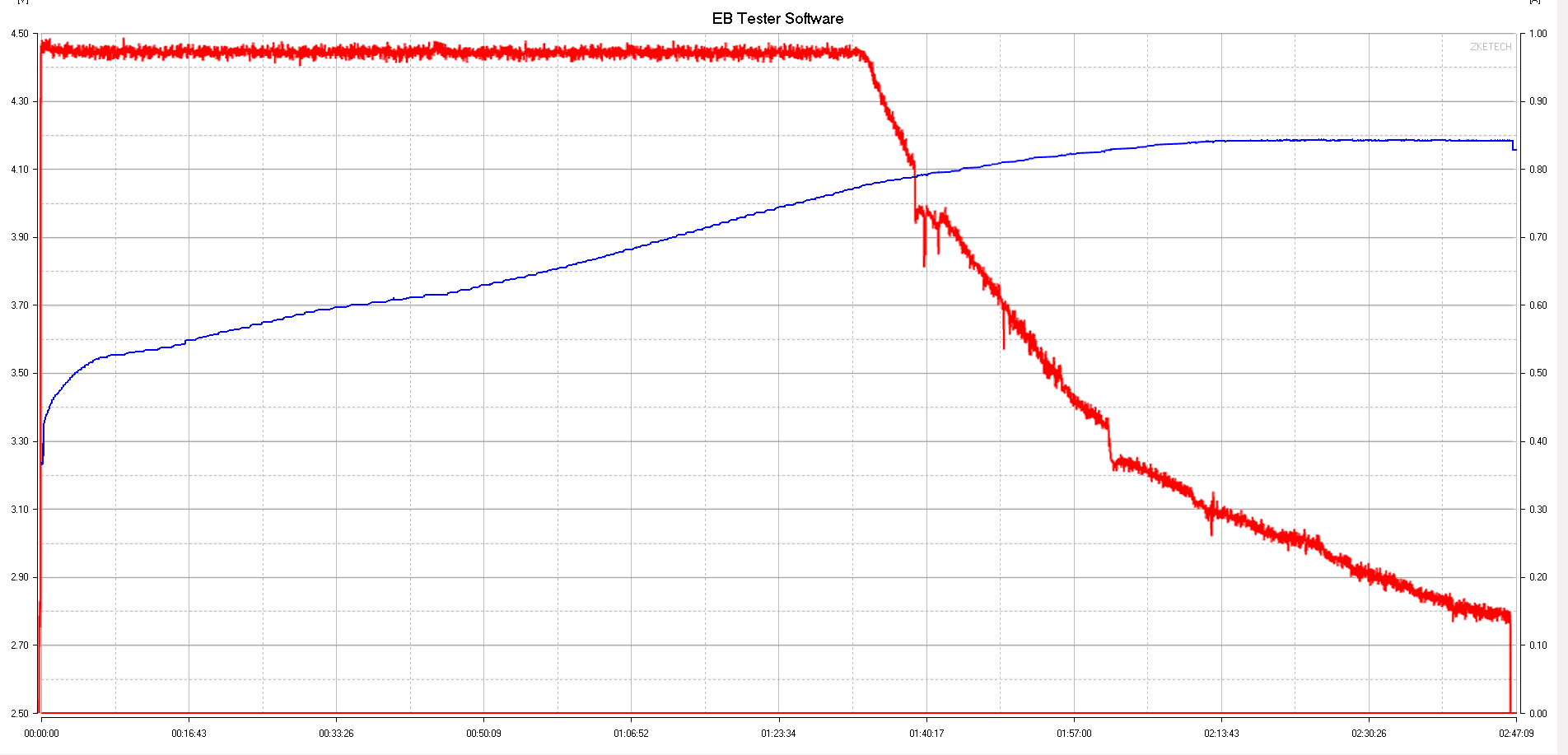
Since the beginning of this test isn't of interest, I'll show the graph after the external load was disconnected: the end of the discharge cycle, when only the charger is working, with no external load, and the charge that follows.
The battery discharges to 0.86 V, and charging starts right away. Considering that the battery is brand new and has a low internal resistance, the device sets a charging current of 2 amps. Because of the high current the battery starts heating up fairly fast, so -dV appears already at 1.45 volts, and the device cuts the charge.
Well, you can't call that a proper training. The discharge is fine (although I'd prefer not to discharge a nickel battery below 0.9 V), but the charge that follows at two amps can hardly be called "training". Then again, with charging like this a new battery will quickly wear out, its IR will rise, and the device will start charging it with gentler currents, which will extend its life somewhat.
A very contradictory device. The big plus is fairly accurate IR measurement and honest display of current and voltage in all modes. The minus is the operating algorithms. With lithium batteries a slight undercharge only adds to their life, but errors when working with nickel-chemistry batteries can quickly ruin them. And here the "intelligence" of our "smart charger" can become a negative: because of the high IR of worn Eneloop Pro batteries the device lowers the current, and because of their high capacity the current isn't enough to raise the battery's temperature and cause the -dV voltage drop that serves as the signal to end charging. And a subsequent attempt to charge a nickel battery with the lithium algorithm up to 4.2 volts could lead to an even sadder result.
To sum up: the device can be used with new, good-quality batteries, which will soon stop being new and good-quality, and you need to keep a close eye on its work. I'd also single out the awful dial indicators, which make it inconvenient to monitor operation; I don't understand what stopped the manufacturer from making normal digital indicators.
Since the device doesn't let you control the charging process, I can't recommend it to pros. And it's hard to monitor the process because of the indicators: you can comfortably read either the current or the internal resistance shown as numbers. The dial readings aren't obvious.
As an automatic device to "give to your parents", it isn't suitable either.
On the other hand, I can't bring myself to call this device bad: it's well and beautifully made and shows honest numbers. All in all, it's for enthusiasts. If you like its futuristic design, I won't talk you out of it, go ahead and buy.
Прокомментируйте: