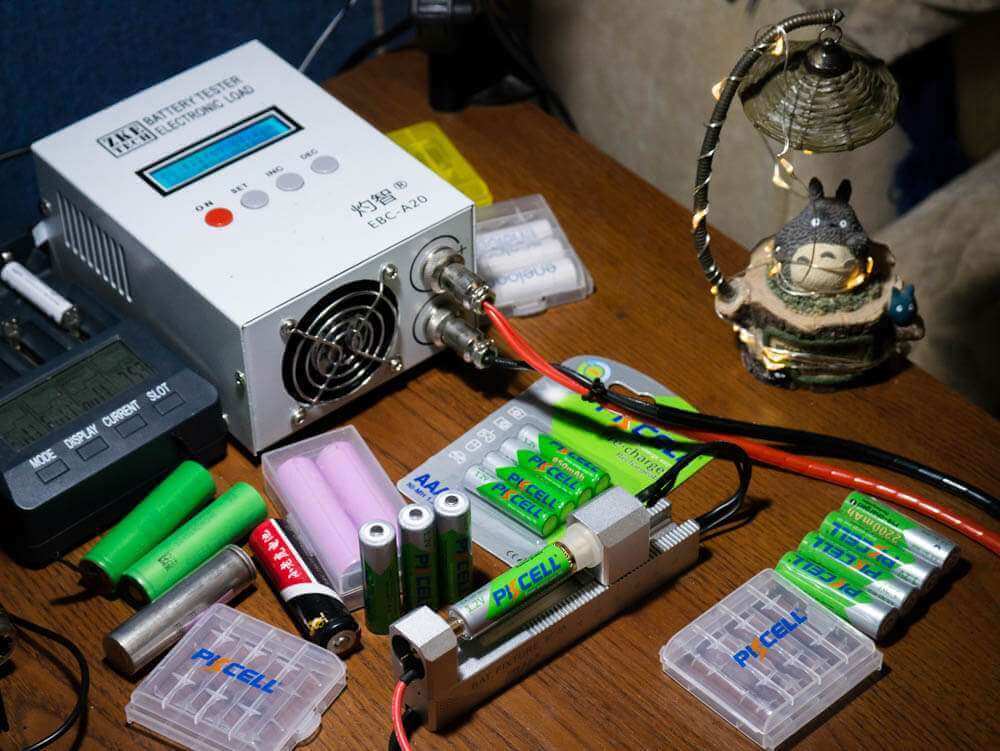
I finally have time not just to test the PKCell AA 2200 Ready to Use batteries but to write the results up. I ordered the batteries from the Pkcell Official Store on AliExpress, for myself, to replace my GS Uyasa LSD cells, which had served 9 years and were thoroughly tired. So, here's what we have:
The measured internal resistance of the batteries was 61-62 mΩ. I find it hard to believe they can sustain 3C discharge, but we'll check.
To begin with, I want to find out how ready for use the "Ready to Use" batteries really are, that is, how much charge they have left after factory charging, and how the characteristics of batteries within one batch differ. The longest procedure lies ahead: we'll discharge the batteries one by one at 220 mA.
Discharged at 0.1C (0.22 A) to 0.9V (the standard voltage at which NiMH batteries are considered fully discharged), the PKCell 2200 showed the following results:
So the characteristics of four batteries from one pack have a spread of about 3%. That's a good result. However, even 1695 mAh is only 77% of the stated 2200 mAh. There may be several reasons:
Unfortunately, the manufacture date isn't given on the packaging. But if they were made more than a year ago, 77% is a perfectly normal value. As a reminder, the manufacturer declares 80% of charge after one year of storage.
From the graph you can tell that discharging the batteries down to 0.9 V doesn't matter, because from 1 V the discharge curve plunges even under a 0.1C load, so for the following measurements I'll stop at 1 volt. On the other hand, a "shelf" is clearly visible on the graph: the span from 1.27 V to 1.2 V takes up more than 70% of the curve, which indicates a fairly high voltage during discharge, and that's good.
When the batteries were discharged at 500 mA, the curves (and values) matched almost completely:
So the difference between the values was about 0.1%, which is an excellent result. The delivered capacity is ~15mAh below the stated one, but these batteries had been through only one charge-discharge cycle before the test. After training their capacity will rise to nominal, as the results of the following tests show.
I discharged this pair of batteries at 1A. The figures obtained:
The capacity is on par with Eneloop under the same conditions, but doesn't reach the stated one. How come? It's very simple.
We're testing the batteries "out of the box". Apparently they sat in a warehouse for quite a while (which their initial charge level also suggests).
The next pair has one more discharge-charge cycle behind it; we'll test it at 2 amps and everything will become clear.
The results of this stage surprised me greatly, because the load was higher and the results better than in the previous test. As a reminder, these were the batteries that had previously gone through the 500mA test. Apparently the discharge and subsequent low-current charge served as training for this pair, and when tested at 2000 mA they showed a better result than the earlier ones, which were first discharged "out of the box" and then charged, with no training cycles at all. So, the results obtained:
A deviation of about one and a half percent, a very good result. Most interesting of all, even under such a load the batteries didn't heat above room temperature. I hadn't planned to test these batteries at more than 2A, but since everything is going so well, let's check what result the PKCell batteries show at three amps.
PKCell batteries keep surprising. From use I knew they were good, but I hadn't run proper tests. The result of discharging the batteries at 3 amps (3000 mA):
Even Eneloop at 3A delivers only ~1600 mAh, and here it's substantially more. The difference in capacity between the batteries is less than one percent. A stunning result.
And again the battery stayed cold: during the test the temperature didn't exceed 27 degrees. That means a pair of PKCell batteries can be used with confidence in powerful flashlights, for example with an XM-L LED, and at full power such a flashlight will run for at least half an hour.
The impressive result of the 3 amp test made me check whether PKCell batteries really can hold 3C. I set 6 amps on the electronic load and here's what I got:
Unfortunately, there's no question of any 3C. However, I want to note that the 3C discharge claim is made by the seller, not the manufacturer. It's apparently just a marketing trick.
Though it's worth noting that even in this test the batteries didn't heat above room temperature.
What conclusions can we draw from our test?
Thanks for reading to the end. I hope the review is useful to you.


Прокомментируйте: