Recently I took a business trip by train, saw a neighbor's Marshall headphones and wanted a pair for myself. Right there on the train I started googling the Marshall Major II, and it immediately turned out that there are a huge number of fakes. I also quickly learned that fakes are fairly easy to spot. However, the next thing I found out was that the second Major is practically unavailable, but a third version of these popular Bluetooth headphones has appeared. And the third version is more comfortable and better than the second. So the question came up: are there fake Marshall Major IIIs, and if so, how do you recognize them?
Googling "Marshall Major III fake" and "Marshall Major III replica" turned up nothing. It seemed the headphones were new and nobody had started faking them yet. But along the way I found out that two versions of the Marshall Major 3 Bluetooth are on sale, with prices differing by about one and a half times. The "expensive" ones were sold in big chain or specialty stores, the "cheap" ones in small online shops and on classified sites. I couldn't find reviews on the subject either, so I decided to find out on my own. I needed a pair of these anyway: one, of any quality, I planned to use with a metal detector, and the second, a good one, for listening to music. So the plan was born to buy both versions of the Marshall Major III Bluetooth and find out how they differ.
The cheap version was being sold near my home, so I started with it. I met the seller, connected the headphones to my phone and tried them on. Wow! The headphones sat on my head perfectly. Nothing presses anywhere, the pads are soft and fit the ears ideally, and the sound is decent. They look great and nothing creaks anywhere. I simply fell in love with these headphones, paid the asking sum without a word and went home to study my purchase.
I'll reveal the fake-headphones topic gradually, especially since at that point I had only one pair and didn't know whether it was an original or a fake. What can we say from the box? The print quality is excellent, the surface is velvety, and there are no grammar mistakes (or I didn't find any). A fake of the previous Marshall Major could be spotted right at this stage: the fake had the label "30+ HRS OF WIRELESS", while the original says "30+ HOURS OF WIRELESS". Comparing with photos of original Marshall Major III Bluetooth Black boxes found on the internet, I saw no differences. Jumping ahead, I'll say there's at least one small difference, but I found it only later, when I compared the box with the original up close. A photo of the box is below.
Inside the box we have the headphones on a cardboard tray, and under it a manual in a great many languages and a warning leaflet. There's no other documentation inside, no warranty card, for example, or website address. Two cords are attached to the bottom of the tray: a Micro USB for charging and a cable that turns the headphones into a wired headset. There are no complaints about build quality; everything is pleasant to hold.
Enough about paper, let's talk about the hardware itself.
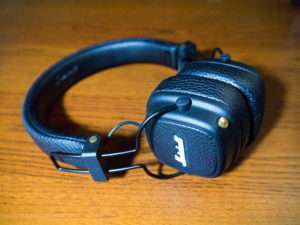
When you first pick up these headphones, the question of a fake doesn't even arise. They're made with astonishing precision and quality. There's no play and no creak. Minor flaws like a sticking-out thread, an uneven seam or an unprinted LEFT label on the headband aren't noticeable. Jumping ahead, I'll say the original doesn't look any better.
The headband is springy but very flexible, with no feeling of a hoop clamped around your head. The ear pads are made of a pleasant, pliable material. I'd never have said the headphones were a fake if I hadn't compared them with the original later.
The cords are soft and nice to hold. There's no feel of cheap plastic, no sprues or burrs.
The fake of the second version of the Major had a gaudy gold inscription on the back of the headband and a button with small concentric circles. On the fake third Major the Marshall est.1962 inscription is exactly the same as on the original, so you can't spot the fake by it. The button also repeats the original exactly; at least if there are differences, they don't catch the eye.
I have to make a reservation right away. I'm not an audiophile, mp3 quality suits me fine, but I have an excellent musical ear by nature. So the main measure of sound source quality for me is "I like it" or "I don't". I liked the sound of the headphones I bought so much that I spent a whole evening downloading all kinds of fun samples like "knock at the door" or "running water", skipped over to my wife and daughter, put the headphones on them and laughed loudly at their wide eyes, and then smiled slyly at the question "how can recorded sound be no different from live?" From my point of view the sound of these headphones is surprisingly lively, real and whole. On rock tracks, Aerosmith and Nirvana in particular, the bass guitar sounds a bit muffled and "slow". Electronic, reggae, Latin and the rest I managed to listen to in three days (that's how long the headphones have lived on my head) sound wonderful to me.
After a whole day on my head the headphones had drained by only 30%, and the next day I dashed to a store on the list of authorized Marshall dealers. After the exceptionally pleasant feeling the fake left, I imagined the original as something downright fantastic. If the fake sits on the head like a feather, gently hugging the ears with its pads, and on top of that plays music very well, what must the original Marshall be like? With roughly such thoughts I walked into the store and asked the salesperson to show me the coveted Major III, explaining along the way that I'd bought a fake and liked it so much that I now wanted to buy the original.
The salesperson brought a box, I opened it, took out the headphones, looked them over (seemingly exactly the same), hooked them up to my phone and pulled them onto my head... and an unpleasant surprise awaited me. The headband of the original headphones was stiffer and the pads were stuffed very densely. When I put the headphones on, the sensations that kept me from buying big headphones earlier came back. I wouldn't say they press, but I feel them and I don't like it. Let's put it this way: if I'd felt this when I tried on the first headphones, I wouldn't have bought them.
Never mind, I thought, the original must play much better! I turned on the first track and felt I was missing something in life. The second, the third. My unpretentious ear, which expected fireworks of clarity and purity, felt literally nothing. Well, headphones. Well, they play. But what are the 150 dollars for? Either my choice of music let me down, or I simply expected something more, but the original headphones didn't impress me.
You'll say "what did you expect from a quick listen to the first song you came across in a store", and you'll be right. And you'll also say "you should have listened to flac", and be right again. The problem is that I need headphones for business trips. I don't listen to Shostakovich on public transport, and I don't even listen to Pink Floyd. And most importantly, I went to buy headphones, not to listen. If I'd gone to listen, I'd have prepared more thoroughly.
When it became clear that I wouldn't buy the original Marshall Major III Bluetooth because I don't like it, my plans to write an article "Marshall Major III Bluetooth, how to tell a fake from the original" began to collapse. I honestly explained the situation to the salesperson and asked permission to take at least some photos of the original, and got the answer "you can, only quickly, while I pack it, because I have to work". So I had to photograph with my phone, for which I sincerely apologize.
Back to the question of how to tell a fake?
The first thing I noticed is that the original connected to my phone on the AAC codec, unlike the fake, which I could connect over the air to the same phone only on the SBC codec. If your sound source doesn't support aptX but can show the codec in use, you can easily tell a fake by this sign.
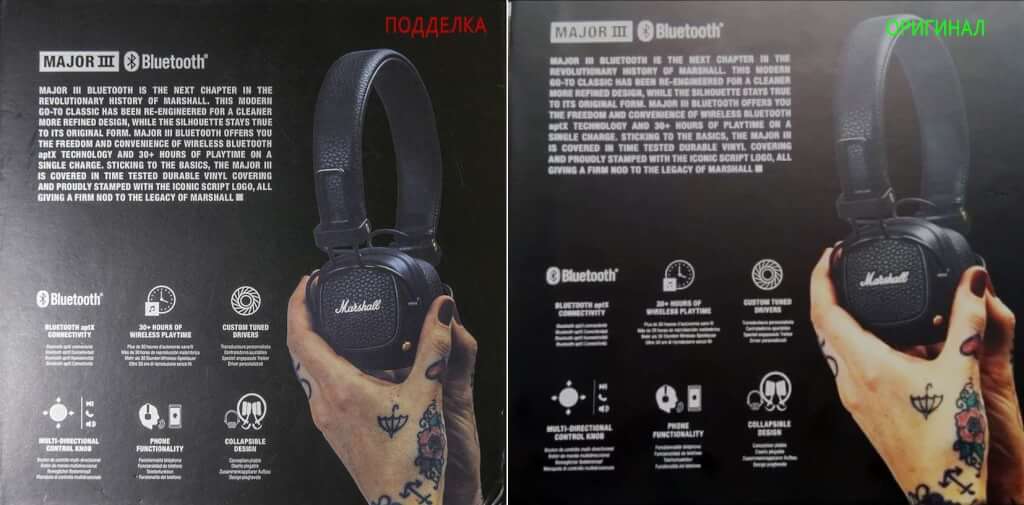
The second sign of a fake is on the box, namely on the back. The manicure and the red tattoo patterns on the hand look very dark on the fake, almost black, while on the original they're dark red.
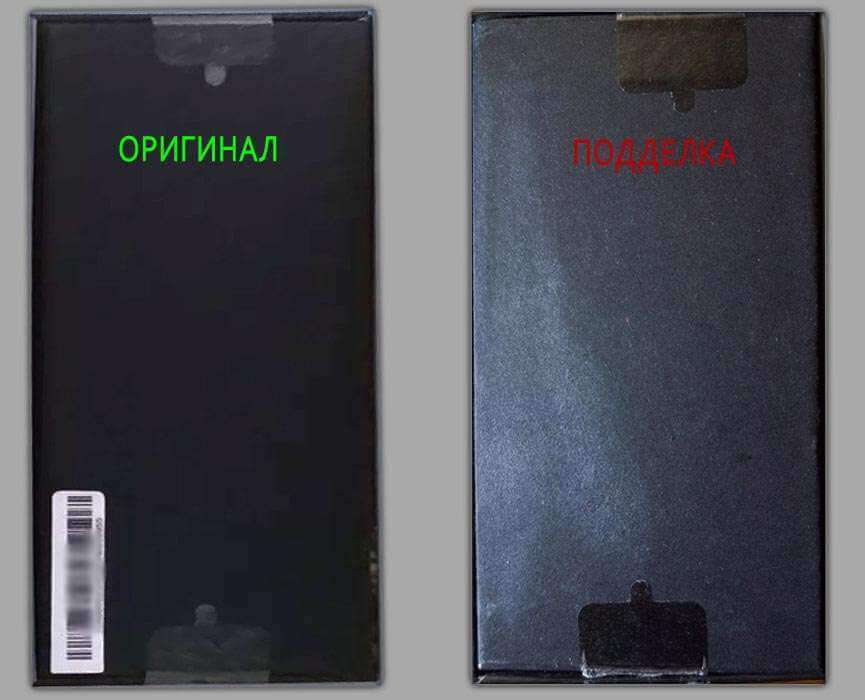
One more point. The quality of the fake is so high that even the shape of the stickers sealing the box repeats the original. Though in my case the stickers on the fake's box were stuck on asymmetrically. Also, the original box should have a sticker with the headphones' serial number, but in another store I saw a box where the number was covered by a price tag, and in yet another the serial number sticker was stuck onto the warranty card, so it's probably not a reliable sign.
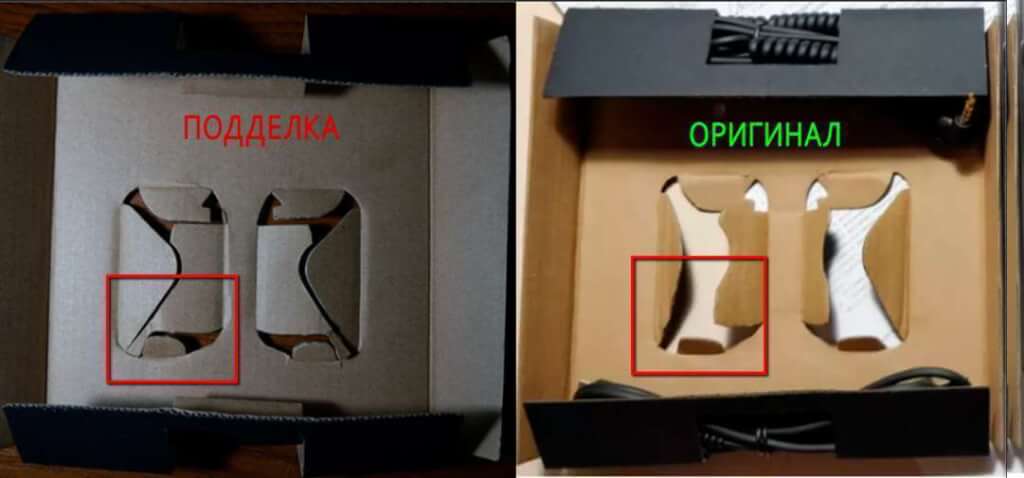
Now inside the box. The tray the headphones lie on is made of smoother cardboard on the original and has a cutout of the same shape, but the cut-out parts are finished differently.
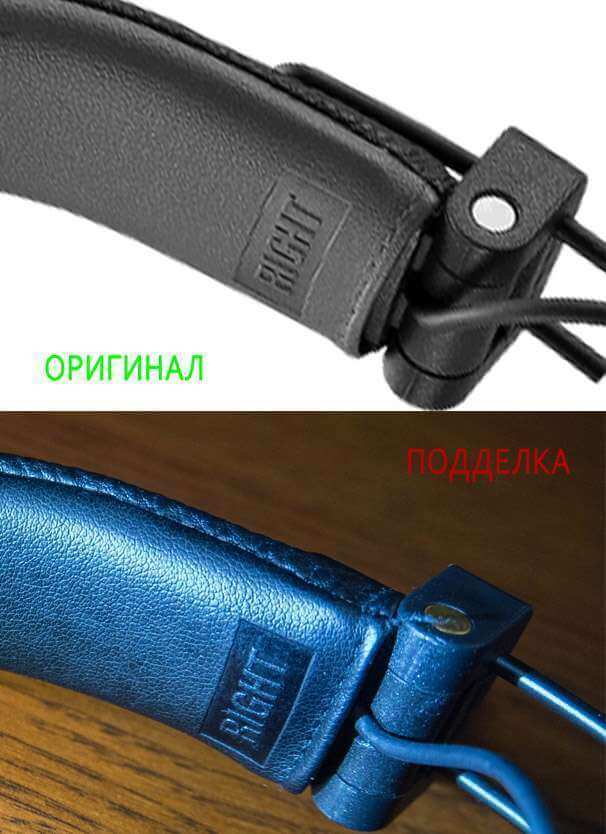
I also managed to find differences on the inside of the headband cover. On the original the surface texture of the material this part is sewn from is finer and more chaotic. On the fake the material texture is coarse and more embossed. I suspect that's exactly why the embossing of the RIGHT and LEFT lettering isn't as neat as on the original, and the press marks look somewhat untidy. Though if I hadn't compared it with the original, I wouldn't have noticed.
What did I take away from my adventures? Which headphones should you buy, the original or the fake?
I know exactly which headphones I bought today. I didn't care about Marshall and bought Xiaomi Mi Headphones Wireless Bluetooth right here. First, it's a hundred percent original with a hundred percent working aptX. Second, I get ANC (active noise cancellation) and can listen to Shostakovich even on an airplane wing, ignoring the howl of the turbines. And third, all this happiness cost me half what I paid for the fake Marshall.
And in the fake Marshall I'll walk through the forest with a metal detector. Where nobody can see me. Of course, you can't tell a fake Marshall from the original even up close. But I know it's a fake.
Enjoy your music!




Прокомментируйте: