After testing the US18650VTC6 batteries from Kedanone and VariCore, I came to the conclusion that to deliver a verdict on AliExpress VTC6 batteries I needed one more test: to check the VTC6 from Liitokala. And although I have enough batteries for my needs, I had to order more. What wouldn't you do for science.
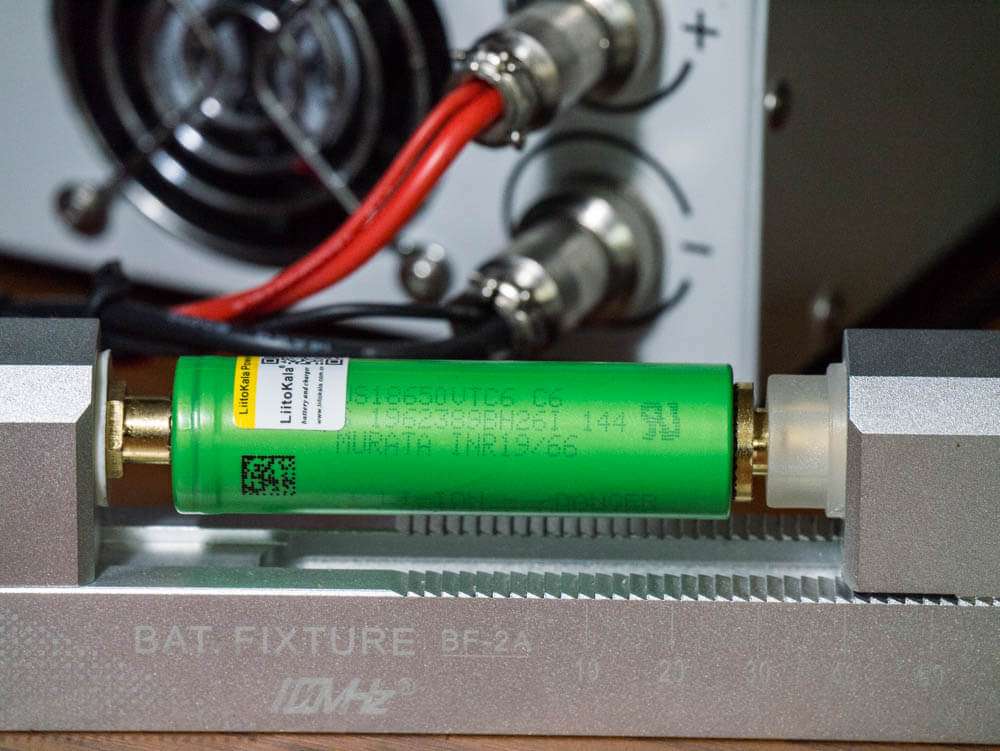
First impressions. The battery is solidly packed in an individual box, which in turn sits in another one, of multilayer cardboard with the Liitokala logo. It's extremely hard to damage a battery in such packaging. That's good. The label carries a sticker with a QR code leading to the Liitokala site, and the label itself has a Data Matrix code which, unlike the codes on the labels of its Chinese counterparts, scans normally and gives the value 300326033002G6207910. The production date code is "BH26", which corresponds to a manufacture date of August 26, 2019. The factory marking is "G", that is, Sony Electronics (Singapore) Pte Ltd. The MURATA INR19/66 inscription simply screams that these are real batteries and not a repack like those of the competitors.
The specifications given by the seller look more like Murata's than like the competitors':
Well, on the outside everything is perfect. Let's get on with testing.
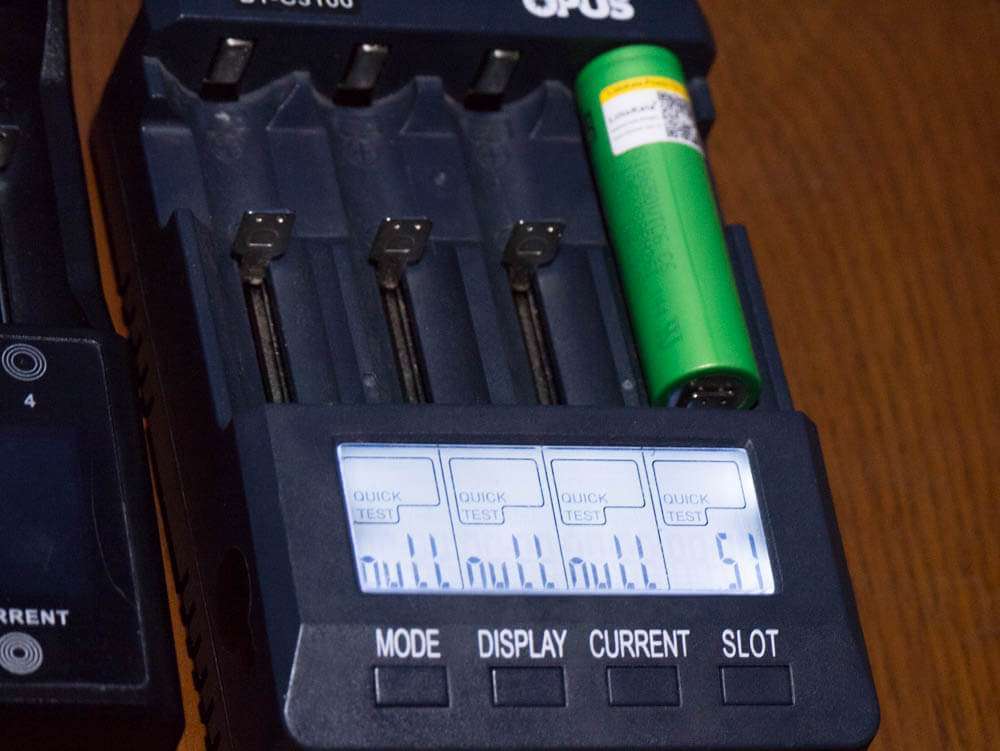
The internal resistance of the Liitokala VTC6 measured by an Opus BT-C3100 was 51 mΩ. That is, the real one is 21 mΩ. I'm disappointed because on the outside you can't fault the battery, and I'd been expecting a value about three times lower.
This could be put down to a measurement error or instrument inaccuracy, but there were no such significant errors before. Let's move on to the main part; now we'll find out exactly what kind of bird this is.
And now everything is clear. The Liitokala VTC6 batteries are just a nicely made fake. Even the hateful Varicore, despite sagging in voltage under a 1 amp load, managed to deliver more than 2900 mAh, while this one gives just 2776 and an average voltage of only 3.65V.
Five amps is a normal load for many 18650 batteries, even ordinary ones. So the Liitokala VTC6's result looks bad: at the start of discharge there's a "hump", which shows that the battery "couldn't cope" with the load and began to heat up. With the heat the chemical processes sped up, and for about three minutes the voltage held at 3.8V. After that the curve went down fairly steeply, without the characteristic "shelf" of high-drain batteries. During discharge the battery delivered 2623 mAh.
Even the Liitokala NCR18650B, which isn't positioned as a high-drain battery, showed a better result.
2590 mAh and 3.31V on average. In the first minute and a half the voltage rose because the battery was heating up, then began to fall. Original Murata cells don't show such "humpbacked" curves even at 20 amps, and here it's just 10. We could stop here, recognizing the Liitokala VTC6 as unworthy of attention, but I've already prepared a protective metal box and will try to take the testing to the end.
Here the Liitokala VTC6 18650 surprised me. I didn't expect even 2000, and got 2566 mAh. The battery lasted more than 10 minutes, and its temperature never rose above 45 degrees. The shape of the discharge curve shows it wasn't easy, but it got through this stage of the test.
And finally, the maximum current my equipment can handle, 20 amps. The expected result: heating to 65 degrees and a hump-shaped curve, 2486 mAh at an average voltage of 3.05 V. Even though inside there's surely a branded battery, whichever it may be, and good batteries don't explode even on a short circuit, I don't advise repeating this experiment.
The first thing to understand: this is not a Murata VTC6 with a Liitokala label, despite the almost perfect outward similarity. The battery's capacity is a little over 2700 mAh, and the short-term current it can hold without significant heating is 15 amps. What's inside the cell is hard to find out; there's no datasheet for the battery, and we'll hardly ever learn the factory specifications.
The battery tested was bought for $3.79 at the Liitokala Official Store, so you can't say it's a fake Liitokala, and the price per battery is quite high.
At the top of the inexpensive 18650 batteries that can hold a high current are, as before, the Liitokala "chocolate bars" at 2 dollars and the Kedanone VTC6 mentioned above.
And finally, all the discharge curves on one graph:
Прокомментируйте: