This isn't part of my general testing and review plan; I just bought a second battery for my YI 4K+ camera. And any battery that lands in my hands gets tested, that's just how it goes. A few words about the stated specifications of the AZ16-1 battery:
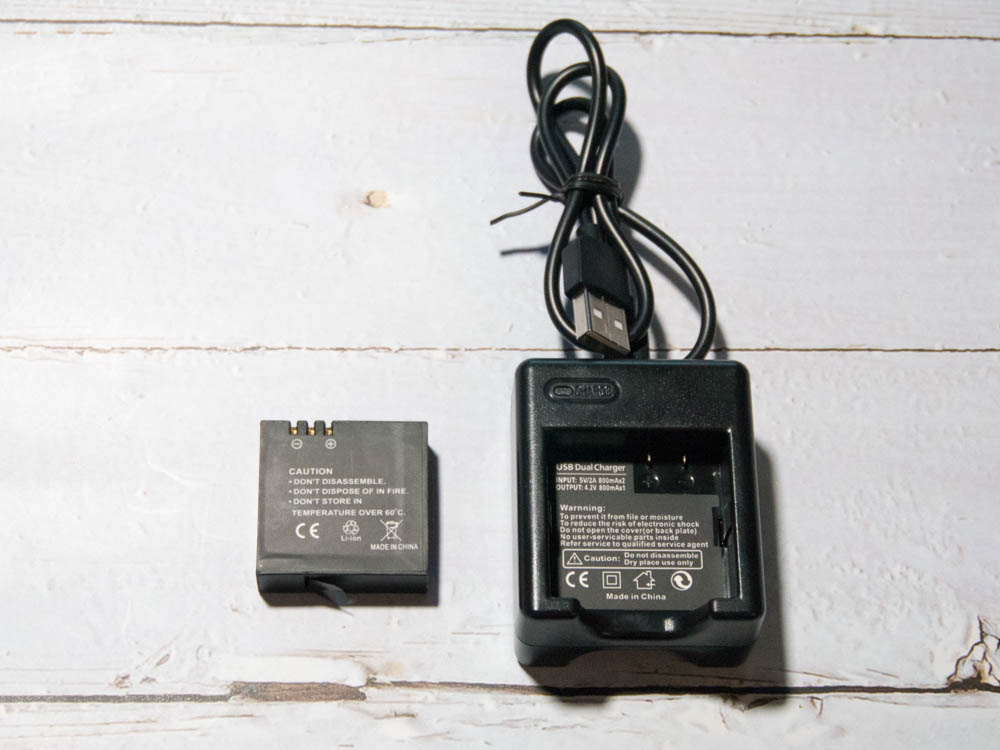
The battery was bought on AliExpress together with a charger. The charger has no manufacturer information either.
Markings on the battery:
The front says BATTERY PACK FOR Z16-1, 3.85V 1480mAh 5.7Wh; the back has the standard "do not disassemble or throw into fire" warning and the words Made in China.
On the charger:
USB Dual Charger
Input: 5V2A 800mAx2
Output: 4.2V 800mAx1
Below that is a warning to avoid damp places and not to open the device, which supposedly has no user-serviceable parts, plus a request to contact an official service center if it breaks.
It's very strange information, where in essence only the first line is true: it really is a USB Dual Charger. Further on, I understand that the power input is USB 5 volts 2 amps, but I don't understand why 800mAx2 is the Input and 800mAx1 is the Output. I understand even less why the output voltage is 4.2 volts when it should be 4.35, since the battery is rated at 3.58 V, so it's an LiHV.
In other circumstances I wouldn't buy such a knockoff, but there isn't a big choice of batteries for these cameras right now, so I decided to take the risk.
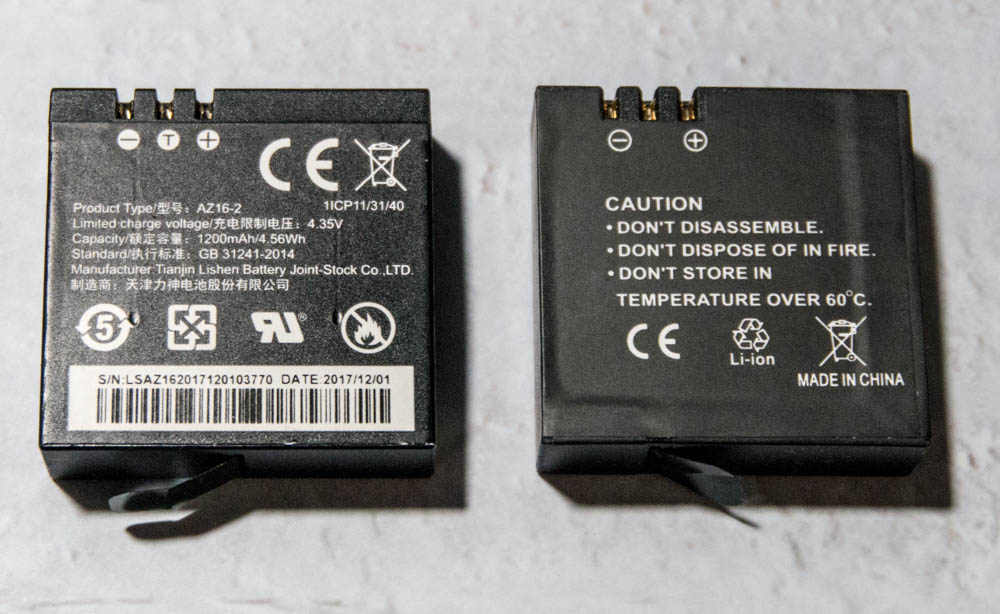
The battery that came with my camera is marked AZ16-2. I spent a long time trying to understand the fundamental difference between AZ16-1 and AZ16-2, and whether they're interchangeable. I concluded that the original AZ16-1 and AZ16-2 batteries differ in capacity and cutoff voltage: the first has a maximum voltage of 4.4V and 1400mAh, the second 4.35V and 1200mAh. Their dimensions and other parameters are the same. So, the specifications of the AZ16-2:
It has a unique serial number and a manufacture date of 2017/12/01.
Among the standard restrictions is information about the maximum permitted charging voltage of 4.35 V.
We connect the battery, charged in the camera, to the analyzer. Test algorithm: discharge to 3.2V, then charge to 4.35. In both cases the current is set to 600 mA, with a cutoff current of 100 mA. The starting voltage before discharge is typical for an LiHV battery: 4.27 V.
The curve is smooth and the graph completely ordinary: voltage falls and rises without dips or jumps. During charging the voltage reaches 4.35 V, after which the current starts to drop until it hits 100 mA, which signals the end of charging. Capacity 954 mAh, energy 4.013 Wh. Remember, this battery is 4 years old.
The battery had been charged in the camera, yet its starting voltage was only 4.12 V. That's normal for an ordinary Li-Ion battery, but this one is advertised as LiHV (a high-voltage lithium battery), which is exactly the type an AZ16 should be. Let's remember that and move on: the discharge curve is quite ordinary, but on the original battery the curve gets steeper toward the end of discharge, and here it doesn't. This suggests we're looking at an ordinary lithium battery rated at 3.6 V rather than a 3.85 V LiHV, with the same curve shape near the end of discharge, except this battery's end of discharge is at 2.7 V, and we discharged only to 3.2 V.
Now the charging cycle. Charging stopped at 4.329 V, and the stop was caused by a broken circuit: the battery's protection tripped. Discharge capacity was 719 mAh, energy 2.58 Wh.
We can conclude that this battery is a fake. I won't charge it in the camera any more, since it might swell and damage the camera. In a charger and under supervision it's fine, especially as the battery does have protection and it works. It will last through a vacation, and meanwhile I'll order a proven KingMa and an original. When they arrive, I'll test both and add the results.
Since I've already started testing, let's also look at how the new battery charges in the supplied charger.
I discharged the battery by 300 mAh and then put it on charge. I saw strange voltage fluctuations at the start of charging, then it stabilized, and at 4.322 V the battery's protection tripped again. Judging by the indicator pulsing red and green, the device was trying to top it up, but the protection kept kicking in.
The battery is clear enough, but what about the charger? Let's try charging the original battery.
Here things are almost normal. The battery reached 4.36 V, after which the device cut off charging and went into standby.
Despite the confusion in the markings, the charging algorithm is perfectly sensible. For the AZ16-2 the cutoff voltage is a bit high, though within tolerance, while for original AZ16-1 batteries it suits better than the stock one, since a slight undercharge increases lithium battery life several times over.
Прокомментируйте: