The best universal charger: Opus BT-C3100 v2.2
Isn't that too bold a headline for a device that's 10 years old, you'll ask? No. I really do consider the Opus BT-C3100 v2.2 the best charger being made today. And let me be precise: the best among universal chargers.
There are devices that can give 3 amps per slot, but they can't charge NiMH. Or they can only charge but can't train batteries, or they can do all that but can't set a current below 500 mA, which is a lot, almost 1C for AAA batteries.
There are four versions of the Miboxer C4 that can set a minimum current of 100 mA, but they can't discharge batteries, and NiMH without training die very fast.
There's the super-combine SkyRC MC3000, but it was discontinued back in summer 2019, and the ones still left in warehouses now cost as much as four Opus BT-C3100 units.
And the JDY IC99, an improved version of our very own Opus BT-C3100, with even more features than the super-combine mentioned above, is made in limited runs and isn't found on the market available to us at all.
So it turns out you can buy a charger for one type of battery that will be more modern, have touch buttons and a color screen, and even charge better than the Opus BT-C3100. But if you want a reliable charger that will charge lithium and nickel equally well, and have your batteries last a long time, you have no choice.
Anyway, today I'll be testing the Opus BT-C3100 V2.2 charger, bought on AliExpress.
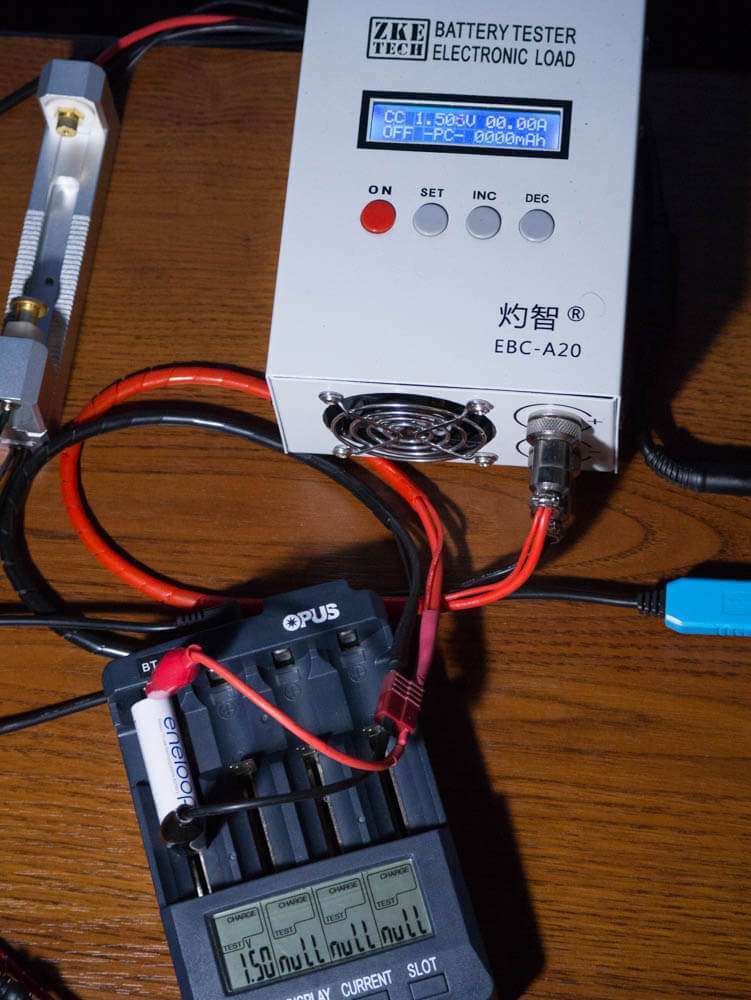
Opus BT-C3100 specifications
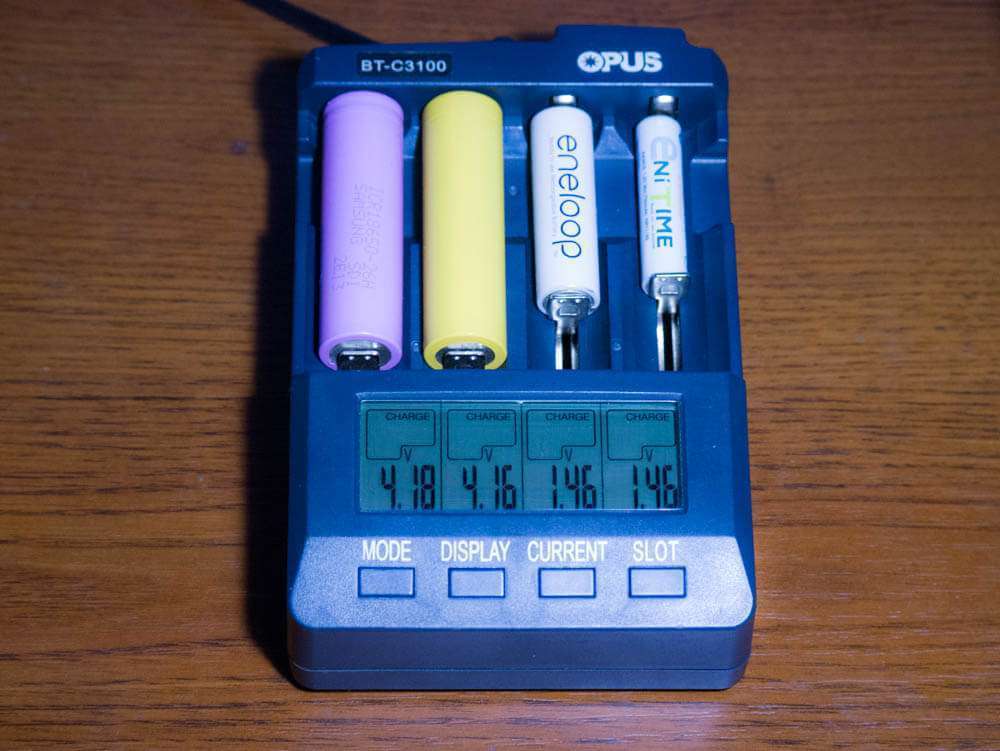
In a nutshell. The Opus BT-C3100 is a charger that can discharge, charge and train LiIon, LiHV, LiFePo4, NiMH and NiCd batteries and measure their internal resistance. Let's go through the points:
- Charge mode. Charging batteries at a current from 200 mA to 1A when charging three or more batteries at once, and up to 2A when charging one or two. The capacity put into the battery is shown on the screen.
- Discharge mode. Discharging batteries at a current from 100 to 500 mA for three and four at once, and up to 1 A when working with two batteries. The capacity is shown on the screen.
- Discharge Refresh mode. Three discharge-charge cycles. Used for training nickel-chemistry batteries; it helps remove the "memory effect". The charging current is set as in item 1, and the discharge current is set automatically to half the charging current.
- Charge Test (Discharge test) mode. Charging the battery, discharging and charging again. During discharge the screen shows the capacity drained, during charging the capacity put in. The currents are the same.
- Quick Test mode. Measuring the internal resistance of batteries. You need to understand that the Opus BT-C3100 measures Rdc (total resistance at direct current), while battery datasheets state Rac, that is, impedance (complex resistance) measured at a frequency of 1 kHz. These are different quantities, and it's wrong to appeal to a Chinese battery seller with a charger's readings. Nevertheless, the internal resistance of a charged battery is a very telling indicator of its condition. The Opus measures it fairly accurately; to get the real figure, subtract 30 mΩ (the device's own resistance) from the reading. Contact cleanliness and clamping force also affect the readings strongly.
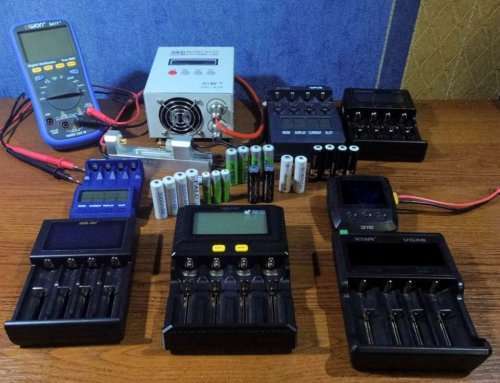
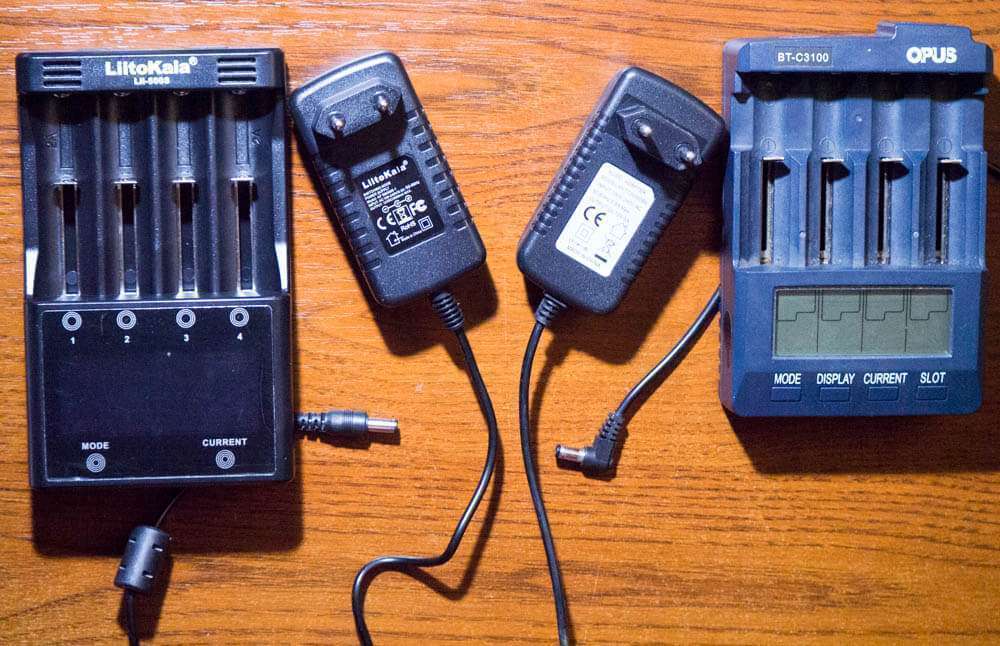
Below, in the photo, is the modern Liitokala Lii-500S next to the Opus BT-C3100.
Testing the Opus BT-C3100
What is this test for? First of all, to find out how honestly the device shows the user what is currently happening with their battery. After all, a charger can't be the best just because it has no alternative. It also has to charge well. That's what we have to verify. Let's start with a lithium battery.
Opus BT-C3100: Charge, working with LiIon batteries
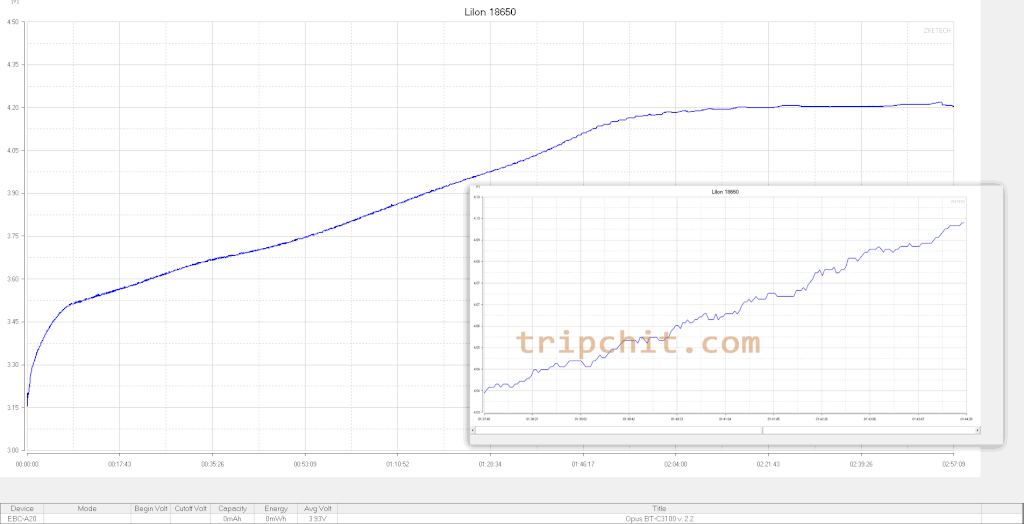
The test uses a Samsung INR18650-25R battery and Charge mode at 1000 mA. Charging is done in pulses, and between them the device measures the battery voltage. The maximum voltage at the charger's terminals was 4.218 V. The battery voltage, after the word Full lit up on the screen and the device stopped charging it, was 4.208 V. After charging ends, the device doesn't maintain the battery voltage, it only monitors it. Charging resumes when the inserted battery's voltage drops to 4.07 V. That's the answer to the question "can you leave batteries in the charger". If the batteries are lithium and the device is an Opus BT-C3100, you can.
Below is the charging graph and an enlarged section of it.
Opus BT-C3100: Discharge, working with LiIon batteries
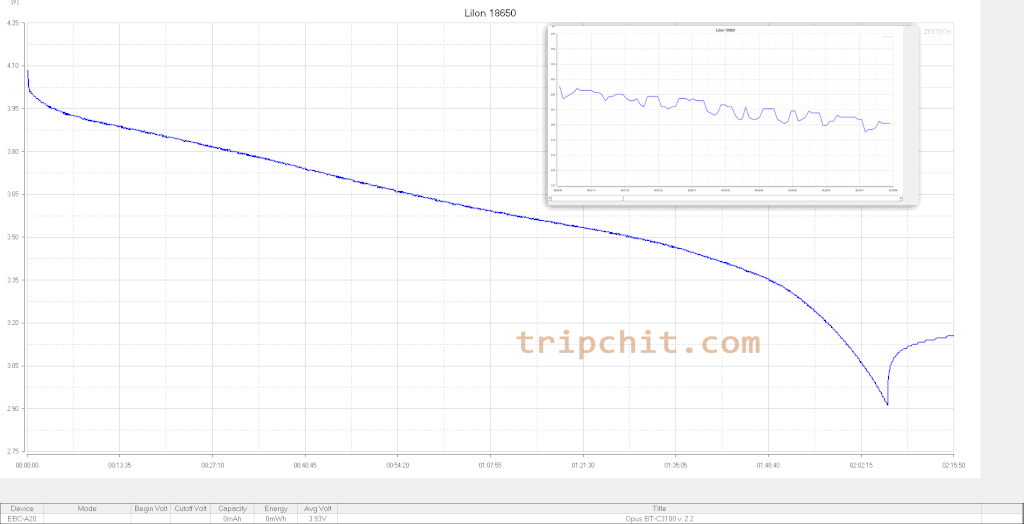
The same battery and Discharge mode at 1000 mA. Discharge to a voltage of 2.912 V. From the shape of the curve you can see the battery could give a little more, but the algorithm doesn't allow it. In principle, that's a good thing. Over-discharge is more critical for a lithium battery than 50 milliamp-hours of capacity on the charger's screen.
Opus BT-C3100: Charge Test, working with LiIon batteries
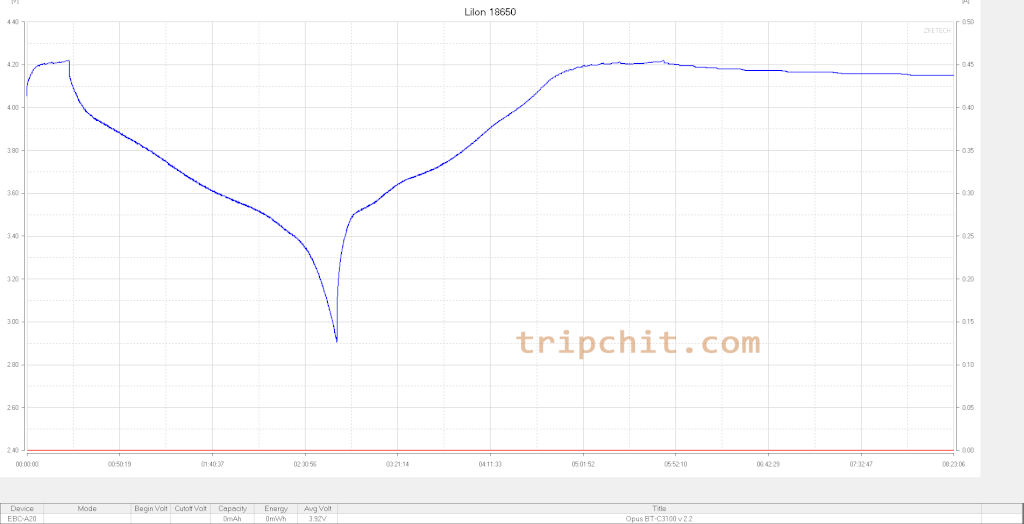
We continue with the same battery, Charge Test mode at 1000 mA. The stages of this mode are charge, discharge and charge again. That way we can analyze all of the device's modes except the Rdc measurement.
Stage one: full charge. Charging is in pulses, and between pulses the battery voltage is measured. The maximum voltage at the device's terminals was 4.219 V. The battery voltage before charging cut-off stabilized at 4.205 V.
Stage two: full discharge. The Opus BT-C3100 discharges the battery to 2.9V at a current equal to half the set one, in our case 500 mA. In reality the discharge stopped at a voltage of 2.906 V.
Stage three: full charge at 1000 mA. The set current holds until the battery reaches about 4.15V, after which the current starts to fall. At the moment the battery reaches 4.205 V, the current is about 500 mA and keeps falling. Charging cuts off when the current is 50 mA. The battery voltage at that moment is 4.208 V, and the terminal voltage 4.219 V.
Opus BT-C3100: Quick Test, working with LiIon batteries
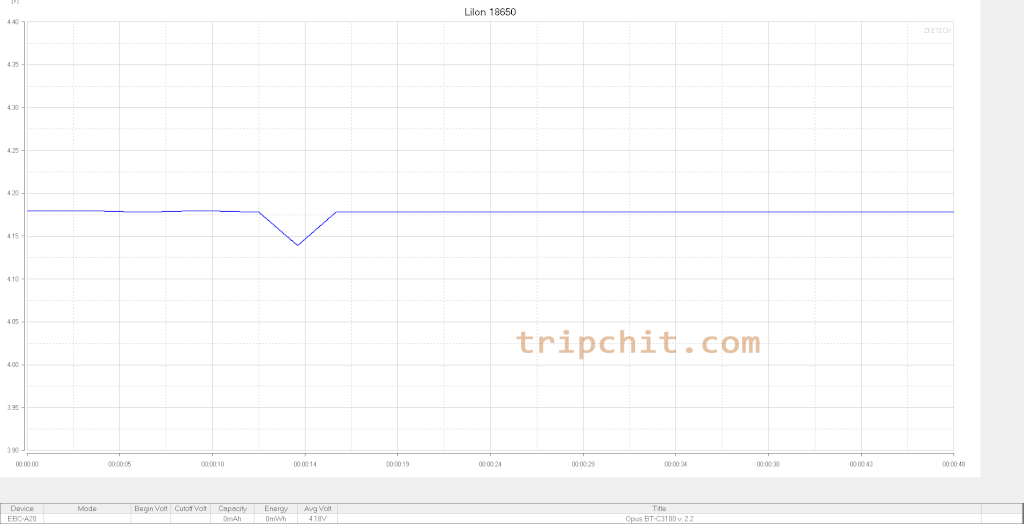
In Quick Test mode the device determines the battery's dynamic internal resistance (Rdc) by analyzing the voltage drop on the battery under a certain load. You can't set the current here; the parameters of this test are hard-coded in the software. The measurement must be made on a fully charged battery. Subtract 30 mΩ (the device's own resistance) from the test result. In my case the device showed 48 mΩ, meaning the battery's own resistance is 18 mΩ. That points to a battery in excellent condition. And here's the graph (it's unclear what it will tell us, but let it be).
Opus BT-C3100: NiMH AA, CHARGE TEST mode
Charge test mode, set current 1000 mA. I chose this mode because it combines charging and discharging. For the test we'll take a Sanyo Eneloop HR-3UTGB battery.
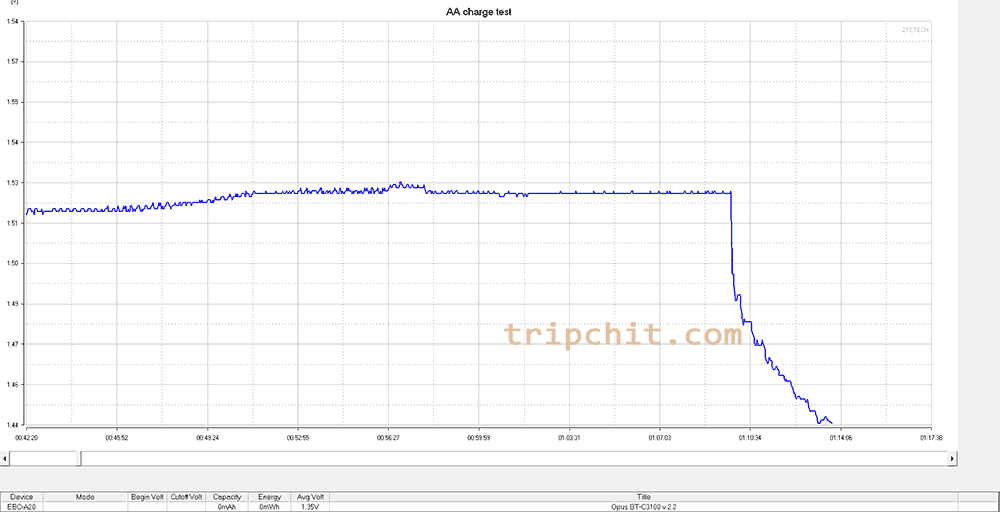
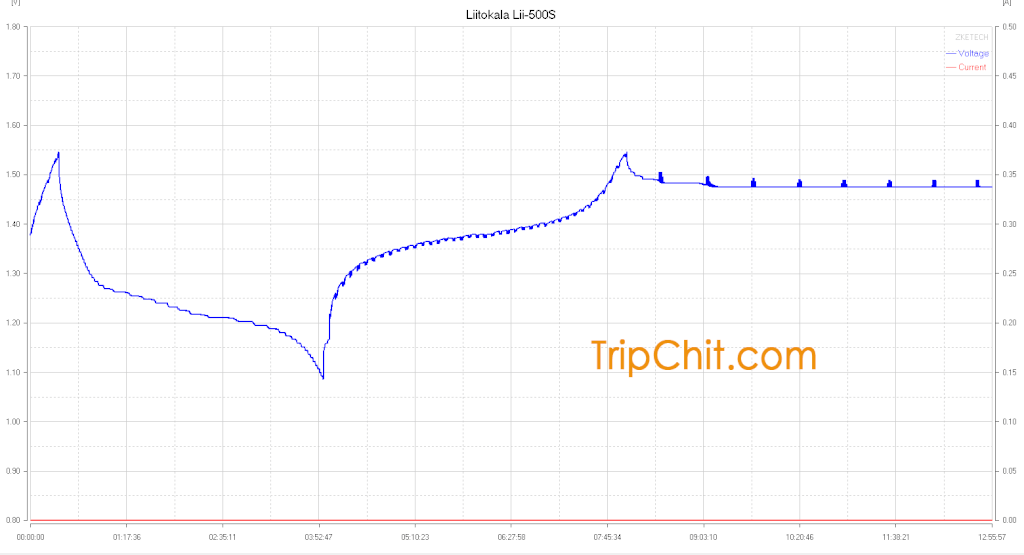
Stage one: preparation for discharge. I called it that because in Charge test mode the initial charge differs from the final one. At 1.526 the device catches -ΔV, continues "trickle" charging for another 10 minutes, and only then moves on to discharging.
Stage two: discharge at 500 mA (set automatically and equal to half the charging current) and capacity measurement. During discharge the load is periodically disconnected so that the device can determine the battery's real voltage. The test ended when the battery voltage was 0.905 V. Under load, the terminal voltage at that moment was 0.703 V.
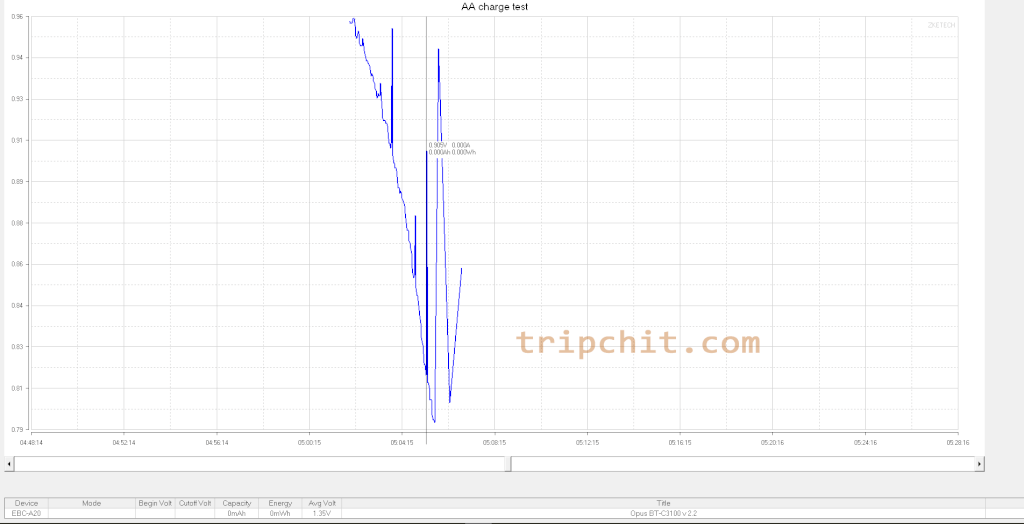
Now the Opus measures capacity while the battery charges. Charging again runs at the set current of 1000 mA, but I'll venture that the pulse current is what's meant. Since there's a gap between pulses (the moment the device measures the battery's real voltage), the charging time is about 4 hours 30 minutes, so with a battery capacity of 2100 mAh the average current works out to about 500 mA.
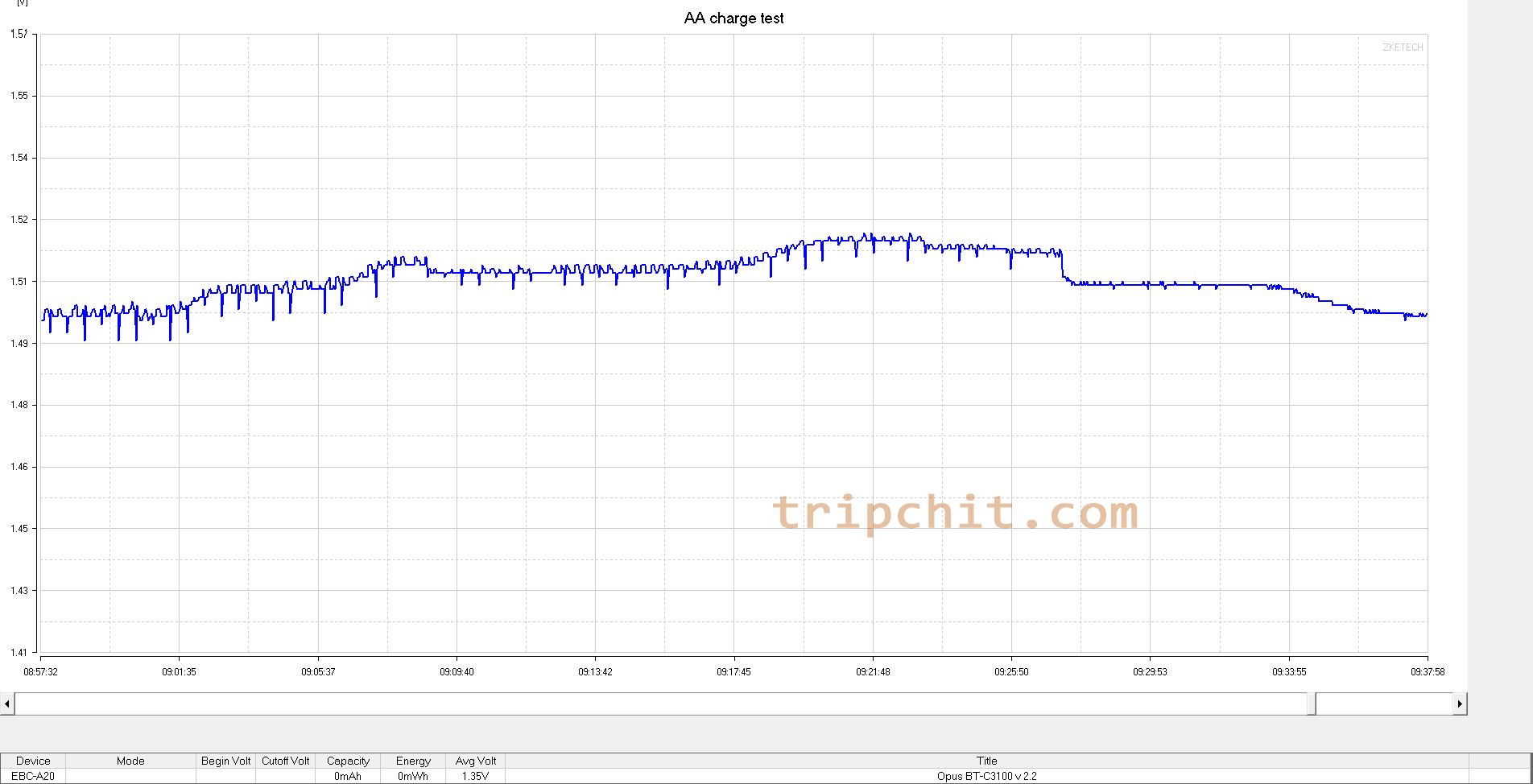
At the end of charging we see a voltage drop on the graph; after the main charging mode switched off and the word Full appeared on the screen, the battery voltage stabilized at 1.498 V and the device then held that voltage with trickle charging. Below is an enlarged section of the graph at the end of charging.
And this is what the full graph of the Charge Test mode looks like.
Opus BT-C3100: conclusion
The testing didn't change my opinion; I still consider the Opus BT-C3100 an excellent charger. The maximum deviation between required and real voltage was barely 0.018 V. Good accuracy, a good algorithm, no overcharge or over-discharge.
There are just two minuses, one about usability and the other about electronics. The first is the screen: to see the digits clearly you have to look at the device from above. With a slight deviation from vertical the digits are still legible, but at 45 degrees they vanish completely.
The second minus is the pulsed charging mode. I don't see any harm in it for the batteries, but with pulsed charging the process itself takes twice as long. When you put a 2000 mAh battery on charge and set 2000 mA, you expect it to charge in an hour. But no, with the Opus you'll wait two hours.
So if charging speed and the look of the device matter to you, take a look at the new Liitokala Lii-500S. In all other cases you know which charger to buy.