Liitokala Lii-600 charger: overview
The Liitokala Lii-600 appeared without much of an announcement, a surprise launch of sorts, even though it could have been hyped up in advance and sold by pre-order in the hundreds of thousands. After all, it's a modern charger with all the necessary functions, the heir to the famous Liitokala Lii-500! Either way, when I saw it on sale in the official store, I bought it right away. How justified the purchase was, we'll find out together as we test.
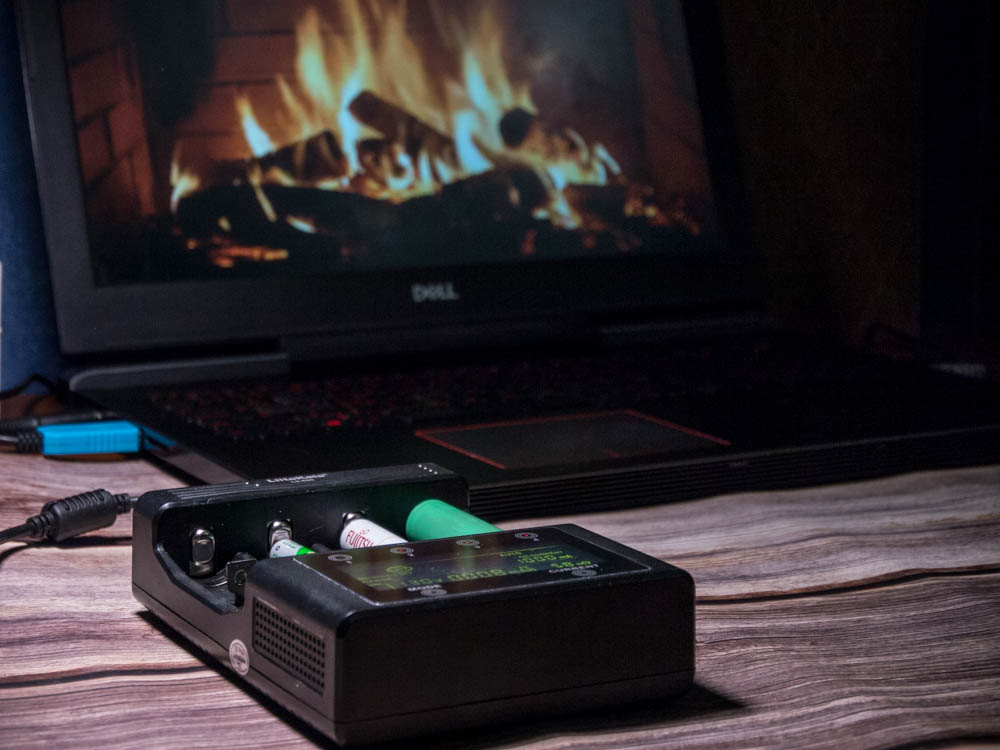
Liitokala Lii-600 specifications
Let's start with the specifications:
- Battery sizes supported: from 10440 to 26650. The manufacturer says nothing about protected batteries or the trendy 21700, but the maximum distance between contacts, just under 74 mm, hints that charging these sizes shouldn't be a problem either.
- Protection against overcharge and over-discharge, short circuit, overheating and reverse polarity.
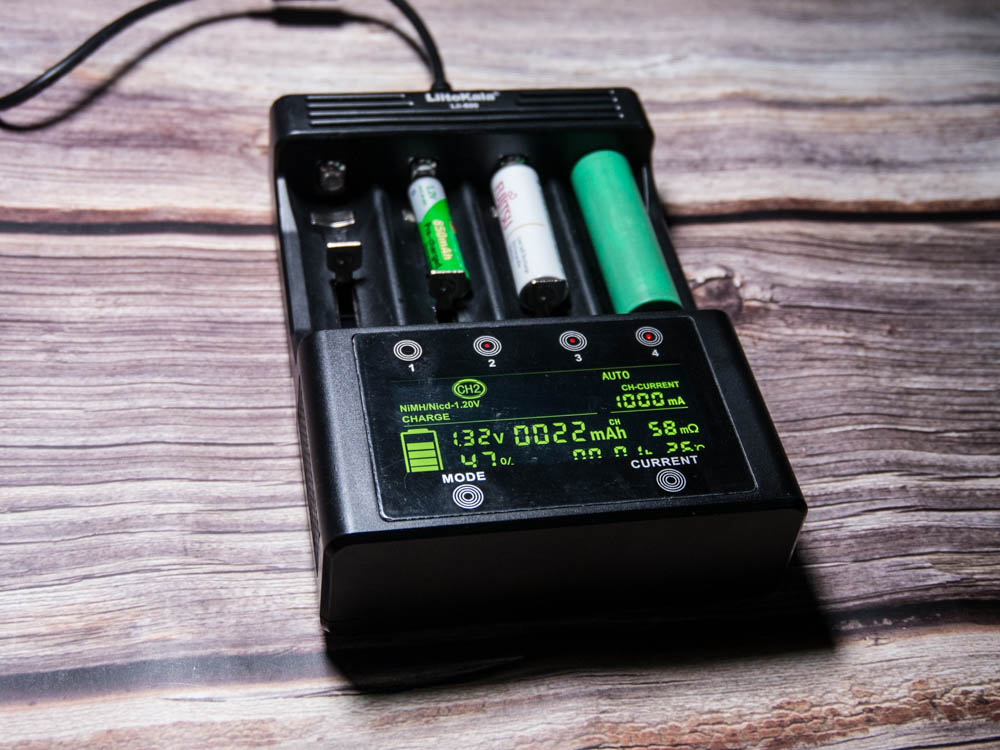
- Touch buttons and an excellent display with wide viewing angles. The display shows the operating mode for each slot, voltage, delivered or charged capacity (depending on the mode), internal resistance and temperature. Temperature is measured for each slot, and I have no complaints about the accuracy of the sensors.
- Modes: Charge, Discharge, Test (a charge-discharge-charge cycle) and Repair.
- Charging current of 3A for lithium batteries and 1A for nickel ones, for all slots in any combination.
- Discharge current of 250, 500 and 750 mA. Even though cooling is passive, the designer gave the case excellent ventilation: at a room temperature of 24 degrees, even with four batteries discharging at once, the case is barely warm.
The device can activate batteries whose protection has tripped (open-circuit voltage 4.7 V). The charging current is set automatically depending on the internal resistance of the cells, and manual selection is also available. Current can be chosen up to 1A in 250 mA steps, and in 500 mA steps between 1A and 3A.
As for chemistry, only LiIon and NiMH (NiCd) are available. LiFePo4, NiZn and other exotics were left out. Charging uses the CC/CV algorithm for lithium; -dV for nickel isn't mentioned, although it may well be there.
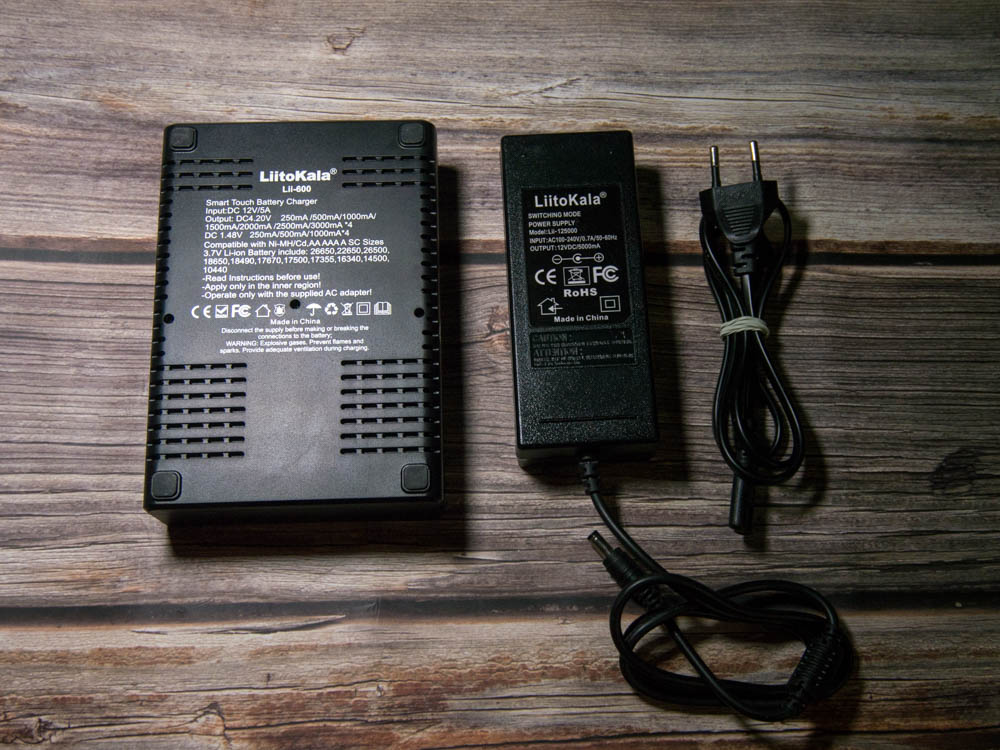
The charger is powered by the Liitokala Lii-12500 unit (12 volts, 5 amps). The box includes an impressive car adapter with a thick cable, but the thin cable of the power supply itself, like its weight, doesn't inspire confidence. Another downside of the power supply is a very loud whine in idle mode. Even if the device didn't beep at the end of charging, you could easily tell it's done when the power supply starts whining again. In nickel charging mode the voltage is measured every second, so in this mode the power supply whines every second, which, I admit, is seriously annoying. The notorious fan in the Opus BT-C3100, when working properly, is quieter. The power supply case can't be opened, so there's no way to fix the cause of the whine. You can only quiet it down by putting a couple more batteries on charge.
The display always turns off automatically, and there's no constant-backlight mode. On the dark display, the readings are very hard to read (only in certain lighting at a certain angle).
The key-press and end-of-work sounds can't be turned off, at least I found no such information in the manual. I should note that the Liitokala Lii-600 manual, for the first time for Liitokala, is written in human language and is quite clear. Before, I had to translate the manuals myself.
Testing the Liitokala Lii-600
Let's check the charger in the "Test" and "Repair" modes to understand in one go how its algorithms work. At idle, the Lii-600 has 4.684 V across its contacts. This lets it raise the voltage on lithium batteries whose protection has tripped and thereby activate them. After activation the device switches to automatic charging.
The device has two operating modes: fully automatic and manual. The first works like this: when a battery is inserted, the internal resistance is analyzed, and the charging current is set based on the result. Charge mode is on by default, and the MODE button lets you pick other modes, with the current still set automatically.
Manual mode is selected by holding the CURRENT button. Once the Manual segment lights up on the screen, short presses of the same button cycle through the charging current: 250-500-750-1000-2000-3000, though for some battery types some currents are unavailable. In particular, I tried a completely "dead" nickel battery to check the training mode, but even in manual mode I couldn't choose a current; only 250 mA was available. The battery's internal resistance went off the scale: the screen showed 999 mΩ.
Current as a function of internal resistance.
For NiMH:
- 190 mΩ - 250 mA
- 88 mΩ - 500 mA
- 68 mΩ - 500 mA
- 39-56 mΩ - 1000 mA
For LiIon:
- 124 mΩ - 250 mA
- 84 mΩ - 500 mA
- 64-76 mΩ 1000 mA
- 42 mΩ - 1500 mA
- 40 mΩ - 2000 mA
- 28 mΩ - 2500 mA
These are roughly the boundary values. I never managed to find a battery for which the device would set a current of three amps.
I liked the repeatability of the internal resistance measurements. The spread of values on one and the same battery is minimal, about 5 mΩ.
Liitokala Lii-600: lithium battery
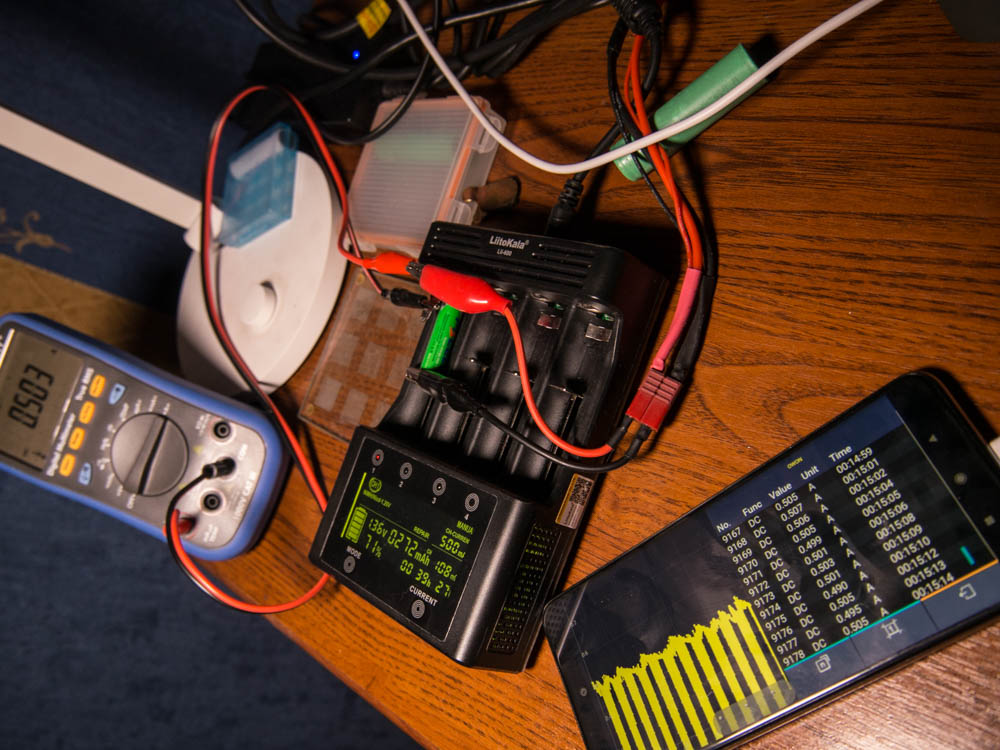
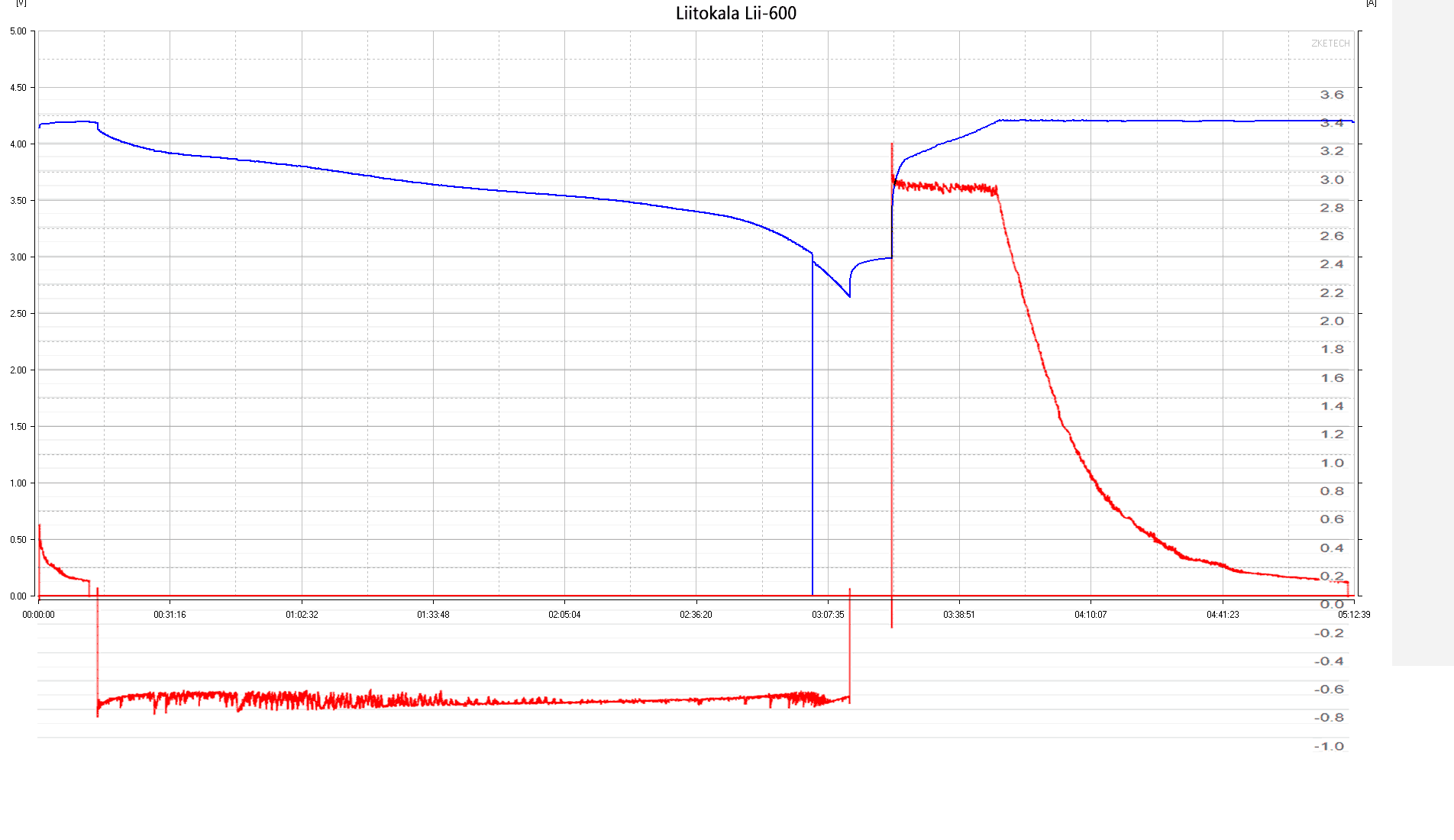
The test uses a Samsung INR18650-25R battery. To show both charge and discharge on one graph, I run the Lii-600 in TEST mode. The current is set to 3000 mA.
Stage one: full charge.
The Lii-600 charges the battery to 4.197 V. The difference from the reference 4.2 V is only three thousandths, which can be put down to measuring instrument error.
Stage two: full discharge. Without a pause, the Lii-600 discharges the battery at 750 mA and measures the discharge capacity. The discharge stopped at 2.649 V. I think the target was 2.65 V. If so, the accuracy of the built-in voltmeter is very high.
Stage three: full charge at 3000 mA. Before this stage the device paused for about eight minutes, or to be precise, 452 seconds. Charging followed an entirely honest CC/CV algorithm, with the current in the CC phase hovering around 2.9 A and the voltage in the CV phase at 4.200-4.208 V. Charging stopped when the average current dropped to 100 mA, and the battery voltage right after the current was cut was 4.192 V.
During discharge and charge the device's display showed the set current (not the real one), and the voltage reading differed from the instrument measurement by no more than 0.05 V.
About three hours into the test, the cat climbed onto the table and took part in the testing too (it knocked off the voltmeter clip). That moment is marked on the graph by a nice vertical line. But since I noticed the mess right away, the voltage measurement was interrupted for literally a couple of seconds, just long enough to pet the cat and hang the clip back. Sorry for not starting the test over; I don't think I missed anything remarkable in those couple of seconds.
Liitokala Lii-600: NiMH battery in TEST mode
Our test subject is a PKCell AAA 850 mAh battery. It's practically new and handles high current, but has a relatively small capacity (a little over 900 mAh), which makes for a quick test. AA batteries above 2000 mAh would take 4 hours just to discharge, and I'd like to get a result sooner.
During the pre-test experiments I was pleasantly surprised. Even when discharging four cells at maximum current at once, the device doesn't heat up; the case feels only slightly warmer than room temperature.
For the test I set the discharge current to 500 mA, so the charging current was 1000 mA. The battery was fully charged, so the initial charge phase was very short. During the discharge phase the delivered capacity changes, and at that moment the DISCH symbols light up near the capacity value. During the charge phase the capacity put in is measured, and this is shown with the CH symbols. The delivered capacity, according to the device under test, was 624 mAh.
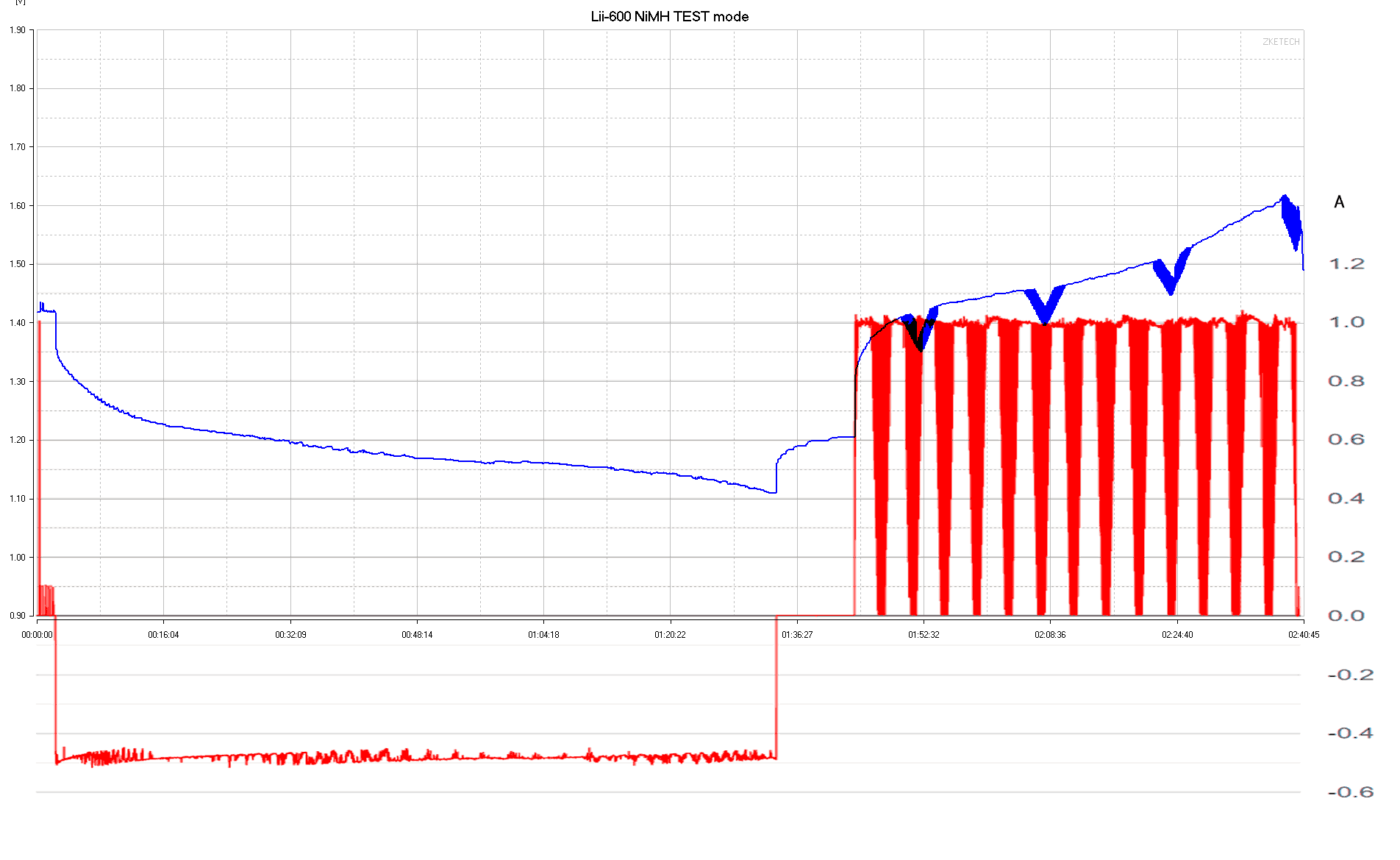
The lower voltage threshold during discharge was 1.109 V. Naturally, the capacity value for a discharge down to that voltage has little to do with the battery's real capacity, which, I remind you, is above 900 mAh. So the measurement error was more than 30%.
Liitokala Lii-600: NiMH battery in REPAIR mode
As it turned out, the Test mode on the Liitokala Lii-600 doesn't work correctly, just like in earlier Liitokala chargers. But the Lii-600 has a new mode, Repair.
In principle, if you plan to work with NiMH batteries, there's no point buying a charger without this mode, because Repair mode (also called training or restoration mode) extends the life of nickel batteries at least threefold. Training lets you rid batteries of accumulated memory effect (follow the link for more on the memory effect). Training is usually done by repeating a "full charge / full discharge at low current" cycle three times. Charging is detected by reaching -dV, and discharge by reaching 0.9 volts, the minimum for NiMH batteries. In some devices, for example the Xtar, the 0.9 V is measured on the battery with no load, while on the Opus BT-C3100 it's measured under load, but either way it's 0.9 volts (give or take a few hundredths).
Now let's look at the graph the Liitokala Lii-600 produced in REPAIR mode with the current set to 500 mA.
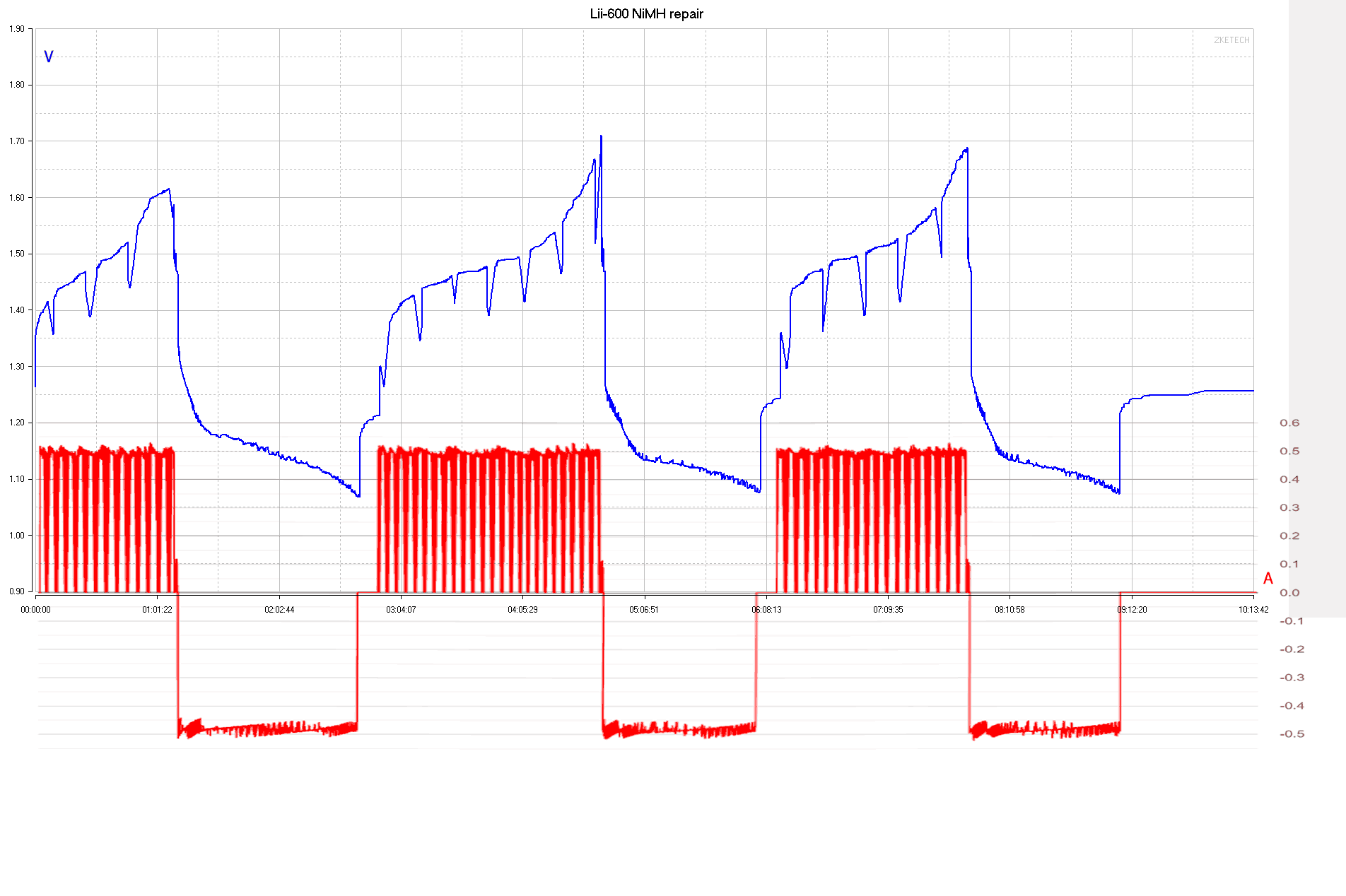
If you're not surprised, you didn't look at the graph carefully.
The first thing that catches the eye is that the voltage at which discharge is cut off differs in each of the three cycles. In the first cycle it's 1.068 volts, in the second 1.078 and in the third 1.075. I couldn't work out which parameter controls the discharge cutoff. If you know, please write in the comments.
The second observation is no less interesting. As I wrote above, training is supposed to remove the memory effect, that is, to complete the reaction of the part of the active electrode/electrolyte layer that has frozen in what we could call a "half-transition" state, which arises when a not fully discharged battery is charged again. Well, the Liitokala Lii-600 doesn't remove the memory effect; on the contrary, it creates one at around 1.07 volts. Look at the first cycle: the battery is fresh, after training in an IC99 charger. Discharge at 500 mA lasts 91 minutes. The second discharge cycle lasts 80 minutes, and the third only 76. That's with identical charge and discharge parameters, in the same device. Some training: the battery's capacity is shrinking right before our eyes.
And the third observation. After three charge/discharge cycles, the Liitokala Lii-600 simply froze. I took the data off the instruments and drew the graph, but the final battery charging cycle never started. A day has passed since the training cycle began, I'm finishing this article, and the long-awaited green light signaling the end of charging still hasn't come on.
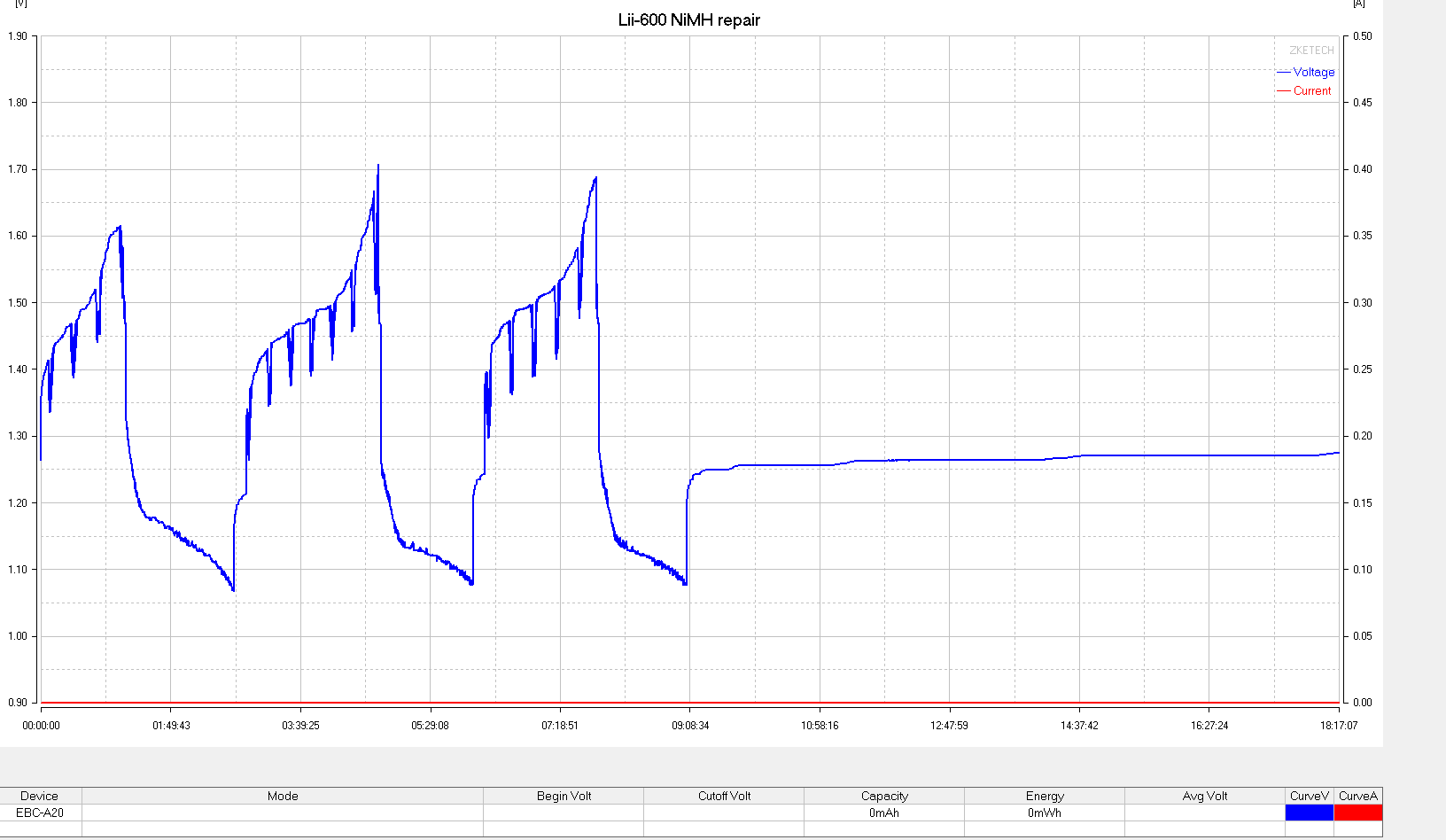
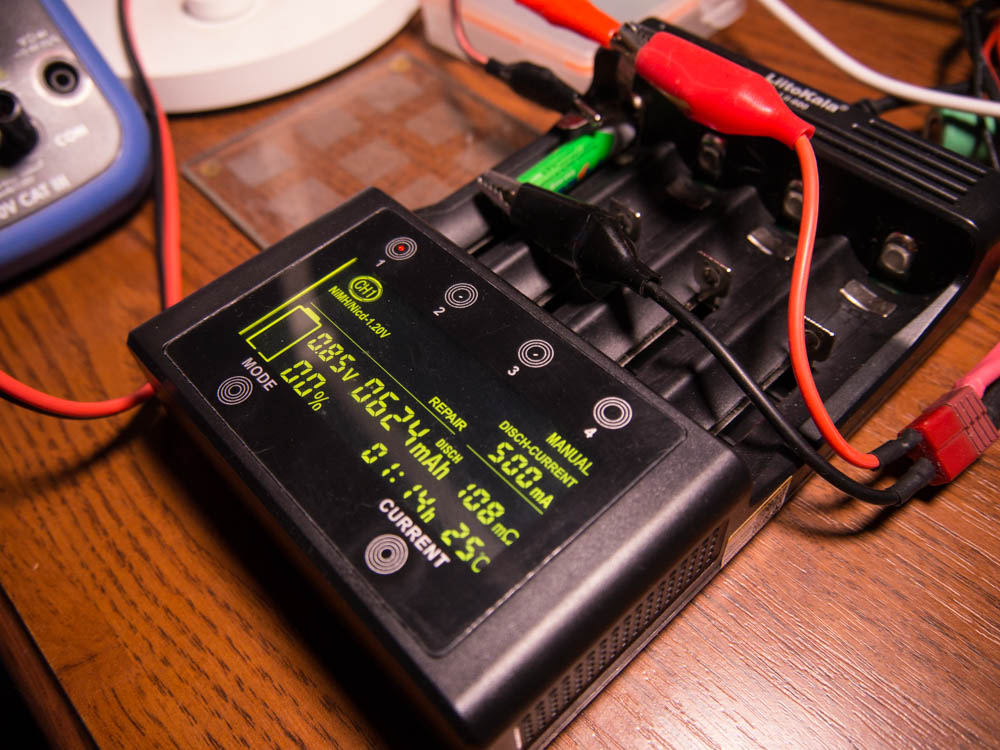
I tried the same mode with a different battery. Same story: after the third discharge stage the device showed a voltage of 0.85 V (where does that value come from???) and froze. The discharge stopped at 1.07 volts and the other channels kept working, so the device's "freeze" was partial; this time the training also stayed unfinished.
Liitokala Lii-600: problems and drawbacks
Conceptually, this device is the best on the market. A modern look, high working currents, fairly flexible charging settings, internal resistance measurement, automatic and manual modes, no active cooling alongside excellent passive heat dissipation, and a full-fledged training mode for nickel batteries: this is exactly the device the market is missing.
In practice, to my sincere regret, Liitokala has missed again. Maybe they'll refine the firmware and start shipping the device with a silent power supply, and then I'll be able to call it the best on the market, but today this device is not recommended for purchase.
UPD. I decided to add something. After a few hours of silence, I finally realized how exhausting the charger's whine was. Fully testing the Lii-600 took almost four days, and all that time the power supply trilled away on a high note.
I switched it off and sighed with relief.