Xiaomi ZMI 2900mAh: is that even possible?
Xiaomi has released AA NiMH batteries with a capacity of 2900 mAh! That's the headline I read in a news digest, and I immediately rushed to order the miracle batteries. I was a bit surprised that a search for "ZMI 2900mAh" on AliExpress returns only two results. But curiosity switched off my logic entirely, and I placed the order.
While the batteries were on their way, I studied the subject. Well, I had fallen for a standard seller trick, where battery capacity measured in mAh is swapped for energy measured in mWh. Decent sellers are upfront about it, so it's better to buy from them and not support the cheats.
In principle, measuring stored energy in mWh instead of capacity in mAh is the right thing to do. A capacity figure, being current over time, only holds for the voltage at the exact moment of measurement. So, for example, a Samsung INR18560-26 and an Eneloop Pro AA end up with the same capacity, but the first can power more demanding devices for a longer time. Or another paradox: when charging, a battery takes in less capacity than it gives back when discharging. How come? Quite simply, during charging an elevated voltage is applied to the battery, and during discharge the voltage sags. At the higher voltage the battery stores as much energy as it later gives back at the lower voltage, although by the capacity figure it comes out smaller. So energy is a more telling number for judging batteries than capacity.
I'm telling you all this only because the energy of a standard AA battery is 2200-2600 mWh. The Xiaomi ZMI LDC01 is rated at 2900 mWh, and the manufacturer promises to deliver that energy at a constant 1.5 V. That commands respect.
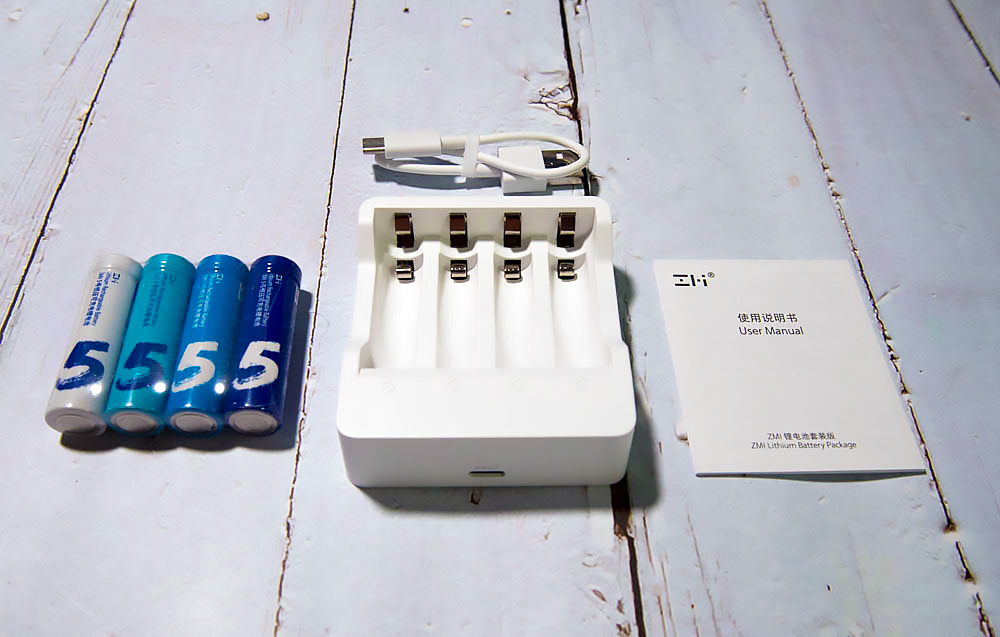
So what are these batteries and this charger? Officially the set is called the ZMI AA lithium battery package. The box contains ZMI 5 LDC01 batteries, the ZMI PB421 charger designed for these batteries, a short USB Type C cable (the shorter the cable, the smaller the losses) and a manual in English and Chinese.
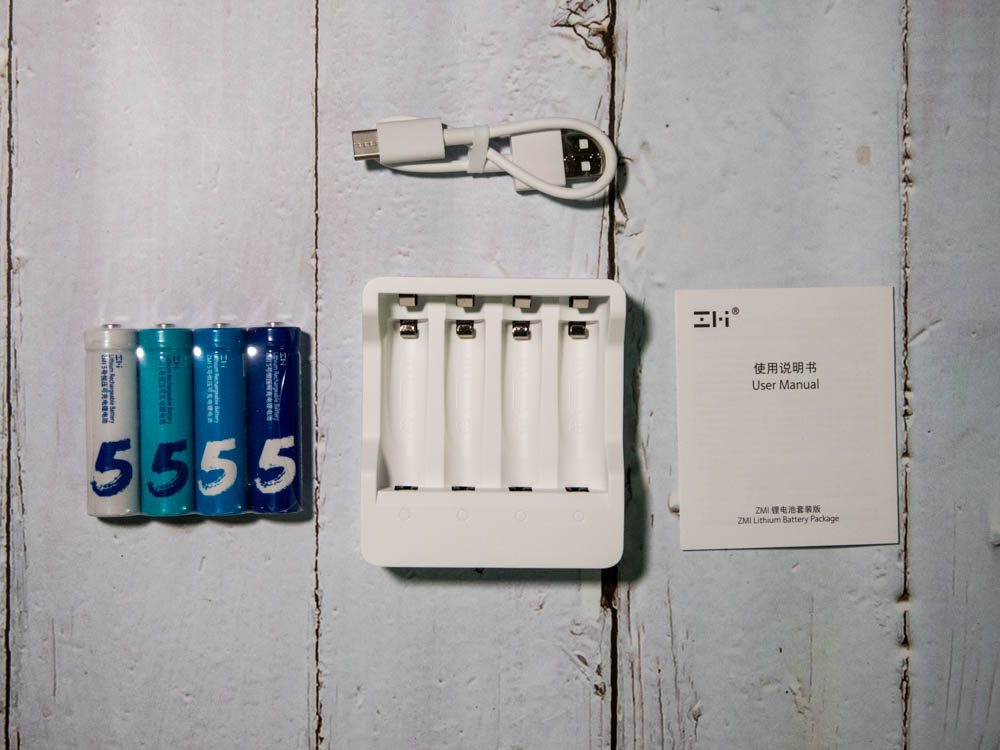
ZMI 5 LDC01 batteries
We won't run an out-of-the-box discharge, since the manual clearly states "shipped discharged, charge before use". While the set charges, here are the battery specifications:
- Model: ZMI 5 LDC01;
- Rated capacity: 1930 mAh;
- Rated energy: 2900 mWh;
- Rated charging voltage: 5 V;
- Maximum charging voltage: 5.5 V;
- Rated charging current: 500 mA;
- Rated output voltage: 1.5 V;
- Rated discharge current: 400 mA.
Voltage and current are regulated by a circuit inside the battery itself. This circuit handles both the charge and discharge algorithm and the battery protection. The claimed protections cover discharge current, charging voltage, temperature, short circuit and over-discharge. They promise more than 60% of capacity retained after 1000 cycles.
The manufacturer recommends these batteries for smart locks, camera flashes, VR headsets and toys that need a constantly high voltage to work.
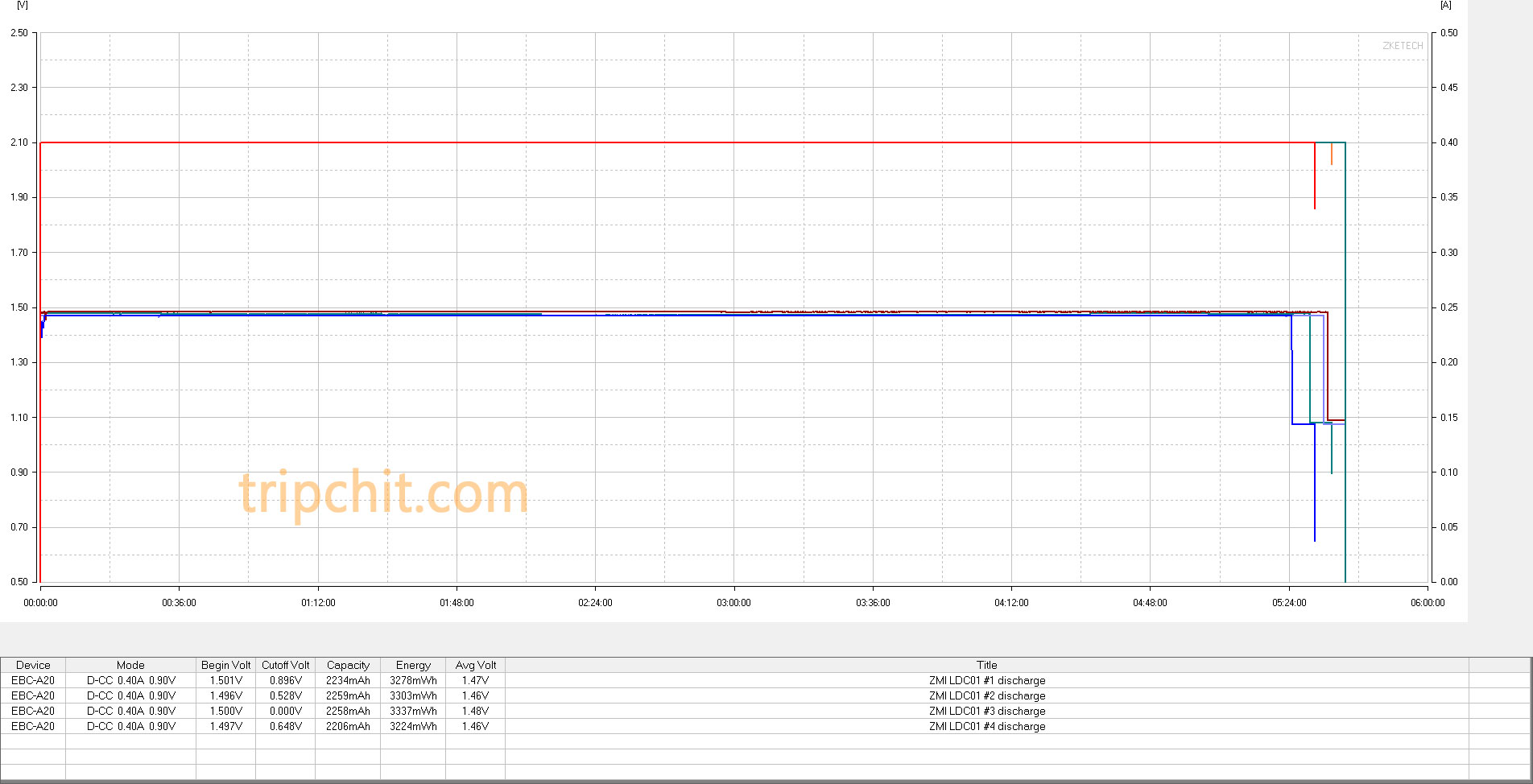
After charging, I discharged the batteries at the rated current of 400 mA. Let's look at the discharge graph. I'm seeing such straight discharge curves for the first time. A few minutes before full discharge, the battery lowers its voltage to 1.1 V. This is done for devices with charge indicators: full charge is three bars, almost empty is one bar. See one bar, put it on the charger. And for smart locks it's a very useful feature: the lock will beep about low charge, but there's still enough energy to open the door.
The batteries discharged almost in sync, with a time spread of six minutes (out of five and a half hours that's about one and a half percent). The open-circuit voltage deviation between batteries is within five thousandths of a volt, and under load no more than three hundredths.
Batteries No. 2 and 3 lasted longest: 5 hours 39 minutes. Battery No. 1 discharged in 5 hours 35 minutes, and No. 4 in 5 hours 32 minutes. So if you used a set of four batteries, your device drawing 400 mA would have run for 5 hours 32 minutes, until the 4th battery broke the circuit.
This is simply a fantastic result. Look at the capacity and energy figures:
- 2234 mAh, 3278 mWh;
- 2259 mAh, 3303 mWh;
- 2258 mAh, 3337 mWh;
- 2206 mAh, 3224 mWh.
Skeptics may say the capacity figures are no higher than those of ordinary AA NiMH, but thanks to the constant voltage the battery delivers one and a half times more energy!
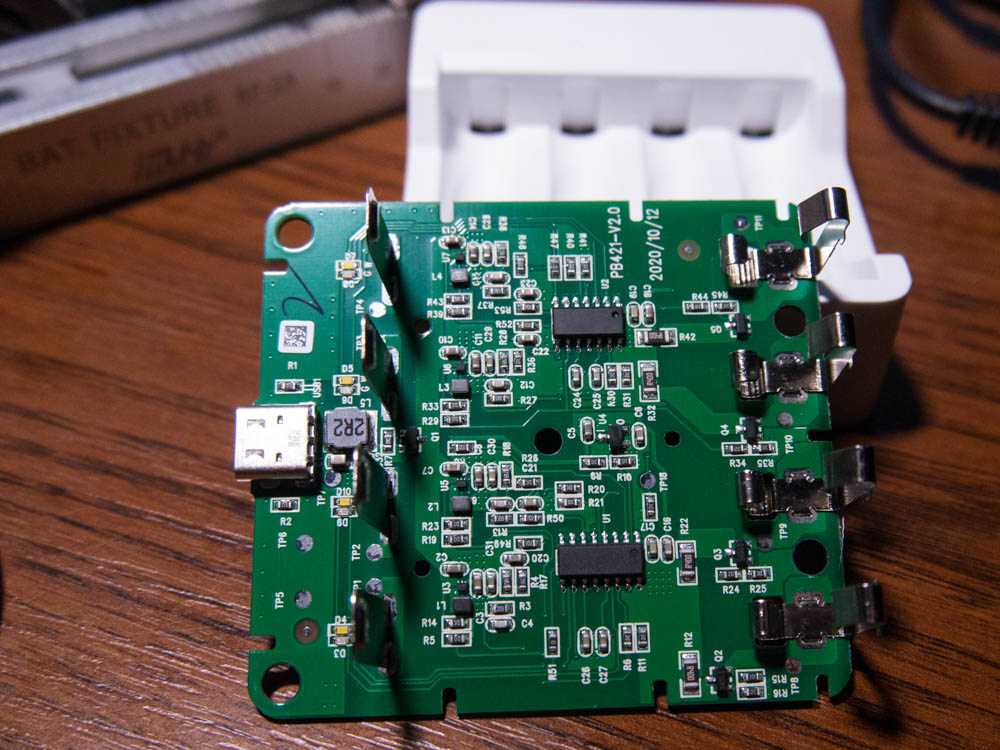
ZMI PB421 charger
The ZMI PB421 charger is essentially an ordinary USB power supply plus a protection and indicator control unit. The component base is unknown, since only the resistors carry markings. For now, the ZMI PB421 can charge only the batteries from the set and nothing else. But the presence of AAA-sized slots gives hope for an early release of "pinky" batteries of this type.
Attempts to put an ordinary battery and a nickel AA battery into the device triggered the protection. The contacts are built so that a battery can't be inserted with reversed polarity: the positive contact simply can't reach the battery's negative terminal.
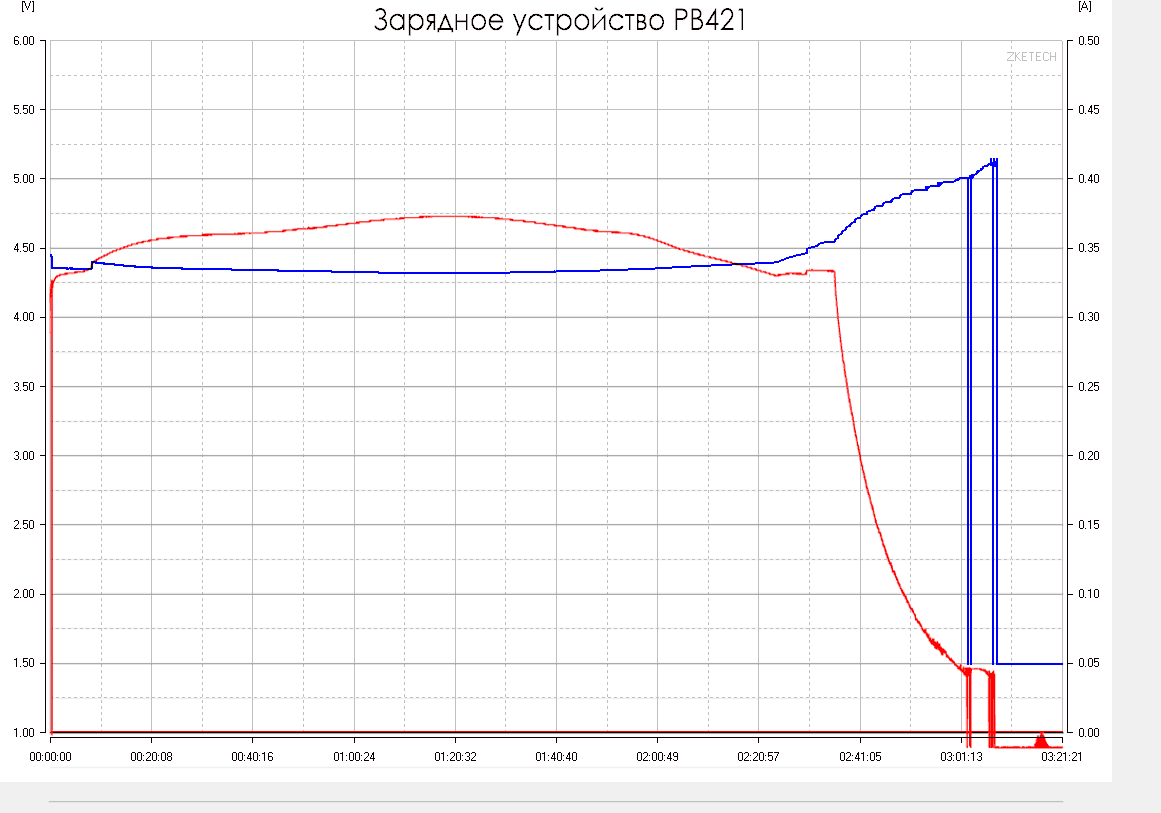
We insert a set of batteries discharged until they went into protection. We try connecting the charger to an ordinary 2.1 A USB power supply. Four batteries charge at about 350 mA, a single one at up to 390 mA.
It's nice that a lithium battery charges faster than a nickel one. The first stage of charging takes 8 minutes to bring it out of "protection" mode. Then charging proceeds, and at the end the current drops to 50 mA. After that, charging pauses for a few seconds, probably to measure the voltage (that's my guess). Once charging is finished, the device goes into standby mode, and the batteries discharge slightly (the instrument recorded a current of -0.011 A).
Xiaomi AA lithium batteries: load testing
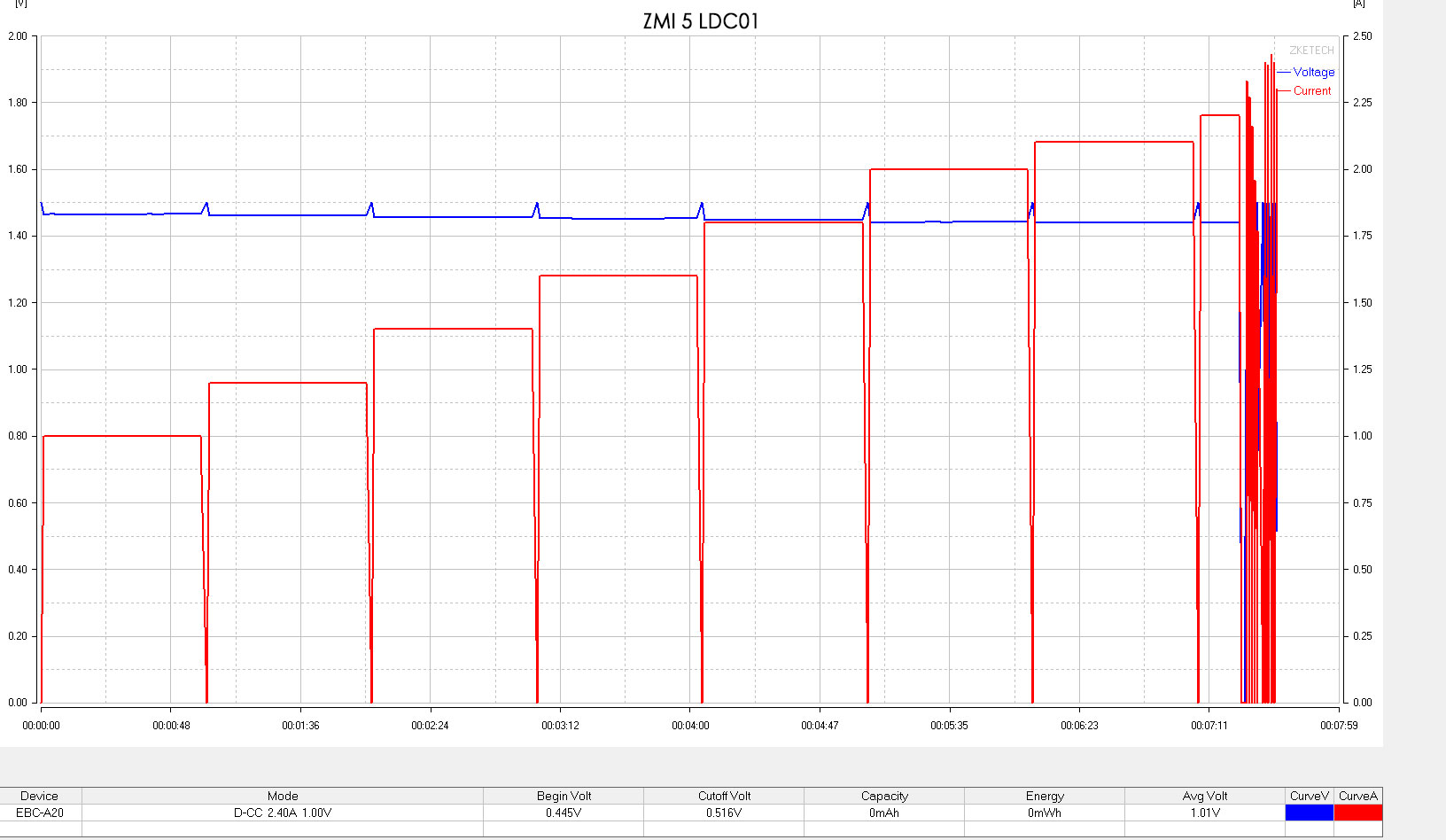
Obviously, with protected batteries the current output is limited by the protection itself rather than the battery chemistry, so I simply set up a test that increases the load every minute. You can see the graph below for yourself. I'll only say that the protection tripped at 2.2 A, 20 seconds after switching on. The last stage passed was 2.0 A.
I think two amps can be called the working current for the ZMI 5 LDC01 batteries.
Conclusion
Xiaomi surprises again. They have released decent AA-format lithium batteries with honest specifications, and I honestly didn't believe that was possible. What's more, with capacity on par with the best LSD batteries from leading manufacturers, the ZMI 5 LDC01 delivers 30% more energy at a stable 1.5 V.
The ZMI 5 LDC01 trails nickel batteries only in maximum working current and in frost resistance. The best nickel-chemistry batteries can reach a maximum current of 6 amps, while the minimum working temperature of, for example, the Xiaomi ZMI ZI5 AA 1700mAh is -20 degrees. Here the maximum working current is 2 amps, and the minimum temperature is around zero. In fairness, I can't name even a couple of devices off the top of my head that need 6 amps from AA batteries, and operation in subzero temperatures is probably a concern only for weather stations (and only in winter).
If it weren't for the need for a separate charger, the ZMI 5 LDC01 could be called the best batteries available today and close the question of AA-format batteries for good. Especially since the charger comes in the box.
So, the ZMI 5 LDC01 is the ideal battery for you if:
- you don't have a stock of nickel batteries and a good charger for them,
- you don't plan to use batteries in the cold.
And you simply can't do without these batteries if you need a consistently high voltage from your cells.