SkyRC NC1500 — a charger for NiMH batteries
I have been using the SkyRC NC1500 for several years without any real complaints, which is exactly why I had never gotten around to testing it. Charging batteries with the SkyRC NC1500 is a routine, boring task. It's a paradox, but a simple, reliable and safe device is boring. Insert the batteries, select the current and wait until they're charged. As a bonus, you can check the internal resistance of the inserted battery. Everything works — what is there to test?
But it has to be tested! Let's get started.
Where to buy? Here!
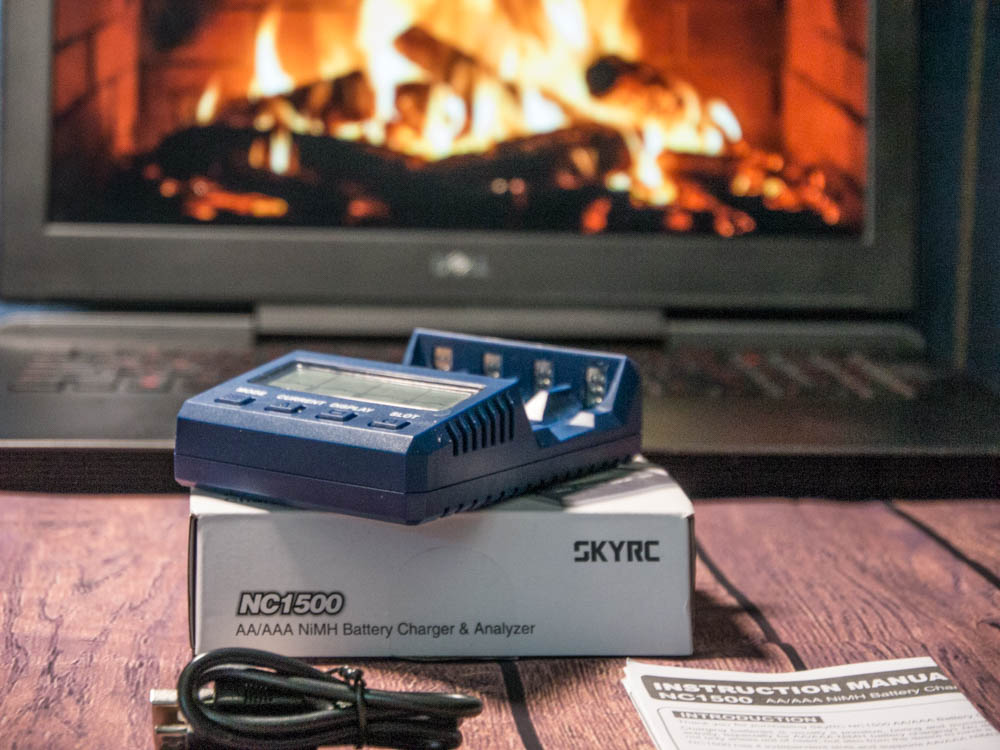
So, what we have here is a compact charger weighing 106 grams, designed for charging and maintaining AA and AAA NiMH batteries. The device does not support any other formats.
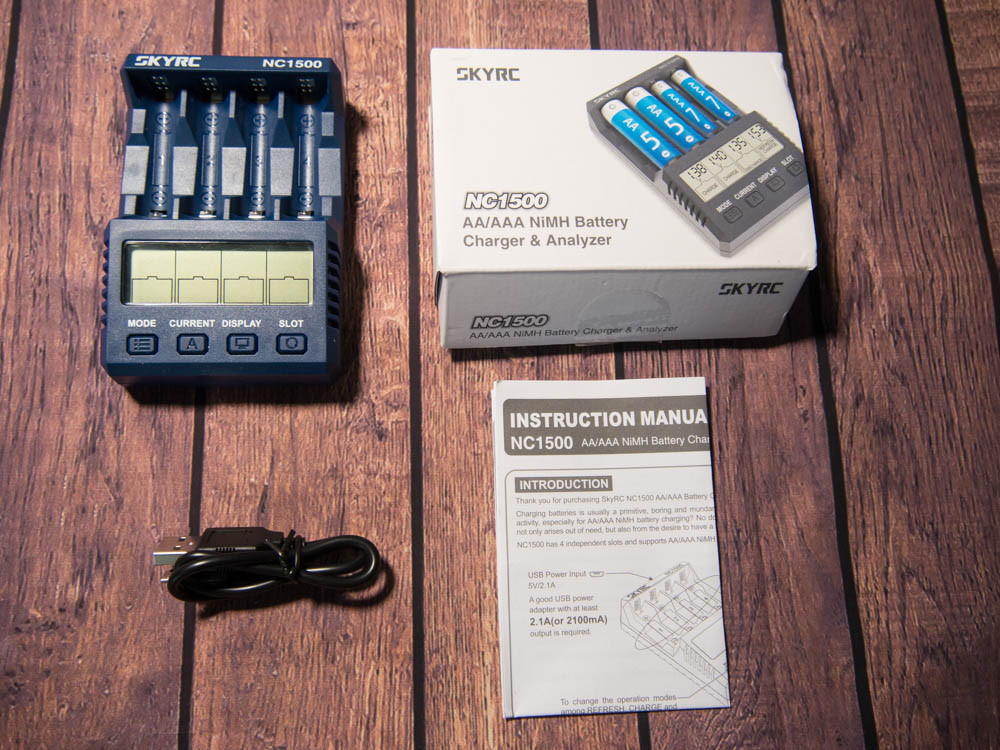
It is powered via a microUSB port located on the rear side and draws 5 V / 2.1 A. Cooling is passive, the color is blue (a pleasant Royal Navy shade). The display is divided into four sections, each corresponding to its charging slot and showing the operating mode (Charge, Discharge, Refresh); in Refresh mode, the current stage (Charge, Discharge) is also shown. If only the word Refresh is lit, the device is pausing before the next stage. There are 4 regular (non-touch) buttons. The Mode button selects the mode (Charge, Discharge, Refresh). Current selects the current. Display switches the readout: current (mA), voltage (V), capacity (mAh), time (h), internal resistance (mΩ). Slot selects the slot for which you are setting the mode; if no slot is selected, the mode is applied to all slots. The buttons and display are not backlit.
The SkyRC NC1500 comes in a white box containing the device itself, a power cable and a manual in English.
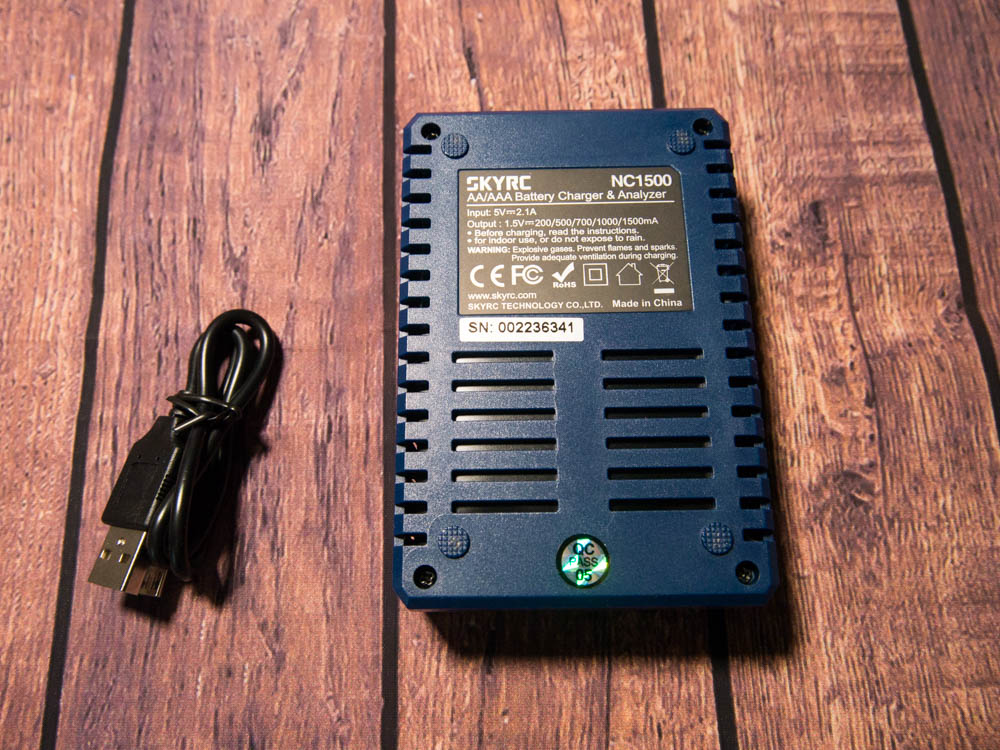
SkyRC NC1500 specifications
- Supported battery type: NiMH;
- Protection against overcharging (3000 mAh), short circuit, overheating and reverse polarity;
- Modes: Charge, Discharge and Refresh;
- Charging current of 1500 mA for two AA slots, or 200mA / 500mA / 700mA / 1000mA in any combination;
- Discharge current of 100mA / 250mA / 350mA / 500mA / 650mA.
The brain of the charger is a 32-bit HDSC HC32L1300J8TA Cortex-M0 processor running at 48 MHz. The processor has 64 KB of flash memory for the firmware, 8 KB of RAM, a clock and a crystal oscillator, which allows capacity to be calculated quite accurately. Protection is handled by two thermistors located between the first and second and between the third and fourth battery slots.
SKYRC NC 1500 test parameters
I won't test the SkyRC NC1500 in every mode with every possible current, since in several years of use I haven't encountered a single malfunction. The only problem is the response to repeated button presses: if you select the wrong mode and start "scrolling" through the modes again several times, after about the fifth to seventh press the device begins to lag by a fraction of a second. So we'll measure the parameters in maximum-current charge and discharge mode, in Refresh mode, and do a "sanity check" — charging and discharging an old battery at maximum current.
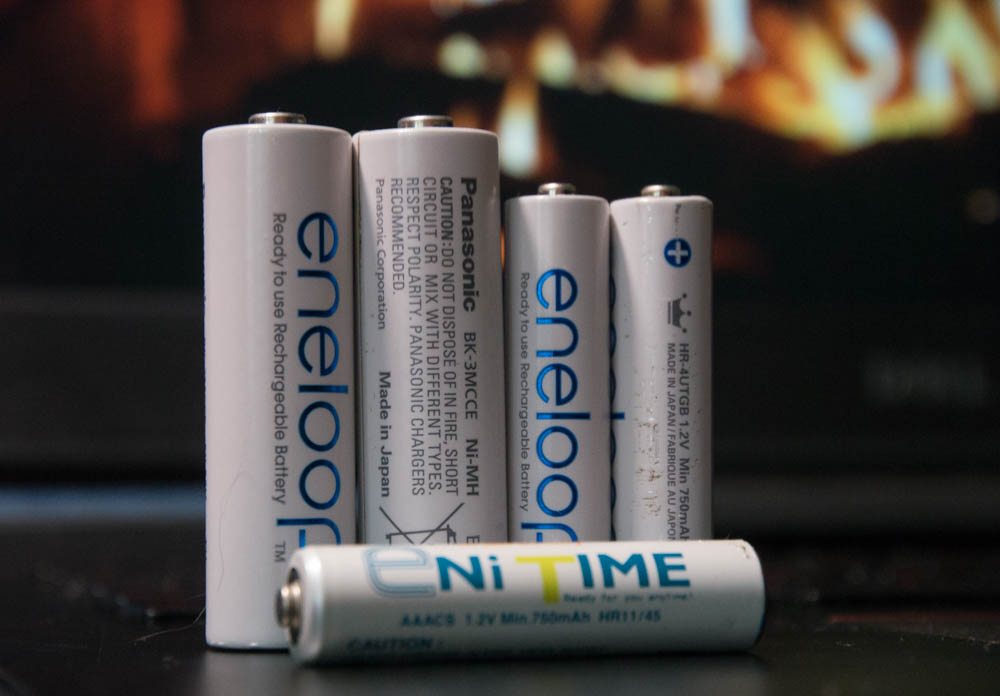
As test subjects I'm using Panasonic Eneloop BK-3MCCE, Sanyo Eneloop HR-4UTGB and GS YUASA Enitime HR11/45 batteries.
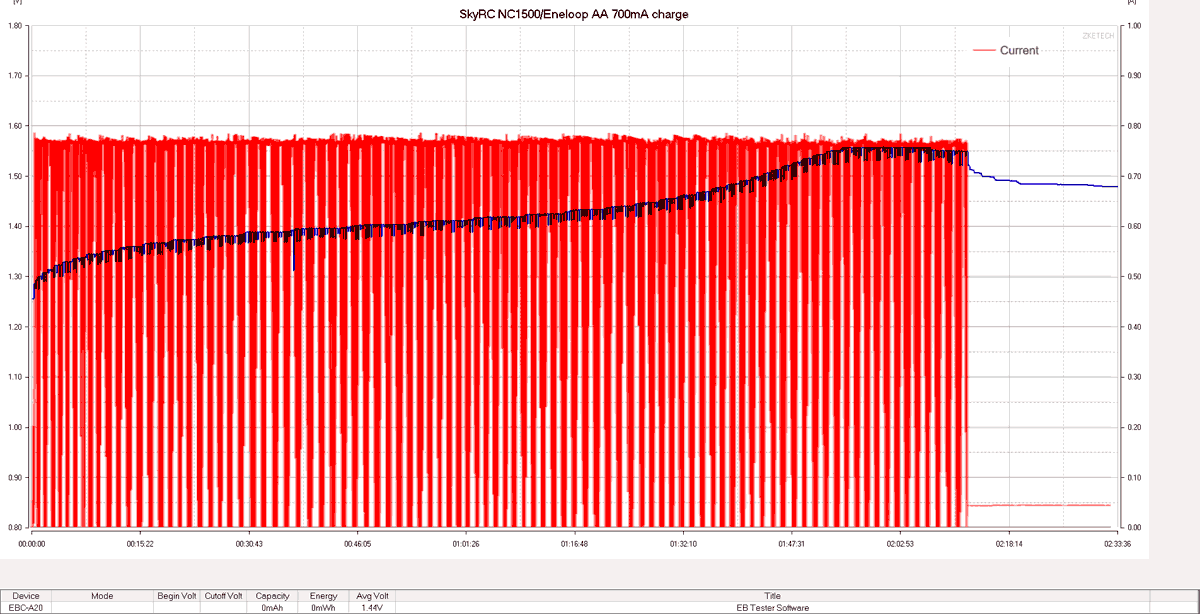
Testing the SKYRC NC 1500: charging a battery at the default current
When a battery is inserted, the device selects Charge mode and a current of 700 mA, so let's measure right away what happens in this mode. Charging runs at about 750–780 mA, but the device periodically takes a series of voltage measurements, and the voltage is measured with no load. This allows it to detect -dV and cut off the current once the battery is fully charged. On the graph, these voltage measurements appear as series of spikes on the current curve.
When the main charging phase is complete, the display shows Full and the device switches to so-called "trickle charging" at a constant current of 42 mA.
The average current over the entire cycle, including peaks and dips but excluding the trickle-charge stage, was 674.1305 mA.
Testing the SKYRC NC 1500: discharging a battery at 650 mA
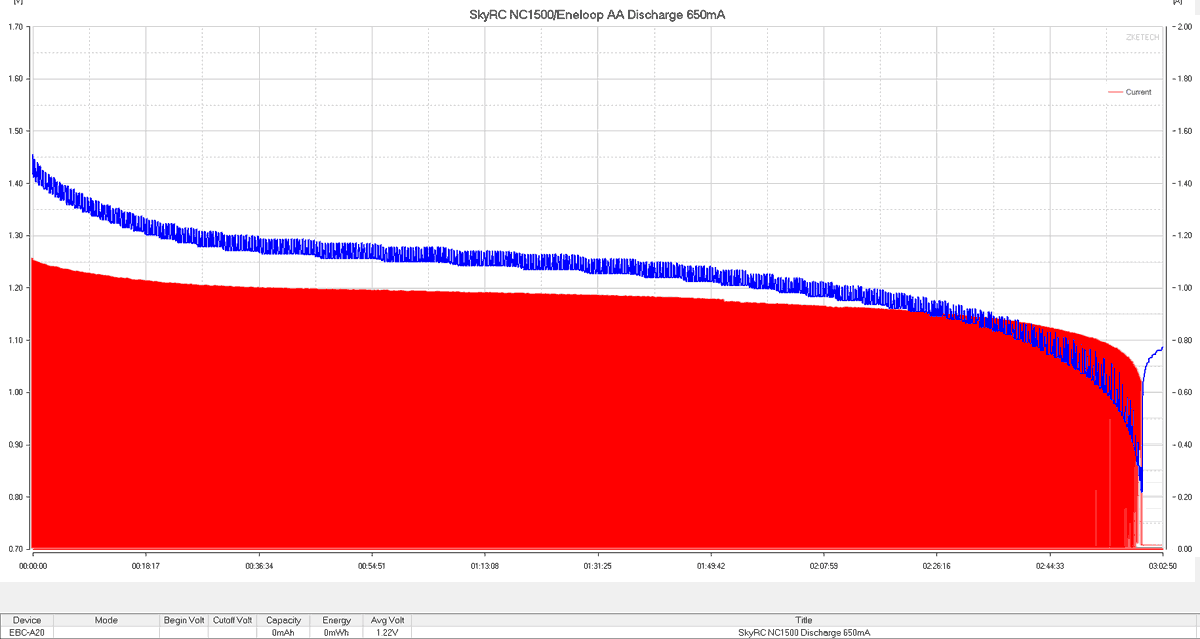
The maximum discharge current the device allows you to set is 650 mA; the current peaks at 1.1 A, and the average value is regulated by the pulse width (below I've tried to explain in simple terms how this works).
Because of this pulse regulation, the current curve on the graph merges into a solid red area. The average current over the entire discharge cycle was 622.85 mA, and the discharge ended when the battery's no-load voltage dropped below 0.9 V (at that moment it was 0.88 V).
Testing the SKYRC NC 1500: charging a battery at the maximum current of 1500 mA
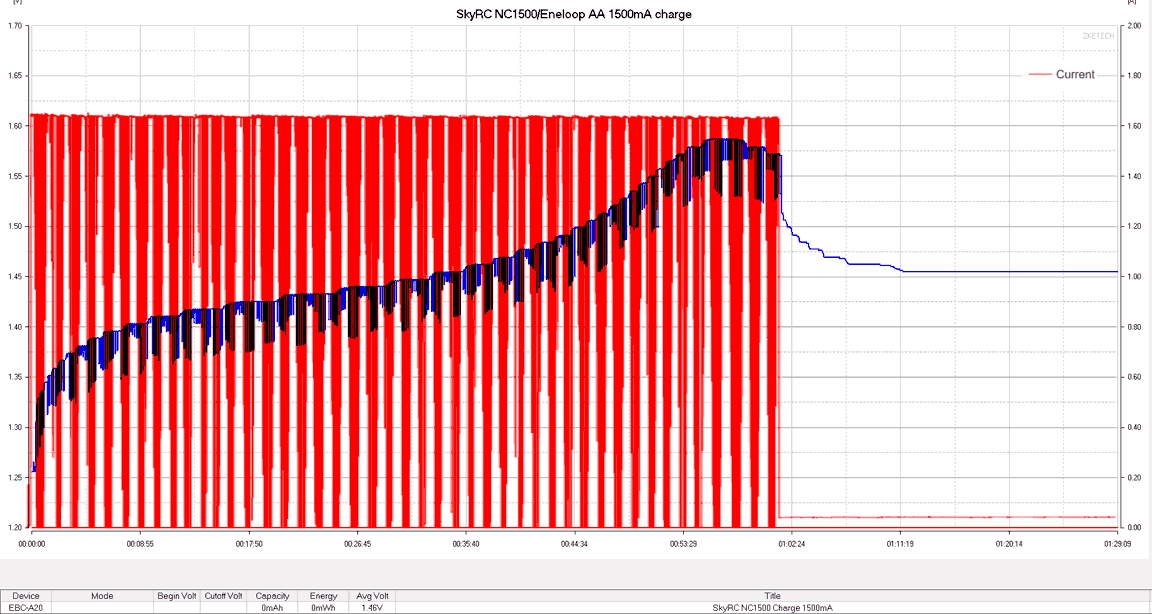
The maximum charging current supported by the SKYRC NC1500 is 1500 mA (only when charging one or two batteries). An Eneloop AA battery handles this current with ease; after that we'll use lower-capacity batteries purely to shorten testing time, since it is quite hard to process data collected by instruments over a full day.
The battery was charged at up to 1635 mA with mandatory pauses for voltage measurement, and at the end of the "active" cycle you can clearly see that very "minus delta V", after detecting which the device stops high-current charging and switches to trickle charging. The trickle-charge current is 42 mA. On trickle charge, the Eneloop AA battery's voltage stabilized at 1.42 volts.
Testing the SKYRC NC 1500: Refresh mode
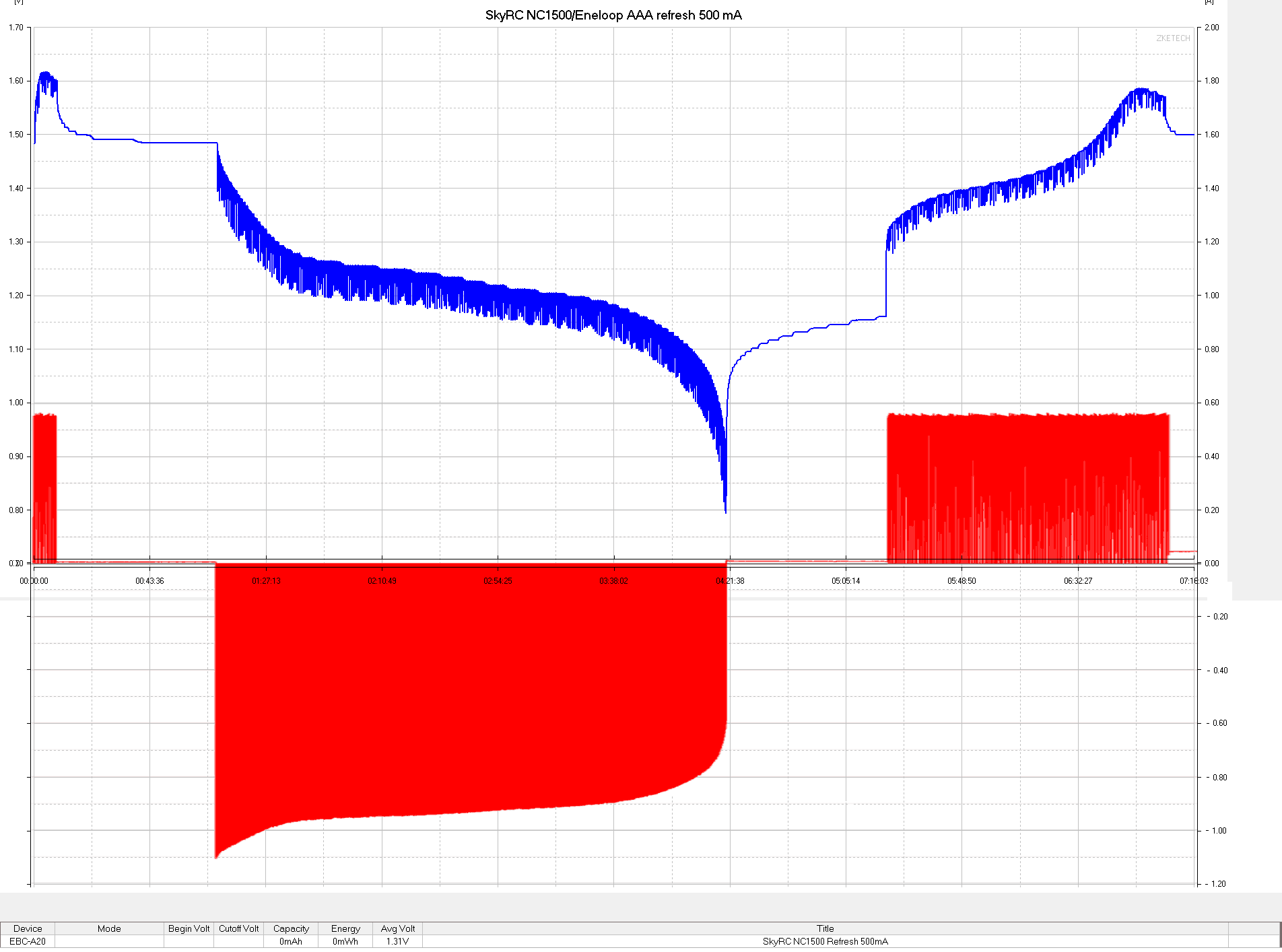
For this test I'll take a 750 mAh AAA battery and set the current to 500 mA. This means charging will be done at the set current, while the discharge current is set automatically to half of the charging current.
The cycle starts with charging. Since our battery was charged a few weeks ago, this stage only takes about 20 minutes. The minus delta is clearly visible on the graph; the device detects it and stops charging. Then comes a one-hour pause, after which the discharge stage begins.
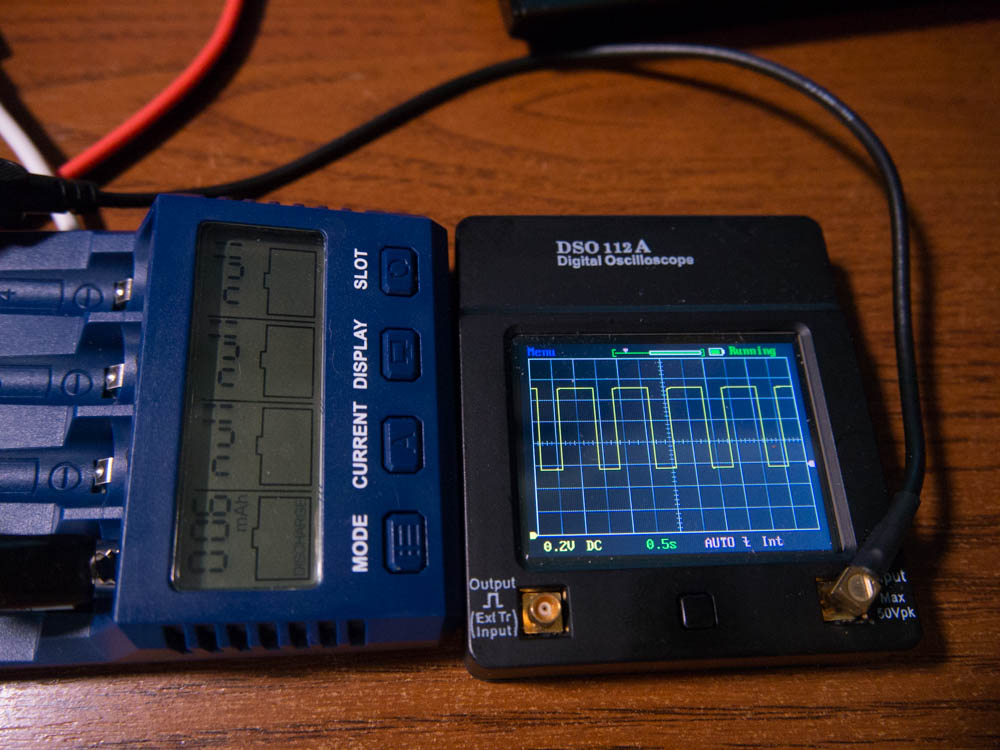
Note that in all discharge cases the graph has a similar shape and an amplitude from 0 to ~1150 mA, even though the current set on the device this time is 250 mA and the actual current is about 220 mA. This happens because discharging is handled by a fixed load resistor, so the current at any given moment in the closed circuit depends only on the resistor value and the battery voltage, and decreases along with that voltage. The discharge current we set is regulated by the duration of the micro-pulses during which the load is applied to the battery, and by the interval between these pulses (the oscilloscope photo clearly shows that the pulses when the load is on are much shorter than the gaps between them). As a result, the average discharge current approaches the value set by the user.
Our battery discharges for about 4 hours, then "rests" for an hour. After the rest, charging mode is switched on again and the battery charges for about two hours. At the end of this stage you can clearly see the voltage drop that the device uses to determine that the battery is charged.
SKYRC NC 1500: charging a bad battery
The SkyRC NC1500 handles batteries in good condition perfectly. Now let's put a GS Yuasa AAA into the charging slot. It's not a bad battery, it's just over 10 years old and its internal resistance is around 850 mΩ. The SkyRC NC1500 shows 999 (it would show more, but its display has only three digits). Nevertheless, the battery has its full capacity and works fine in low-power devices such as a weather station, a clock or a remote control. Let's test charging at maximum current.
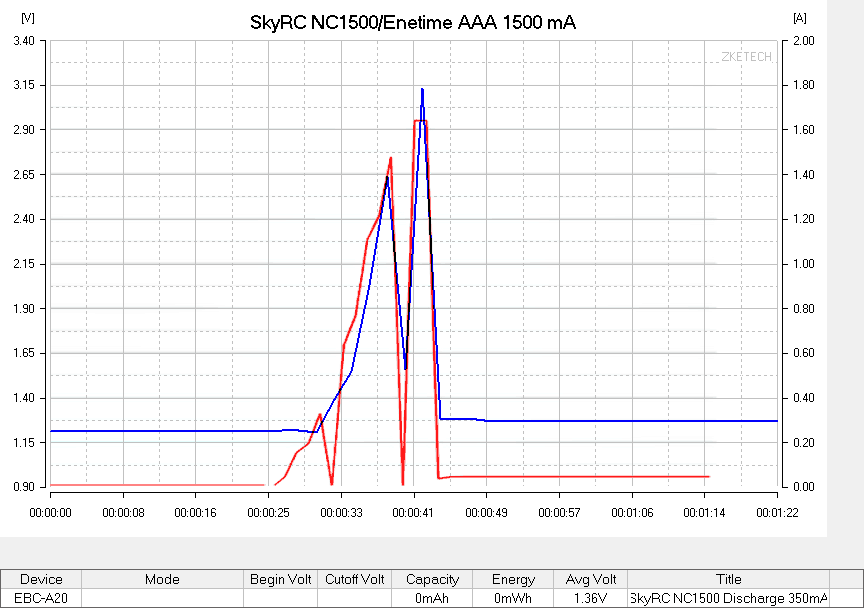
To raise the charging current to 1500 mA with such a high internal resistance, the device has to increase the voltage. As the graph shows, the voltage rose to 3.15 volts, after which the device stopped charging. No error — it simply displayed FULL. Well, it didn't boil the battery, which is already good, but it didn't charge it either. Let's lower the current by one step.
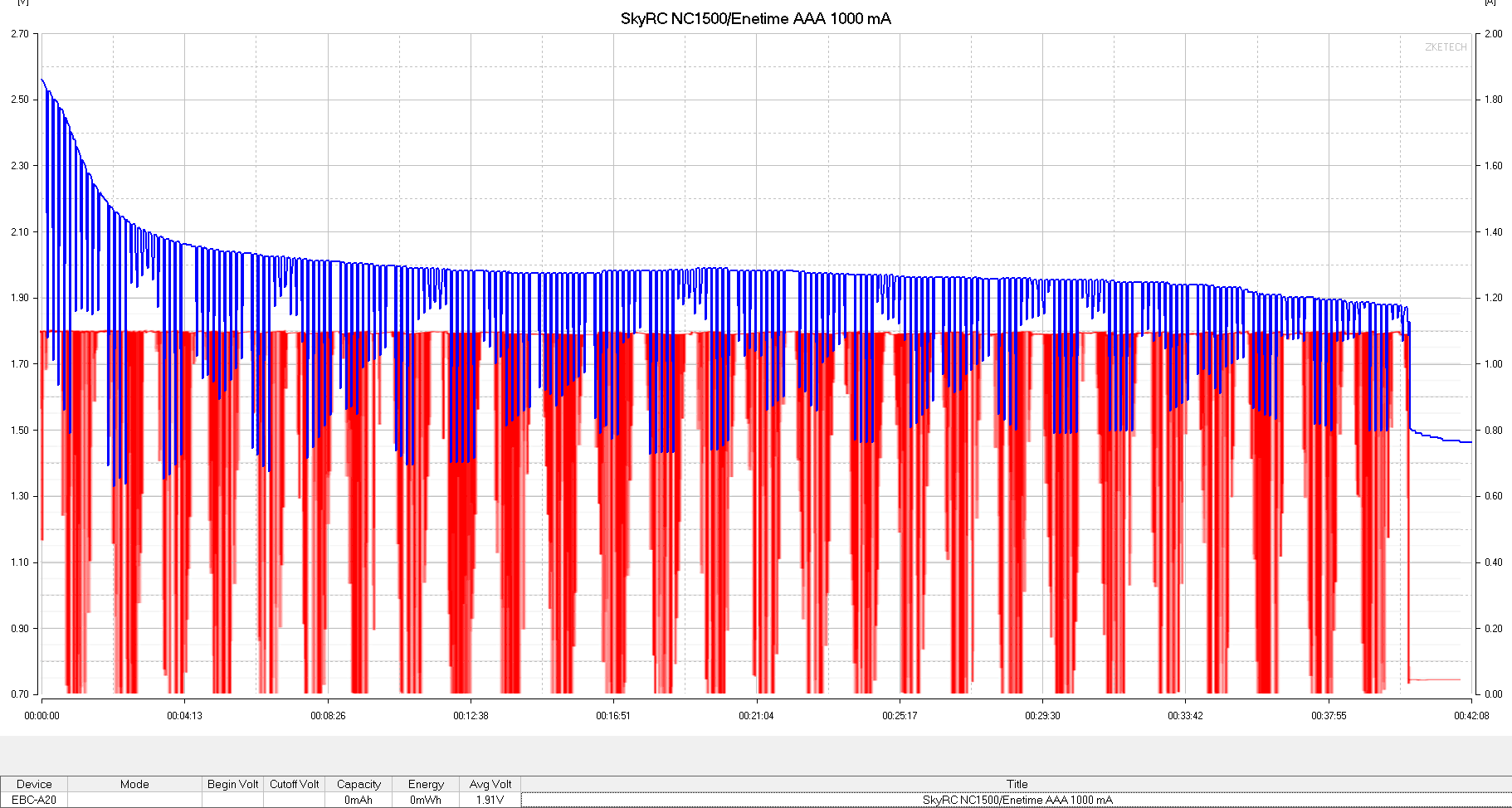
Here we see a pattern typical of the charging curve of batteries with high internal resistance. A discharged battery has a higher internal resistance than a charged one, so at the beginning of the charging cycle the device has to maintain a high charging voltage for the current to match the value set by the user. As charging progresses, the battery voltage rises and the resistance drops. And the device lowers the voltage to keep the set current.
The graph shows that the device handles bad batteries quite sensibly, even if the user has set a higher current than a battery in such a condition should get. Sensibly means it does what the user tells it to do, rather than what it has decided for itself, like many other modern devices. Set it to 1000 mA, and the battery charges at 1000 mA.
And to help the user avoid such mistakes, the device has a built-in function for measuring the internal resistance of batteries.
SKYRC NC 1500: problems and drawbacks
To be honest, over several years of use I have run into a few problems with the SKYRC NC1500. I even had to keep a file where I wrote them down. So, point by point:
- Delayed response to the buttons if you scroll through the modes for the second or third time,
- After Refresh mode finishes, it is sometimes impossible to view the results for all batteries, except by selecting a slot and scrolling through the readings with the "Display" button,
- In some modes, if you put two batteries in the middle slots, it starts looking for batteries in the outer ones,
- Internal resistance is measured once, when the battery is inserted into the slot, and is not monitored during charging.
The first problem shows up regularly when you've inserted the batteries and forgotten which mode you wanted. You just keep mindlessly poking the button, hoping that whatever appears on the screen will snap you out of it.
The last one is not so much a problem as a feature of how the device works.
The second and third occurred once each and never happened again, and I was unable to reproduce the conditions under which these errors occurred.
Another drawback is the low accuracy of internal resistance measurement, but I would argue with that: what matters is not the accuracy of the number, but the reading relative to previous measurements. You buy a new battery, no matter which brand, and the device shows an internal resistance of, say, 60 mΩ. You know from the datasheet that this battery's internal resistance should be 17 mΩ! So what? Should you worry? Of course not. You should worry when (ten years later) the device shows 600 mΩ on the same battery. That's when you'll know the battery is nearing the end of its service life and shouldn't be used in critical applications (or charged at 1000 mA, either).
And I am confident that with this charger your battery will last ten years. Just buy good batteries and don't forget to run Refresh every now and then.
So the verdict is: the device is necessary, useful and recommended for purchase by those who don't use lithium batteries and only use regular AA and AAA.