an honest review
Have you noticed that when you photograph objects up close, the pictures often come out dull, and in poor light blurry too? A beginner photographer's first impulse is to use the built-in pop-up flash (entry-level and semi-pro DSLRs have one, such as my Canon 1000D). But the photographer ends up disappointed: because the flash sits on the same optical axis as the lens and directly above it, part of the frame comes out dark, since the lens blocks part of the light beam from such a flash. Such shots are a technical defect. You can avoid it with a different lighting setup: use an external flash placed to the side of the subject, or an external on-camera flash with a swivel head and a reflector. That setup suits still-life shooting indoors, where you can set up extra equipment and shoot in peace. But it doesn't work if you shoot with a macro lens or a lens with extension tubes, when the front element sits very close (3 to 10 cm) to the subject: then an uneven shadow falls across the frame from the side because of the lens barrel around the front element. Again, a technical defect.
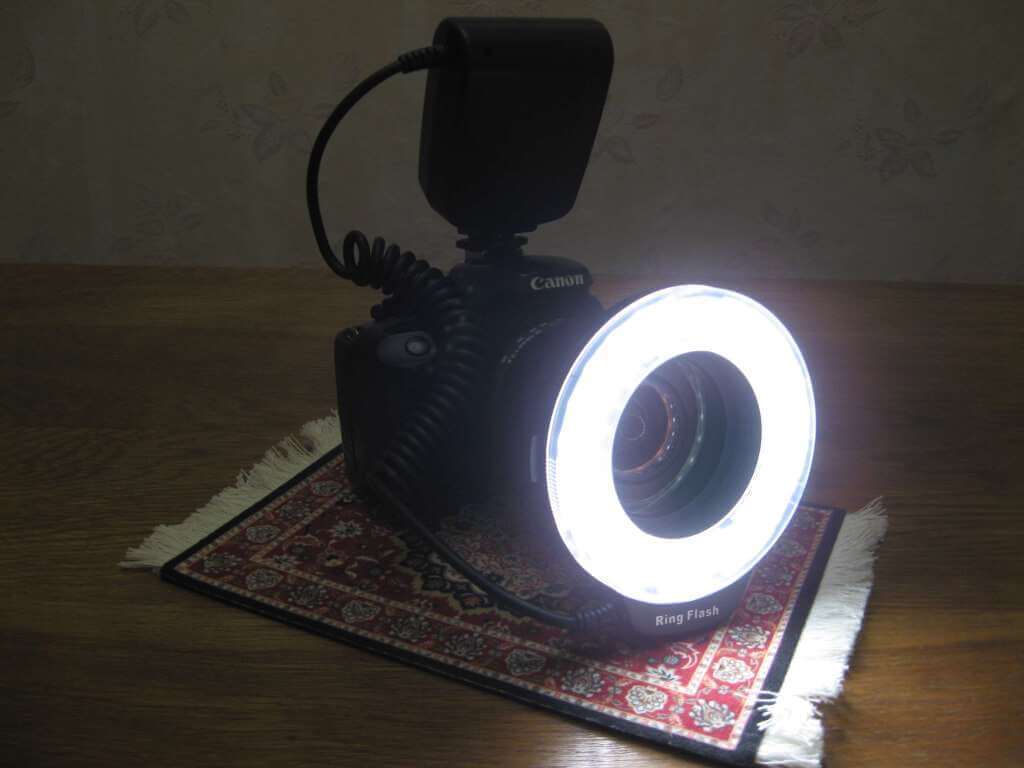
So the optimal solution is to place the light source as close to the subject as possible, with the beam not blocked by any parts of the lens. That solution is a ring macro flash: the light sources sit in a circle around the lens's front element and nothing stops them from lighting the things in your composition. Canon's branded flashes include worthy models that are good in absolutely every way except one: an extremely inhumane price tag for amateur photography. Fortunately, Chinese engineering, as always, is ready to come to the rescue of beginner photographers. In our case that help is the inexpensive ring LED macro flash HD-130 (about 20 dollars), sold by the hundreds on AliExpress. I bought mine in this store.
And for a background I chose a fantastic mouse pad today, in the form of His Fluffiness the Persian carpet, sold right here. I bought it for a laugh, but it unexpectedly turned out to be a very high-quality and comfortable pad, and it makes a strong impression on unprepared people.
What's in the box with the RF-550D/HD-130 macro flash
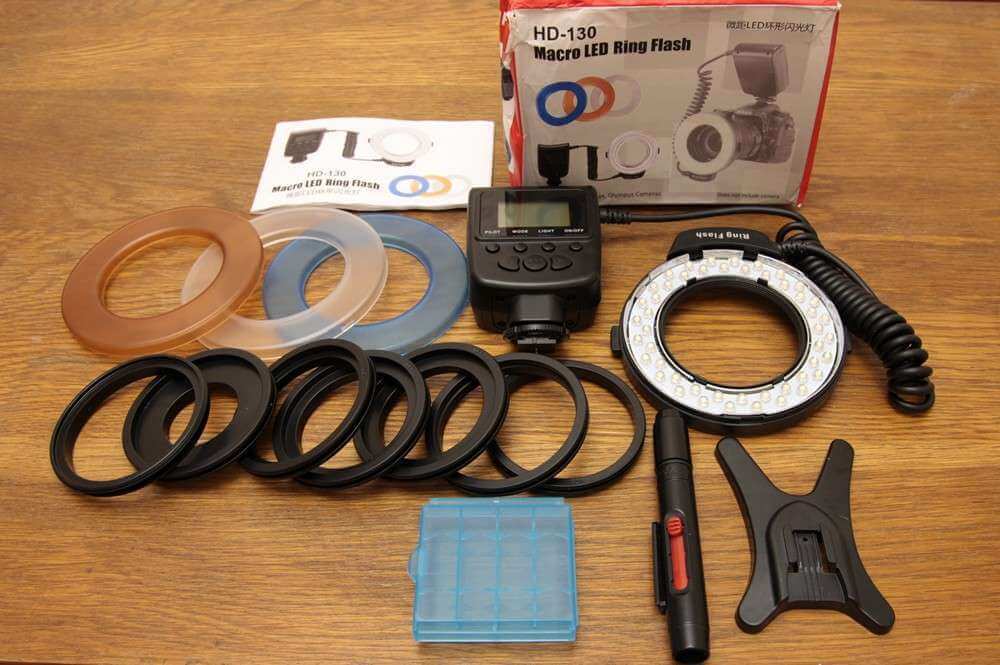
The parcel contained:
- a box;
- a manual;
- three light filters;
- a stand for the flash control unit;
- a set of adapters for mounting the flash on a lens);
- and the flash itself;
and two small but nice bonuses:
- a lens cleaning pen;
- a plastic box for storing batteries.
Now about everything in order:
Packaging. As tradition demands, a human foot has generously walked across the box (sometimes I think that's a sort of Chinese quality mark). It shows the product's appearance and contents. There's nothing else remarkable about the box itself; what matters is that the parcel's contents weren't damaged.
The manual is in two languages, English and Chinese, short and illustrated, and needs no deep knowledge of the language.
Light filters (yellow, white, blue). Frosted and translucent. In theory they should tint the light the flash emits and make it more even; we'll check in practice later.
The stand. Hm, thanks, of course, but what it's for I honestly didn't understand.
Ring adapters. Lenses have a barrel around the front element with a thread for a filter, and the adapter ring screws onto that thread, with the lighting unit then fitted on it. So if you're asking yourself "will this flash fit me?", the answer is most likely "yes". If your camera has a "hot shoe" (the socket for an external flash) and the filter thread diameter matches one of the adapters (and there are seven in the kit), the flash should sit on the lens fine and work (unfortunately I can't say this with absolute certainty, as I don't have cameras from every photo equipment maker. Consult the seller if you have doubts).
Bonuses. The pen, although it looks very much like the original LENSPEN, disappointed in quality: bristles come out of the brush, and the carbon-impregnated pad is glued with an adhesive that smears the lens. That's bad. No complaints about the plastic box: it holds 4 AA or AAA cells.
Review of the RF-550D/HD-130 macro flash


Structurally the flash is made of two units connected by a coiled cable.


The control unit, with a hot shoe, has two contacts on its base for receiving a signal from the camera. The unit is fixed on the camera with a plastic clamping ring (don't overdo it when tightening the ring: I once had an on-camera flash with a plastic ring and misjudged my strength, and the ring cracked).
On the side facing the photographer are a backlit screen and the flash control buttons. Power is 4 AA cells. The battery compartment cover is on the side and opens and closes without problems, whether the compartment is empty or loaded with batteries (on some flashes that's a problem: closing the compartment with batteries in it without breaking the cover). If you mix up the polarity when inserting the batteries, the flash simply won't turn on, and after inserting them correctly it turns on as usual (checked personally).
There are no other connectors on the unit, which means no external power can be connected and it doesn't sync with the camera. The front of the case is blank: there's no light trap, so the flash can't be triggered by another flash, and moreover, if you look at the EXIF of the files you can see the entry flash did not fire [off], even though it did fire! So the idea of mounting the control unit on a stand (the LED ring itself has no way of being mounted except on a lens adapter) is completely baffling to me, hence my surprise at why the stand is in the kit.
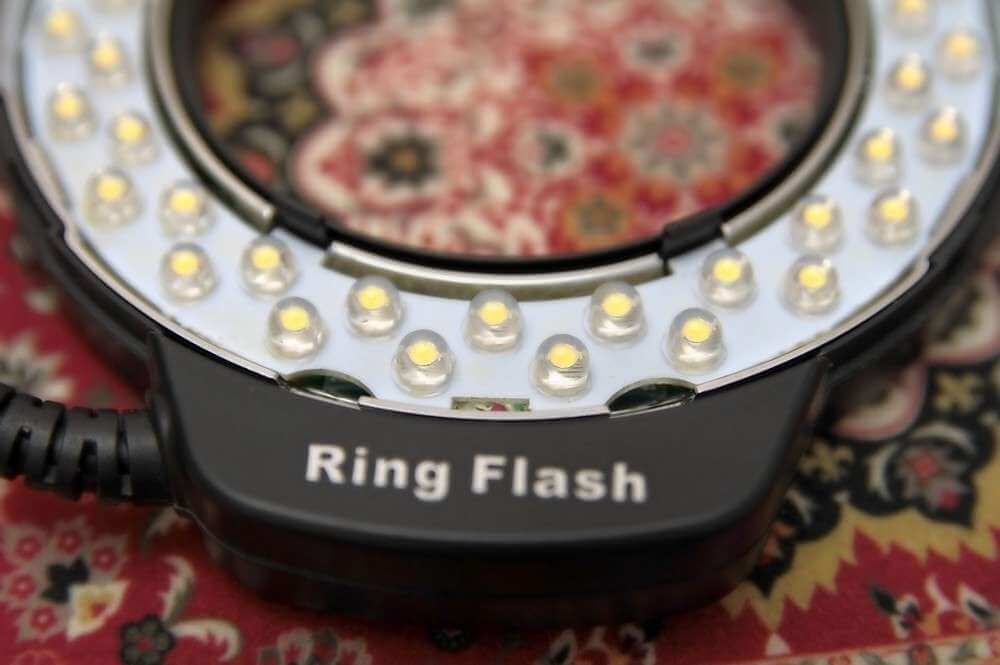
The lighting unit is a ring with 48 LEDs arranged in a circle in its recess, with a reflective plastic rim. The larger number of LEDs compared with other similar flashes should give more even light, which the frosted filters should also help with.
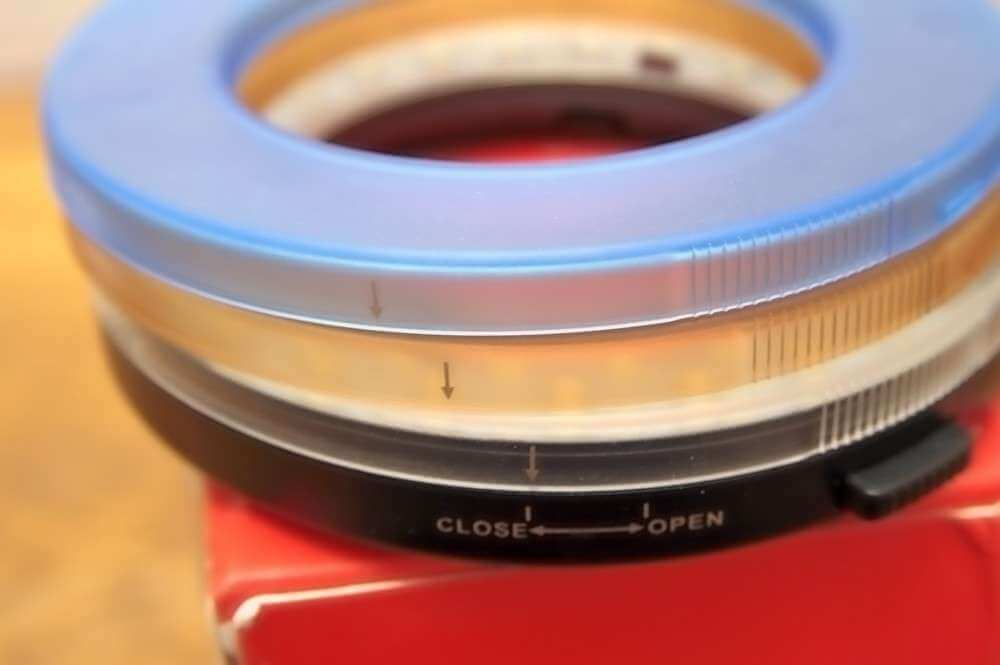
The filter comes off by turning it a few degrees; which way to turn is shown by the mark on the end of the unit and the line on the filter.
The unit locks onto the adapter with four teeth inside the ring; to remove the unit, press two buttons on the outside of the ring at the same time.
The LEDs work in three modes:
- a short flash;
- constant light;
- the left or right half of the ring working (set through the menu on the control unit). You can't set a power ratio between the halves (the right three times brighter than the left, for example).
Controlling the RF-550D/HD-130 macro flash
Flash control. Since the camera has no idea a flash is attached, all adjustments and mode switches are made with the buttons on the control unit, so let's go through them:
ON/OFF power on/off. The flash turns on after you press and hold the button for five seconds and turns off in the same time. The screen backlight lasts about twenty seconds after the last activity (a button press or a flash firing). A full shutdown is promised after 30 minutes idle, but once I counted on that, and wrongly: the flash stood with its screen on from evening to morning (though the backlight turned off). Still, it didn't noticeably affect the battery level.
LIGHT constant light mode with the whole LED ring.
MODE a button that cycles between the modes FLASH, L, R (flash mode, flash with the left half of the ring, flash with the right half, respectively); the selected mode is marked with a dot under the corresponding menu item on the screen.
PILOT a button for testing the selected mode (flash with the ring, the left or the right half).
SET in fact a button for beauty and symmetry; it does nothing, as the manual honestly says (Vacancy button).
◄ ► buttons for theoretical flash power adjustment; the values on the screen run from -1.5 to +1.5 (duplicated by bars, like a Wi-Fi signal level). The manual says the value -1.5 corresponds to 1/64 of flash power, and power 1/1 corresponds to the value +1.5. That works out to seven steps, with power changing twofold per step. There are seven steps in all, with the default value "0" (1/8).
Sample photos and working with the RF-550D/HD-130 macro flash
That's all for theory and review, so on to practical photography.
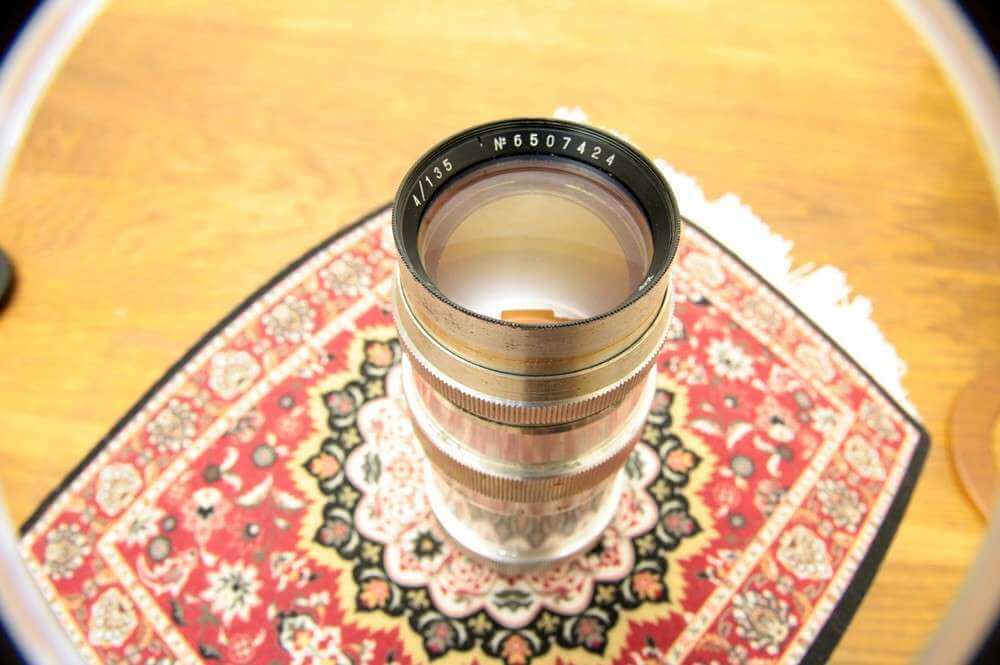
With this simple composition in fully manual mode (ISO 100, F7, 0 EV, 1.3 sec) we'll take test close-ups and see whether the filters make sense (flash in FLASH mode).


Seven frames with flash power changing from -1.5 to +1.5 (photos 12-18) and one without it at all (photo 19); for convenience I'll paste histograms into the shots:


Now I'll swap the lens for a HELIOS 44-2, attach it to the camera with extension tubes and try to take macro shots with different flash modes (left, ring, right, no flash):


And the last test shot, with a Sigma lens at wide angle (18 mm). See the flare in the corners of the frame? That's light from the filter getting into the lens. The manual warns about this, though on the last page, and advises setting a focal length of at least 50 mm.
Finally, the Specifications table taken from the manual (and notes to the table):
| Guide number | 15 |
| Effective range | 5 cm – 2 m * |
| Color temperature | 3000 – 15,000 K ** |
| Flash duration | 1/100 s |
| Weight (without batteries) | approx. 200 g |
| Adapter thread diameters, mm | 40,5; 52; 55; 58; 62; 67; 72; 77 |
* two meters is a fairy tale; across about fifty test shots the flash's effect is distinguishable at 80 cm at most.
** 15 thousand Kelvin is a winter sky on a bright frosty day. They most likely meant to write 3 to 5 thousand Kelvin (from warm to cool white, using the filters, but made a mistake). Well, it happens to everyone, right? ¯\_(ツ)_/¯
Conclusions:
Overall impression: a solid C.
In essence this isn't a macro flash but an LED flashlight with adjustable power, mounted on the lens's front element. That's undeniably better than a built-in flash, but it's still very far from a proper macro flash. It will suit non-professional photographers for still-life close-ups of small objects, for online stores, for example.
If you want to get seriously into macro photography, where control over flash parameters matters, I recommend a clone of Canon's branded MR-14EX ring macro flash, but with a far more humane price tag, from Yongnuo.
Important! For macro shooting (and close-ups in general) always use a tripod and a remote shutter release (see my Review of remotes)